DVORAK: String Quartet No. 11 in C Major, Op. 61; WOLF: Italian Serenade – Juilliard String Quartet – HDTT HDCD220, 38:35 [avail. in various formats from www.highdeftapetransfers.com] ****:
A fine LP when released in 1964, the Juilliard String Quartet’s inscriptions of Dvorak and Wolf returns to us via HDTT’s high-definition Weiss POW-r Dithering Software process and other tweaks, and the results certainly do compel repeated listening. The Juilliard’s personnel at the time–Raphael Hillyer, viola; Robert Mann and Isidore Cohen, violins; and Claus Adam, cello–merged into one seamless expressive ensemble whose tonal accuracy and incisive driving readings of their chosen repertory were peerless among American chamber groups.
The C Major Quartet of Dvorak (1881) fulfilled a commission from the Hellmesberger Quartet, a work with Schubertian influences, certainly; but it reveals the composer’s native Bohemian ethos and impulse for grand and heroic gestures. Somewhat like Dvorak’s Op. 48 Sextet, the piece cannot always sustain the arduous development Dvorak applies to his melodic fragments. Much internal counterpoint marks the Poco adagio et molto cantabile second movement, often expressive in woven chromatic lines. Some fine dialogue occurs between Mann and Hillyer, singing high over strummed arpeggios or pizzicati in the bass. The Scherzo (Allegro vivo) recasts materials from an 1879 polonaise for cello and piano.
The trio section plays like a smaller-scaled Slavonic Dance or one of the composer’s Legends. Open sounds and hurdy-gurdy bass effects impose a decidedly rustic air of a spirited village dance. The last movement rather looks to Beethoven as a model, particularly in the bravura violin writing and in the application of pedal points. Typical of Dvorak, his chosen instrument, the viola, enjoys prominent lead parts. The bustling momentum soon achieves a kind of mesmeric effect and a touch of the Mendelssohn wit. A last a sweet melody emerges then undergoes transformation of rhythm and timbre, especially in stretto. The last pages, rife with brio and lyricism at once, also make way for that “fairy-tale ending” rhetoric in Dvorak, the kind of epilogue that tells children of all ages that happy endings are possible.
The Juilliard’s sec approach to Hugo Wolf’s long-familiar G Major Serenade (1887) plays as rather linear but not perfunctory. The Italianate melody supposedly derives from an archaic tune played on an obsolete form of the oboe. The piece fills out its concentrated course in swarthy dialogues and sudden urges of energy, pizzicati, and vital ostinato figures. Hillyer’s viola consistently emerges from the brew as a strong suit, along with Claus Adam’s cello a potent voice. The last page captures Wolf’s dry, even biting wit. An audiophile’s delight from first to last, but a bit short in programming, for my taste.
— Gary Lemco
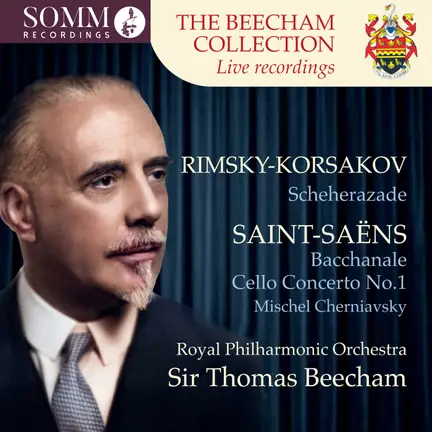
Sir Thomas Beecham conducts Rimsky Korsakov, Saint-Saëns – SOMM
Three mid-century concerts