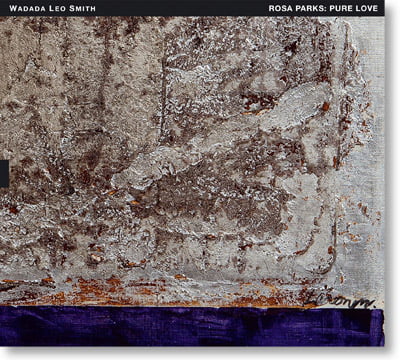
Wadada Leo Smith – Rosa Parks: Pure Love. An Oratorio of Seven Songs – [TrackList follows] – TUM 057, 71:39 [2/15/19] ****:
Trumpeter/composer Wadada Leo Smith is an evolving and creative musician. During February’s observance of Black History Month, the TUM imprint issued one of Smith’s most determined works, the 71-minute Rosa Parks: Pure Love. An Oratorio of Seven Songs. The interconnected suites are a tribute to the Civil Rights activist who was at the forefront of advancing freedom in a time and a place where such freedom was shackled by racism, prejudicial laws and ingrained bigotry. Smith states, “Rosa Parks: Pure Love employs the song form as composition to convey a philosophical and spiritual narrative about my vision of Rosa Parks. The oratorio is concerned with ideas and my meditation on the Civil Rights movement.” This direction is not new to Smith. In 2012, he released the four-disc box set Ten Freedom Summers, which focused on the Civil Rights crusade and other related matters; it was a 2013 finalist for the Pulitzer Prize for Music.
Rosa Parks: Pure Love is a seven-suite celebration and homage. It is not a classical work but utilizes some elements often associated with Western classical music, including strings, opera-like vocalists and interrelated themes. There is also jazz improvisation as well as avant-garde touches which include a trumpet quartet, a percussion duo, electronics and a pipa (a four-stringed Chinese musical instrument akin to a lute). Despite the inclusion of many people and several long-form pieces, Rosa Parks: Pure Love frequently has a minimalist stance, which assists Smith to reach elevated emotional artistry and a profound substance.
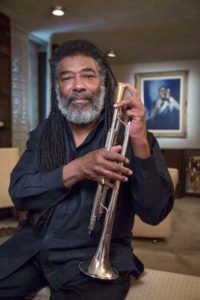
Wadada Leo Smith,
by Jimmy Katz
Smith commences with the two-part, 4:32 opener, “Prelude: Journey/Vision Dance 1: Resistance and Unity,” where Smith deftly blends the Janus Duo (Pheeroan akLaff on drum-set and Velibor Pedevski [AKA Hardedge] on electronics and pre-recorded percussion) alongside the BlueTrumpet Quartet. In the suite’s second half, Smith introduces the RedKoral Quartet (violinists Shalini Vijayan, Mona Tian and Andrew McIntosh, and cellist Ashley Walters). “Vision Dance 1: Resistance and Unity” is fascinating since both the string and trumpet quartets maneuver around each other while Hardedge supplies unsettling electronic effects. The double quartets continue during the second suite, the nearly six-minute “Rosa Parks: Mercy, Music for Double Quartet,” where there is a chamber music-like approach. The strings and brass produce beautiful synchronicity with lines brimming with dynamism and grace. The impact of Parks’ story of rebellion and revolution is further externalized during the third suite, the lengthy West-meets-East “Song 1: The Montgomery Bus Boycott – 381 Days of Fire/Song 2: The First Light, Gold,” where Min Xiao-Fen’s vocals and pipa, as well as the RedKoral Quartet’s alluring strings, express a degree of universalism and empathy for Park’s fearlessness, which has influenced individuals across the globe. There is a stronger experimental edge to “Song 2: The First Light, Gold,” where the strings craft an almost sensuous circumference which glides beneath vocalist Carmina Escobar, who sings text based on the words of Martin Luther King, Jr. African-American singer Karen Parks takes the spotlight during the first segment of the fifth suite, the 13-minute “Song 3: Change It!/Song 4: The Truth/Song 5: No Fear.” Parks operatic-esque singing has an eloquent, dramatic timbre which harmonizes with lyrics about resolution, the need for transformation and the struggle for equality. The other two portions, “The Truth” and “No Fear,” offer pictorial string contributions and moody drums and percussion, which both contrast and match Park’s plea for understanding, peace and courage.
The RedKoral Quartet showcases an expert ability to not sound like a typical classical string foursome throughout the three-part “Vision Dance 3: Rosa’s Blue Lake/Song 6: The Second Light/Vision Dance 4: A Blue Casa.” During this 15-minute excursion, Smith provides tetchy trumpet noises; Min Xiao-Fen furnishes breathtaking and moving vocals; and at the end the BlueTrumpet Quartet deliver fluent brass backing. Smith concludes with the three-pronged piece, “Song 7: Pure Love/The Known World: Apartheid/Postlude: Victory!,” where Parks passionately presents lyrics related to the necessity for commonality, and the downfall of apartheid. The postlude serves as a consummation, where the strings and brass commingle with percussion to bring a resourceful and sometimes dissonant culmination to Smith’s overarching epic about effort, action and achievement. The best way to experience Rosa Parks: Pure Love is via the TUM label’s thorough CD package. The 39-page insert booklet includes all the lyrics; Franz Matzner’s notes on Rosa Parks; Smith’s recollections on his early days in Chicago; and detailed remarks on the compositions, the collective musicians, the artwork and photography, and the recording/engineering.
Musicians:
Wadada Leo Smith – composer, trumpet; BlueTrumpet Quartet: Smith, Ted Daniel, Graham Haynes, Hugh Ragin – trumpet (tracks 1, 2, 6, 10, 12, 14-15); Janus Duo: Pheeroan akLaff – drum-set, Velibor Pedevski (AKA Hardedge) – electronics, pre-recorded percussion; RedKoral Quartet: Shalini Vijayan, Mona Tian, Andrew McIntosh – violin, Ashley Walters – cello (tracks 2-15); Diamond Voices: Min Xiao-Fen – voice, pipa (tracks 4, 9, 11), Carmina Escobar – voices (track 5, 8), Karen Parks – voice (track 7, 13)
TrackList:
01 Prelude: Journey
02 Vision Dance 1: Resistance and Unity
03 Rosa Parks: Mercy, Music for Double Quartet
04 Song 1: The Montgomery Bus Boycott – 381 Days of Fire/05 Song 2: The First Light, Gold
06 Vision Dance 2: Dance, Justice and Liberation
07 Song 3: Change It!/08 Song 4: The Truth/09 Song 5: No Fear
10 Vision Dance 3: Rosa’s Blue Lake
11 Song 6: The Second Light
12 Vision Dance 4: A Blue Casa
13 Song 7: Pure Love
14 The Known World: Apartheid
15 Postlude: Victory!
—Doug Simpson
Giving voice through jazz of a hero’s journey…