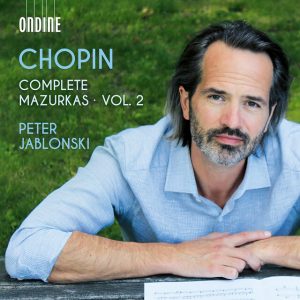
CHOPIN: Complete Mazurkas, Vol. 2 – Peter Jablonski, piano – Ondine ODE 1431-2 (73:49) [Distr. by Naxos] ****:
Recorded June 2023 at the Malmö Palladium using a Steinway D, this second volume of Chopin mazurkas in chronological order testifies to a familiarity with the musical style whose documents extend over 20 years, to 2002. Jablonski studied percussion and piano at Malmö Conservatory from 1982 to 1986, and his 2008 accomplishment had been to move to conducting. Chopin obsessed himself with his native mazurka, the musical expression of his innate nationalism, occupying his efforts between 1826 and 1849, the year of his death. The dance form appears in triple time (frequently in quick tempo), with heavy accents on the second or third beat of the measure, often with an accompanying heel tap, to emphasize its emphatic, proud character. Chopin, in his evolving maturity in using the form, blurred his accents to diminish the metric pulse, so that the resulting ambiguities would create a hybrid form that absorbed the waltz.
Jablonski chooses for his second volume of the 57 entries in Chopin’s oeuvre, four groups of posthumous mazurkas, beginning with two from 1826 and concluding with the four of Op. 68, a publisher’s (Fontana) collection collated from independent items written between 1827-1849. From the opening notes of the B-flat Mazurka, B. 16, we feel the alert presence of Jablonski’s spirited sympathies for this music. The G Major, B. 16 reveals the distinction Chopin could draw from the dance, whose three forms – the mazurek, the oberek, and the kujawiak – present alternate moods and affects in bearing. Of this early group, the B-flat Major, B. 73 “Wolowska,” (1832) already initiates a rhythmic audacity in elegant rubato that immediately captures our ears and tapping feet. The Mazurka in C Major, B. 82 (1833) exerts a firmly expansive resolve that will later affect Chopin’s polonaises. The group concludes with the Mazurka in A-flat Major, B. 85 (1834) that more than hints at waltz tempo.
Of the two posthumous mazurkas of 1840 and 1841, that in A Minor, “À Émile Gaillard,” written in an antique style in homage of Chopin’s pupil and friend, who collected Renaissance art, resembles the courtly dance, the gaillard. Jablonski’s supple rendering of its parallel octaves adds a palpable to the moment. The Mazurka in A Minor, “Notre Temps,” dates from 1841, and its melancholy hue presents several points of harmonic wandering and counterpoint. The three mazurkas of Op. 50 (1841-1842) demonstrate the polyphonic activity Chopin exercised after his study of Cherubini’s counterpoint treatise of 1837. The G Major and A-flat numbers enjoy a healthy optimism, especially the lyric component of the latter, close to bel canto arioso. The Op. 50/3 in C# Minor, however, exhibits an epic, tragic dimension that elicits a grandly poetic drama worthy of such eminent predecessors Rubinstein, Lipatti, and more recently, Shehori.

Chopin
The year 1843 includes the triptych of Op. 56, of which the first, in B Major, incorporates the contrapuntal chromatics in major thirds that appeal to the later Scriabin. The delicate filigree receives lustrous realization from Jablonski. The relatively brief C Major, No. 2, reveals a rustic, Polish, hopping-dance character, with its drone accompaniment in irregular accents. A winding, melodic theme marks the C Minor, music rhythmically ambiguous so as to hint of patriotic impulses of a tragic hue. The most expansive of all the mazurkas in the collection, this piece resembles a ballade in its narrative, sectional structure. The three mazurkas of Op. 59 result from Chopin’s 1845 stay at the estate of George Sand in Nohant and were published without any dedication. The melismatic and lyrical No. 1 in A Minor revels in its lyrical, ascending melody and slightly darker middle section.
The Op. 63 triptych appeared at a dark time in Chopin’s career, when both his health and relationship with George Sand suffered decline. The opening piece in B Major, reveals little melancholy, moving Vivace, optimistically resolute. Built in small, energetic kernels, the piece vibrates with nationally ornamental fervor. The ensuing F Minor, No. 2, proceeds in a melancholy Lento, rife with nostalgia, or better, tesknota, pained reminiscence. Despite its brevity, the piece resonates with nuance, its A-flat Major middle section offering little consolation. The No. 3, a kujawiak, tenders a lovely lilt, especially when Jablonski intones its melting lyricism sotto voce. The passing counterpoints add an almost Baroque dimension to the austere sensibility.
Editor Julian Fontana (1810-1869), a childhood friend and lifetime mentor to Chopin, edited the Opp. 67 and 68 sets of four mazurkas in 1855, gathering individual pieces that date as far back as 1827 and conclude with Op. 68/4 from 1849, the last piece Chopin composed but could not perform in public due to the poor state of his health. Fontana, a true patriot, participated in the Warsaw revolt of 1830 and for a time had to flee Poland. The Op. 67/1 and Op. 67/3, in G and C, respectively, date from 1835. The No. 4 in A Minor dates from 1846, while that in G Minor, No. 2, was set down in 1849, among Chopin’s last efforts. The G Major, Op. 67/1 gives us a striking, upbeat dance that often swirls in imitation of waltz rhythm. Its percussive optimism remains gently rendered by Jablonski. The G Minor, a great favorite among performers, offers a tender, nuance-laden lyric marked by a turn. Jablonski breathes refreshed life into its familiar tropes. Once more, the waltz seems nigh in the C Major, Op. 67/3, with its quick grace notes and subtle rubato. The music has a casual grace whose accents add a touch of drama. The A Minor Mazurka proves more meditatively spacious, perhaps touched by its proximity to the Ballades of the period.
The final group Op. 68 begins with the C Major effort of 1830. Its hearty, robust assertion conveys something of the revolutionary fervor of the times. It aches to become a polonaise. The 1827 A Minor proceeds in cautious steps, highly ornamental, almost an homage to the Baroque. The subtle mystery of the ternary piece has everything Satie would spend years to capture, and so too, Scriabin. Jablonski literally strums its trio section. The F Major (1830) Mazurka enjoys a ringing clarity, an annunciation tune close to what Grieg sought in his character pieces. A warm intimacy inhabits this brief piece, whose middle section plays like a Grieg music-box. We say farewell in fateful F Minor, the melody searching for soulful resolution in chromatic line whose bass offers its own, quiet audacities.
More than an hour of the same keyboard genre might daunt prospective auditors, but Jablonski has maintained a taut lyricism and subtle drama throughout; and with Vol, 1 (Ondine 1412), I recommend his survey without reservation.
—Gary Lemco
More information for Ondine recording through Naxos