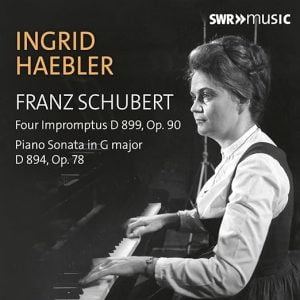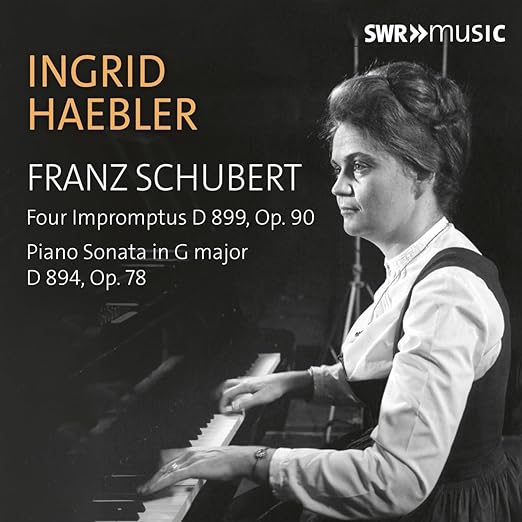
SCHUBERT Four Impromptus, D. 899; Piano Sonata in G Major, D. 894 – Ingrid Haebler, piano – SWR19435CD (7/20/23) (61:18) [Distr. by Naxos] ****
Viennese pianist Ingrid Haebler (1926?–2023) remained a staunch advocate for the Classical tradition, imbuing her impressive legacy of Bach, Mozart, Haydn, and Schubert with an innate dignity, clarity, and elegance of line. The Schubert sonatas from SWR derive from Stuttgart studios: the Sonata in G from February 1, 1957, and the set of Impromptus from June, 1954. Haebler could attribute much of her undemonstrative, natural fluency of delivery to the pedagogy of masters Paul Weingarten, Marguerite Long; and Nikita Magaloff. Haebler’s consistent sense of the balanced phrase has much in common with the style of another Classicist pianist, the Hungarian Lily Kraus.

Franz Schubert,
by Wilhelm August Rieder
The 1826 “Fantasie Sonata” of Schubert finds Haebler in studied, nuanced attention to the work Robert Schumann deemed “the most perfect in form and conception” of the Schubert sonata oeuvre. Her capacity to render each phrase and transitional sequence of the opening Molto moderato e cantabile in an arioso sonority invests an unbroken sense of spiritual serenity in this work, in spite of its occasional sojourns into emotional anguish, notably marked in minor key fff at the inception of the development. The pearly play, even in staccato, proves both lucid and delicately resolute. Haebler’s treatment of Schubert’s idiosyncratic harmonies in the Andante, constantly disrupted by minor key outbursts, proves alert and dramatically pointed. The application of a demonic trill followed immediately by soft chords, pp and ppp, offers a dynamic canvas on a par with the late Beethoven sonatas. The step-wise motion of the melody, finally restored in the coda, ppp, seems a moment of poetic justice. The Menuetto casts a rustic, surly energy in B Minor offset by a ländler Trio projected by Haebler in the style of a B Major musical box. The concluding Allegretto enjoys a steady momentum, pastoral in character, jaunty at times, all the while moving by intervals of a sixth, until the key of G once more asserts itself. Again, in spite of occasional clouds in the sky, Schubert’s serene horizon spreads open in optimistic figures, rife with song and dance, and a liquidly diaphanous coda carries us far from any mortal storm. Ned Rorem has noted, in his memoir, Lies, that “all music worthy of the name is self-evident.”
It becomes apparent that the chaste poetry Haebler delivers in her four Schubert Impromptus communicates the composer’s sincerity and intimacy with an immediacy that reminds me of my first experience of these pieces, from Artur Schnabel. For those who linger upon the more sensationalist aspects of the music business, recall how Haebler became the innocent victim in the Joyce Hatto affair of 2005, her Denon recordings of Mozart manipulated, appropriated and attributed to Hatto by the unscrupulous machinations of Hatto’s husband, sound engineer and producer William Barrington-Coupe. Is not imitation the sincerest form of flattery? What then, of plagiarism? And how did the so-called “experts” and “pundits” in music criticism swallow the Hatto hoax wholesale? Perhaps the good to come from these reflections lies in the care we lavish in appreciating Haebler’s art anew: the fluid confidence of her pulse in the E-flat Impromptu; the swelling, richly nuanced lyricism of her G-flat Impromptu; and the buoyant, thoughtful symmetries of phrase that define her A-flat Impromptu No. 4, with its singing cello melody. I turn once more to Ned Rorem, “the fuss comes from a need for Greatness in a time of triviality.” When this need finds fulfillment legitimately, as from Ingrid Haebler, our only mission should be to recognize it for what it is.
—Gary Lemco
More information available through Amazon