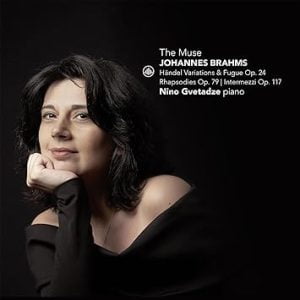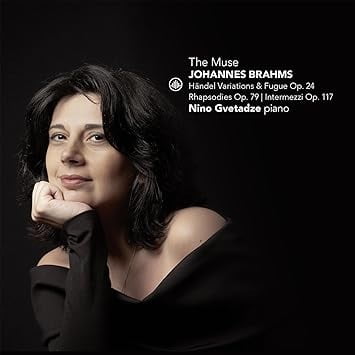
BRAHMS: Handel Variations & Fugue, Op. 24; Two Rhapsodies, Op 79; Three Intermezzi, Op. 117; CLARA SCHUMANN: Romanze, Op. 21/1 – Nino Gvetadze, piano – Challenge Classics CC72970 (69:27) (1018/23) [Distr. by Naxos] ****:
Subtitled “The Muse,” this all-Brahms recital (recorded April 25-26, 2023) centers on the composer’s “Manifesto” of 1860, proclaiming his aesthetic distance from the “New German School” embodied by Liszt and Wagner. In particular, the 1861 Handel Variations demonstrates the functionality of the Brahms ethos, in which he utilizes Baroque music practice as a source for his own, fertile imagination. The same urge to an idiosyncratic Classicism inhabits the remaining Brahms pieces, each revealing a penchant for sonata form as a structural foil to their innately romantic, ardent temperament. That Clara Schumann (1819-1896) remained for Brahms an incarnation of the “immortal beloved” for his life and work justifies the inclusion of her music, especially the one Romance from the set of three from 1853, composed at the height of Robert Schumann’s mental crisis, which resulted in his institutionalization in 1855.
From the opening quotes directly from Handel’s “Air” from the 1733 Suite in B♭ Major, Gvetadze applies a light touch that, in its quick articulation of grace notes and passing galanteries, emphasizes the Baroque archaism of the occasion. On the other hand, literally, the No. 4 Risoluto variation in sf octaves in both hands does not lack for expressive girth, as required. A lovely, romantic hue veils the excursion into the tonic minor at No. 5, espressivo. Its direct heir, No. 6, sempre and legato, demonstrates Gvetadze’s finesse in contrary motion, the two-part canon in octaves. The succeeding variants indulge our taste for brisk staccato accents, often in three voices, with the No. 8 asking for inverse figuration of the hands, made poignantly dramatic, in this instance. The most “Hungarian” of the variations, No. 13 in the tonic minor, Gvetadze plays quite slowly, asserting its martial, almost funereal sensibility, the sixths in the right hand seeming to sound the dirge of drums. The bravura of No. 14 (marked sciolto) brings a new assertion of Handel’s original key and a flurry of vibrant energy infused into the successive variants. Attention, please, to No. 19, a leisurely siciliana in olden style, likely influenced Brahms’s study of the music of Couperin. Gvetadze takes us to the chromatic organ loft temporarily in No. 20. The following two variants, as do several in the journey, pair off, the No. 21 having modulated to G minor, Handel’s tune in grace notes; and then, perhaps many listeners’ favorite, the musette in delicate, repeated drone figures, dancing in a song of perpetual charm. At variant No. 23, 12/8, Brahms and Gvetadze initiate the steady, ineluctable ascent to the monumental final variation prior to the massive fugue, this last a miracle of contrapuntal compression of prior impulses derived from Handel’s motives. Gvetadze imposes a balanced, albeit marcato, combination of gravitas and textural clarity, without any sacrifice of forward propulsion.
The 1879 Rhapsody in B Minor receives an equally “studied,” if not precious, realization, the approach sensitive to the Brahms penchant for structural, ternary formality in the midst of passions. Most notable become Gvetadze’s upward runs, rather meteoric, Mannheim figures to the next evolution of thematic development, in the manner of Bruckner. The middle section enjoys the lyrical daintiness evoked in the light and drone-sounding sections of the Handel Variations. The sense of tragic resignation has not escaped Gvetadze’s rendering, the drama’s having demanded a near paroxysm of emotional expression in the last pages, in which the opening motifs sullenly fade away. The Rhapsody in G Minor has its own sonata-form ethos, which Gevadze takes at a moderate tempo. The bass progression clearly receives the emphasis, even as the right hand explores some audacious modulations. The bass line assumes a serpentine power, creeping up and then insisting on its authority before the texture thins out, at least temporarily. Gvetadze plays with the contrasting dynamics, weaving a kind of hypnotic net in preparation for the last appearance of the opening flourish, which has come to resemble more a rondo than a sonata hybrid. The figures dance in counterpoint before one last thrust, for the final cadence.
The context shifts to those sad “lullabies to my sorrows” of 1892, his Op. 117, relatively small, condensed piano pieces, often in ternary form, to which Brahms mockingly referred as his “old-bachelor music.” From a Herder translation of a Scottish ballad, “Lady Anne Bothwell’s Lament,” Brahms imposes a 6/8 meter to effect a rocking consolation to a child, softly and securely ensconced in a cradle. Despite some dark shadows and passing sighs, the music maintains its innocence, though the air of nostalgia invokes the shade of Robert Schumann. The second piece of the triptych, in B-flat minor, consistently invokes the “rainy-day,” autumnal image of late Brahms generally. The modulation of the fragmented arpeggios flows without effort into a compressed development section, equally lyrical and introspectively passionate, building to a pained climax. Four notes sound a kind of sullen “fate” motif, sequential and soon exhausted. The last of the group, in C-sharp minor, sounds like a moment of post-WW II Germany, bleak in the manner of Kurt Weill. Gvetadze does not soften the emotional rigor of the piece, though its middle section plays lucidly with plastic impulses offered in consolation. A step-wise transition rife with the opening motif leads us to the recapitulation, more resigned than before, heart-rending. Gvetadze invokes a clarion, bell-tone series of chords that chime an emotional fatality to the occasion.
The final entry comes from Clara Schumann, her anguished Romance in A Minor, expressive of her profound empathy for her ailing Robert, for whom she wished a merciful release, “Because I loved him so.” Marked Andante, the music swells in affect and in tempo to achieve one climactic, poignant moment, then retreats in legato and parlando to conclude in a spirit akin to many of Robert Schumann’s epilogues, tragic and mysterious.
—Gary Lemco
More information available through Amazon