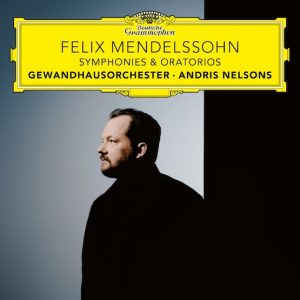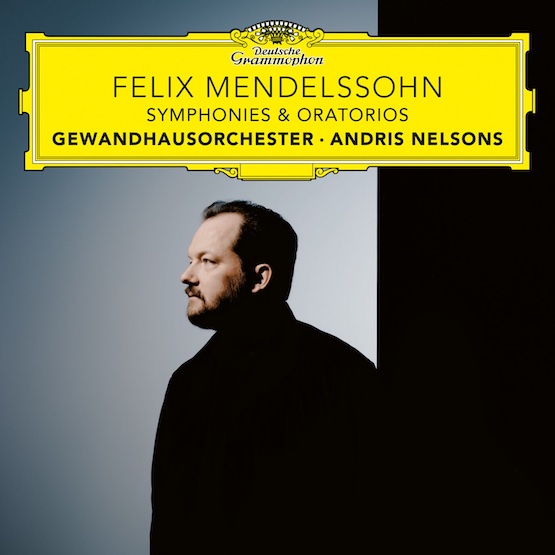
MENDELSSOHN: Symphonies & Oratorios – Gewandhausorchester Leipzig/ Andris Nelsons – Deutsche Grammophon DG 486 8178 (2/10/26) (7 CDs = 70:10; 55:05; 66:22; 61:49; 72:25; 74:03; 59:25; complete contents/credits detailed below) [Distr. by Universal] **8**:
Deutsche Grammophon collects the 2021-2024 recordings by Latvian maestro Andris Nelsons, including his readings of Mendelssohn’s oratorios, Elijah and St. Paul. Nelsons leads the Gewandhaus Orchestra of Leipzig, historically the very ensemble Mendelssohn himself conducted. I postponed my audition of the Biblical settings to enjoy Nelsons’ athletic rendition of the youthful (1824) C Minor Symphony No. 1, a product of an ardently inspired master at fifteen-years-old. Energetically dramatic in the manner of both Beethoven and Weber, the opening Allegro di molto oozes confidence and optimism. The two interior movements linger in the imagination for their songful appeal as well as jubilant buoyancy in the Menuetto. The last movement, Allegro con fuoco, reveals a young master of polyphonic procedures, the discipline derived from Bach and the previous mastery of thirteen string symphonies by which Mendelssohn’s craft attained a fine sheen.
Coupled on Disc 1 with Op. 11 we have Mendelssohn’s evocation of Sir Walter Scott’s highlands, his Symphony No. 3 in A Minor, “Scottish.” Composed over an extended period (of revision), 1829-1841, the work enthusiastically captures Mendelssohn’s fondness for the Edinburgh environs and their pageant of history. Strings and elegiac woodwinds intone, Andante con moto, the innate nobility of the landscape, a brisk tempo that does not compete with the sheer monumentality of effect garnered by Otto Klemperer and the Philharmonia Orchestra. The ensuing Allegro un poco agitato projects a virile, elastic swagger – wonderful in the cellos and timpani – much in line with that drive Dimitri Mitropoulos imparted to the score. The marvelous, diaphanous clarity of the woodwinds, especially the clarinet, in the Vivace non troppo, the scherzo, redolent of highland bagpipes, deserves repetition. Pathos and dignity suffuse the Adagio, alternately offering deep sincerity in the strings followed by a funeral march. The last movement, Allegro vivacissimo – Allegro maestoso assai, conveys the grumbling, impulsive, Scottish sense of militant virtues, concluding with a victory hymn.
“The jolliest piece I have written,” Mendelssohn’s words to describe his 1833 “Italian” Symphony, literally explodes with Nelsons’ exuberance for the opening Allegro vivace, whose lithe bluster rivals the same movement from Sir Thomas Beecham. Vivid trumpet calls saturate the lively atmosphere, a fervid sense of former Roman glories superimposed on a brilliant landscape. Andante con moto, the second movement proceeds a bit marcato to my taste, but persuasively evocative of a leisurely tour in pace and time. The ensuing, rather brisk, Con moto moderato hints more of the light-infused Black Forest than sunny Tuscany, given the luxurious horn calls and flute trills with their mesmerizing, bucolic colors. The dazzling hustle of the concluding Saltarello movement, Presto, enjoys the deft alternations of light and shade, thin and lush textures, to impart a fervent, enduring affection for the Italian ethos.
Disc 7 concludes with Mendelssohn’s musical celebration, 1830, of the centennial of the Augsburg Confession, a major rite of the Lutheran Church, his “Reformation” Symphony in D minor. Legend has it that, from the initial notes of the Gregorian Magnificat, Mendelsohn composed the entire score vertically, as if to commemorate its ecclesiastical rigor. Motifs like the “Dresden Amen” infiltrate the polyphonic texture, a progression that elicits awe and reverent menace, at once. Nelsons takes a huge lacuna prior to the “Amen” that recurs late in the recapitulation, a virtual signal for Wagner to usher forth his “Grail” motif from Parsifal. The second movement, Allegro vivace, begins as a muted woodwind serenade that soon gains heft and splendor, though it retains its function as an interlude. The brief Andante movement provides, arioso, a transition to the initial, woodwind devotions of the final movement, whose Lutheran hymn Ein feste Burg ist under Gott soon monumentally irradiates, Allegro maestoso, the finale. Remember Mendelssohn’s “War March of the Priests” from Athalie? A similar martial fervor invests Nelsons’ brisk delivery of the composer’s mighty contrapuntal filigree, set in contrasting, sweeping, orchestral antiphons.
For the 400th anniversary of Johannes Gutenberg’s printing press, 1840, the city of Leipzig heard Mendelssohn’s celebratory Symphony-Cantata Lobgesang, his “Hymn of Praise,” that reveres an invention heralding Mankind’s progress, “the armor of light” to cast off the darkness of paganism and illiteracy. Mendelssohn utilizes Martin Luther’s translation of the Bible, a vehicle of faith made available by the innovation of moveable type. In ten sections, the work finds its unity in the trombone hymn that sets the whole in motion in the contrapuntally rich “Sinfonia.” After the spirit of Beethoven’s Ninth, Mendelssohn invokes a vocal as well as an instrumental arsenal, a structural “hybrid,” that blurs the distinction between absolute music and ecclesiastical reverence. The cyclical character of the music reaffirms God’s plan in finding through Gutenberg “the Word,” now made available to all flesh. Movement six proves especially dramatic and poignant: three times “Watchman is the night past?” appears, answered by the radiant soprano and chorus alike, “The night Is past,” to invite a new era of (German) Reformation, affirmed by the chorale, Nun danket Alle Gott, in a capella chorus and then with full orchestra. The prevalence of J.S. Bach’s polyphony in conjunction with Mendelssohn’s innate Romantic diction, his potent sense of vocal impact, makes for a notable composition too often relegated to the composer’s less successful efforts.
Nelsons includes two oratorios familiar in the United Kingdom in their Victorian English translation, but in this case sung in German. Paulus (1832), heavily influenced by the cantatas and passions of J.S. Bach, results from a commission from the Saint Cecilia Society in Frankfurt. The narrative traces the transformation of the Jewish Pharisee Saul into the Apostle Paul as a result of the stoning and death of Saint Stephen and the events of the road to Damascus. Periods of lyrical contemplation in the various arias alternate with highly dramatic exclamations by the chorus that often resemble moments in Handel, even more than in Bach. The narrator in Paulus imitates the Evangelist in Bach’s St. Matthew Passion. After Saul causes the death of Stephen, the chorus intones “Happy and blessed are they who have endured.” Attend to the last pianissimo, “For though the body dies, the soul shall live forever.” Basso Georg Zeppenfeld characterizes a somewhat truculent Saul, but his voice finds wonderful solace in the soprano of Julia Kleiter, who in her aria, “Jerusalem!” reminds me of Lucia Popp.
Mendelssohn’s oratorio masterpiece, Elijah, results from a commission from the Birmingham Festival in 1845 to compose a work (here based on the Book of Kings) that would succeed Paulus. The life of the prophet Elijah epitomized the evolution of Jewish faith from worship of the Babylonian pantheon of idols and myths to the worship of one monotheistic God. Even as a convert to Protestantism, Mendelssohn retained a strong Jewish sense of identity, having remarked, “It took a Jew to resurrect Bach’s St. Matthew Passion!” In this case, the typically wrathful prophet will be borne aloft on an angel’s wings, a reward for his visionary powers. A key moment has Elijah come to the end of his earthly life, and the accompaniment disappears so the chorus may sing, a cappella, a mighty C Major fortissimo. Andrè Schuen has the title role, here realized with a fine-tuned instinct for dramatic conviction.
Kudos to the DG production team for having assembled a sincerely felt, musically alert series of performances by Nelsons, who proves himself a master of the Mendelssohn style.
–Gary Lemco
MENDELSSOHN: Symphonies & Oratorios
1Paulus, Op. 36; 2ELIAS, Op. 70;
Symphony No. 1 in C Minor, Op. 11;
3Symphony No. 2 in B-flat Major, “Lobgesang,” Op. 52;
Symphony No. 3 in A Minor, “Scottish,” Op. 56;
Symphony No. 4 in A Major, “Italian,”
Op. 90; Symphony No. 5 in D Minor, “Reformation,” Op. 107
1Julia Kleiter, soprano/
1, 2Wiebke Lehmkuhl, alto/
1,2Werner Guera, tenor/
1Georg Zeppenfeld, bass/
1,2,3MDR-Rundfunkchor/
1,2,3Philipp Ahmann, chorus master/
2Golda Schultz, soprano/
2Andre Schuen, baritone/
3Christiane Karg, soprano/
3Elsa Benoit, soprano II/