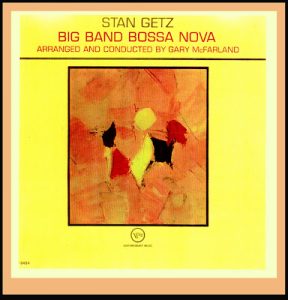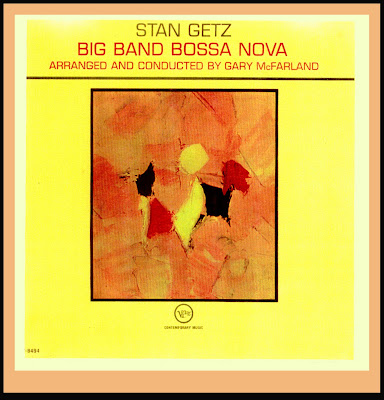
Universal Music Enterprises/Verve Acoustic Sounds Series releases and impressive 180-gram vinyl of Stan Getz’ large ensemble Bossa Nova.
Stan Getz – Big Band Bossa Nova – Verve Records V6-8494 (1962)/Universal Music Enterprises 199957085069 (2026) Verve Acoustic Sounds Series 180-gram stereo vinyl, 33:30 *****:
(Stan Getz – tenor saxophone; Gary McFarland – arranger, conductor; complete credits listed below)
In the late 1950’s, a new genre of music was introduced…Bossa Nova. It was a hybrid of samba and jazz, pioneered by João Gilberto and Antonio Carlos Jobim. The musical style included syncopated guitar (nylon string), elaborate harmonies and quiet vocals. The guitar playing was central to this movement, intermingling samba-like percussion and motifs to classical guitar.
An early cultural breakthrough was the film score for Black Orpheus (1959) which had a memorable song “Manha De Carnival”. Another milestone was the 1964 single, “The Girl From Ipanema” sung by Astrud Gilberto. She recorded this on the Grammy-winning album Getz Gilberto. Getz became the American impetus for Bossa Nova, recording several albums in this genre and soon popular music in the U.S. embraced the new craze.
Universal Music Enterprises (Verve/Acoustic Sounds Series) has released a 180-gram vinyl of the 1962 album Stan Getz – Big Band Bossa Nova. At the core of this album are the meticulous arrangements of Gary McFarland. Side A opens with the quintessential Luis Bonfá composition “Manha De Carnival”. A gentle acoustic guitar (Jim Hall) leads into a lyrical Getz lead, as subtle orchestration and a concise groove anchors the jam. As trumpets come in, they are unobtrusive. “Balanço No Samba” (one of four McFarland Originals) is more lively with punctuated brass accents, and the ensemble shares the spotlight.
As the title suggests, “Melancólico” has a late-night vibe with textured horns and woodwinds in counterpoint to Getz’ breezy articulation. Hank Jones’ piano lines are exceptional. The fulsome big band arrangement is fluid with crisp play and tight rhythm grooves. “Entre Amigos” exudes a cinematic resonance with trumpet and saxophone in counterpoint and harmony.
Side B kicks off with Antonio Carlos Jobim’s beautiful, Chega de Saudade”. Getz’ fluid notation is complemented by the reeds and brass. It is complex, accessible and distills the melodic essence of this music. In a pensive change of pace, McFarland’s ode to sadness, “Noite Triste” displays a similar balance between Getz’ lead and the reeds/horns. Jones adds some delicate piano runs, and at the 3:22 mark, a forceful tempo transition energizes the number. Getz eases into swing mode and the band glides.
McFarland adds muscle to the brass on the perennial favorite ‘Samba De Uma Nota”. Subtle piano, flute shading and sharp cymbal work maneuver this swaying number to big band aesthetics. The finale, “Bim Bom” (another Gilberto tune) is regarded by many as the first Bossa Nova hit when it was first recorded in 1958. Here, Getz’ approach is hypnotic with feeling, against the tightly constructed rhythm section.
This vinyl edition of Stan Getz – Big Band Bossa Nova is a stellar jazz recording.The sound mix has an expansive aural landscape with precision and clarity. Despite McFarland’s denser instrumentation, the separation is specific and uniquely detailed with Getz’ saxophone front and center, surrounded (but not overwhelmed) by the brass, reeds and percussion. The QRP pressing is vibrant, but also maintains quiet surface ambience.
Highest recommendation!
—Robbie Gerson
Stan Getz – Big Band Bossa Nova
More information through Verve Records
TrackList:
Side A: Manha De Carnival; Balanço No Samba; Melancólico; Entre Amigos
Side B: Chega De Saudade; Noite Triste; Samba De Uma Nota So; Bim Bom.
Performing Artists:
Stan Getz – tenor saxophone;
Doc Severinsen – trumpet;
Bernie Glow – trumpet;
Joe Ferrante – trumpet;
Clark Terry – trumpet;
Nick Travis – trumpet;
Ray Alonge – French horn;
Bob Brookmeyer – trombone;
Willie Dennis – trombone;
Tony Studd – bass trombone;
Gerald Sanfino – flute;
Ray Beckenstein – flute, clarinet;
Ed Caine – alto flute;
Babe Clark – clarinet;
Walt Levinsky – clarinet;
Romeo Penque – bass clarinet;
Jim Hall – guitar;
Hank Jones – piano;
Tommy Williams – bass;
Johnny Rae – drums;
José Paulo – tambourine;
Carmen Costa – cabasa;
Gary McFarland – arranger, conductor