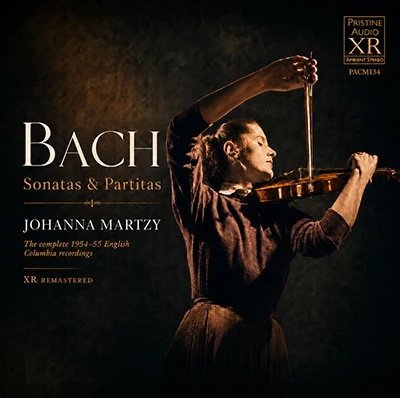
BACH: Sonatas & Partitas for Violin, BWV 1001-1006 – Johanna Martzy, violin – Pristine Audio PACM 134 (2 CDs = 2:20:15) [www.pristineclassical.com] *****
Likely due to the scarcity of recorded repertory, a cult surrounds the reputation of Romanian violinist Johanna Martzy (1924-1979), whose explosive, exemplary talent had been noted by Glenn Gould. After her victory at the Geneva Competition in 1947, her international career began in earnest, even having attracted EMI for a recording contract. The uninvited attentions of producer Walter Legge, however, obviated any extended relationship with Abbey Road past the 1950s, though Martzy found more congenial atmospheres with Columbia, Heliodor, Coup d’Archet, and Deutsche Grammophon. Martzy invited admiration for her immediate, sonorous tone, her long line, her driven tempos, and her judicious, expressive use of vibrato. She set the Bach solo violin works down between May 1954 and May 1955.
Andrew Rose details the arduous restoration process employed by Pristine Audio to rejuvenate these precious realizations of Bach’s 1717-1720 set of polyphonic, solo masterpieces.
Rather typically, I began my review with the 22-24 July 1954 performance of the Partita No. 2 in D Minor, especially noted for the monumental “Chaconne” that never ceases to mesmerize the mind and the soul of any auditor. The opening “Allemande” displays a seriousness of purpose, piercing intonation, and a dramatic sense of breath between phrases. Her “Courante” proceeds in a reticent dance tempo, though lyrically informed. The passing dissonances and sudden depth or “bloom” of dynamics prove startling. A deeply felt “Sarabande” and taut, mincing “Gigue” demonstrate the emotional versatility in her application of bowing and fingering technique. The phrases enjoy a wonderfully symmetrical resolution.
The “Chaconne,” the ecstatic monument to contrapuntal expression on the solo violin, can easily overwhelm any practitioner who lacks the sheer stamina to maintain its relentless pursuit of its emotional permutations. For my taste, Martzy exhibits the same, calm level of execution and structural continuity as we find from veterans Milstein, Menuhin, Szeryng, and Heifetz, while injecting her own, studied effects in rubato and fluidity of transition. Then, there looms Martzy’s undeniable passion in this music, whose gravitas astounds all beholders.
Bach’s “church “sonata da chiesa” Sonata No. 1 in G Minor assaults the ear with quadruple double-stops in the tonic key, and the instrument’s two lowest strings, in G and D, provide an organ-like, pedal-effect, warm resonance. This particular chord will serve to anchor the work at various points of composition. Martzy establishes the first two movements as serving as as a colossal, sometimes anguished and ornamental, prelude followed by a fugue in the three voices. The D string, with its open harmonies, enlarges the sound and imparts a sturdy, organ sensibility to the violin’s otherwise limited range.
The ensuing Siciliano in 12/8 exudes a wistful countenance, exploiting the low registers of the violin, while upper voices seem to sigh in response. Martzy imparts a meditative passion into the dance, the dotted rhythm’s conveying a studied melancholy. The Presto 3/8 asserts a perpetual-motion sensibility in 16th notes, rich arpeggios pitted against scalar runs. Martzy’s rasping, acerbic attack infuses the metrically ambiguous gigue with a degree of palpable frenzy.
Bach’s “Preludio” that begins his Partita No. 3 in E Major ranks among the most notable moments of any of his six solo compositions. Consisting of fluid 16ths, the impetuous piece receives from Martzy a dazzling rendition accomplished in one, brilliant musical gulp. Conceived in six dance movements, each remains in the major mode, thus imparting to the whole a genial though learned character. The “Loure,” as well as “Gavotte en Rondeau” and “Bouree,” assign a distinctly French character to the suite. Martzy executes a biting attack that spices up the “Gavotte” in pungent, double-stopped figures. The two “Menuets” receive a meditative color that rather transcends their courtly status. The final two dances impress us with Martzy’s uncannily swift shifts of bow position and bow pressure, thr fluid metrics of the pieces impelled by a deft lightness of touch complemented by precise intonation.
The splendor of Bach’s capacity for variation technique shines in the Partita No. 1 in B Minor, BWV 1002, as it does in the Chaconne, but here each dance insists upon a Double, which does not follow a strictly imitative function. The deliberate repetitions invite the performer to add his own ornaments, adding breadth to the already innovative notion of playing a solo instrument so as to produce polyphony. Martzy recorded the eight-movement Partita No. 1 from 27-30 April 1955. The sonorous depth – often sounding in tones more reminiscnt of a viola – of the opening, extended “Allemande” achieves a grave sensibility in its broad meanderings marked by pedal points. The ensuing “Double” has Martzy’s introspectively tracing Bach’s maze in a manner worthy of Theseus in the Labyrinth. Martzy’s “Courrente” proceeds with a sense of holding back, likely in anticipation of the “Double,” which demands a (wizardly) Presto execution. Bach’s “Sarabande” proves deeply expressive in chromatic double notes, Martzy’s rich attacks rife with drama ending in a brief coda. The “Double” speeds up the meditation and feels improvised. The last movement gives us Bach’s only “Bourree” with a “Double.” Its martial resolve finds in the succeeding, final movement not an abbreviation but a pulsating, searching response with its own exploratory atmosphere.
The remaining sonatas da chiesa in four movements contain each a massive “Fuga” that serves as the work’s emotional center. The Sonata No. 2 in A Minor opens with an expressive, slow-evolving “Grave” that showcases Martz’s long trill in the course of an extended, ceremonial line. The dotted-note “Fuga” moves between strict polyphony and episodes that run seamlessly and imbue the single instrument with the quality of a miniature concerto grosso. This movement, as does the “Fuga” from Sonata No. 3 in C Major, testifies to Martzy’s staying power. This “concerted” effect infiltrates the poignant “Andante,” set as flowing, steady bass 8th notes over which the melody proceeds, almost an organ concerto slow movement. The final “Allegro” energetically circulates our blood by way of a moto perpetuo. Echo effects replace Bach’s chordal approach, and Martzy executes the music in dazzling style, the sonorities seeming to bounce across the bridge of the instrument and contours of our minds.
Bach’s Sonata No 3 in C Major, BWV 1005 may owe debts to the Italians of his time, Corelli and Marcello. Several commentators point out similarities between the slow, long notes of the opening “Adagio” and an oboe concerto Bach arranged as BWV 974. Corelli’s set of Op. 5 sonatas (c. 1700) present fugal passages. Martzy breathes a passionate life into the “Adagio,” in which the added voices intensify a searing transformation of numbers from geometry to intimate tragedy. The monumental fugue again reveals Bach’s inventive strategies for a single, four-stringed instrument. The main motif combines chromatically with other voices, then stratifies in melodic layers which may invert or retrograde. Martzy colors her lines athletically, so we appear to receive competing voices well beyond the immediate. The key to the “Largo” lies in avoiding an anticlimax after the imposing “Fuga.” Martzy plays to Bach’s Spartan intimacy, offering an orison or contrapuntal prayer of thanksgiving. The finale, “Allegro assai,” cuts the rope, as Zorba might express it, moving in a feverish impetus inflected by bow position shifts and varied attacks in antiphonal format.
Collectors have a rare opportunity to hear a master interpreter of Bach, who, by the way, was the first female performer to record the Bach six masterworks. The XR restored sound proves unvarying, thrilling.
—Gary Lemco
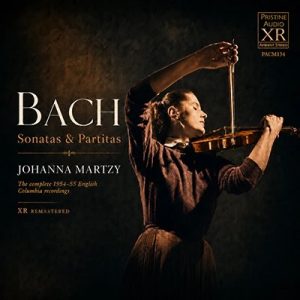
From Pristine Audio, Johanna Martzy playing Bach’s Sonatas and Partitas for Solo Violin. Classical Music Review by Gary Lemco.