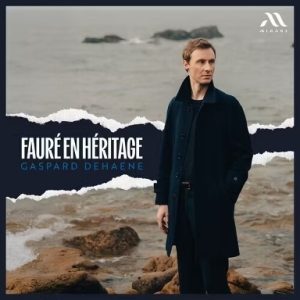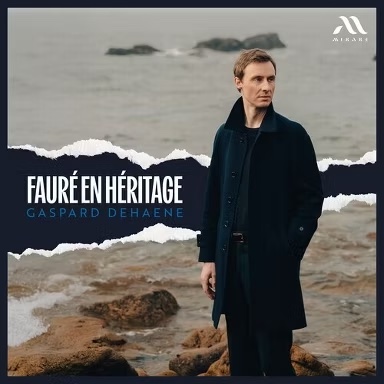
FAURÉ en HÉRITAGE = Works by Faure, Ravel, Schmitt, Boulanger, Ducasse, Enesco, Koechlin, Ducasse, Aubert, Koechlin – Gaspard Dehaene, Piano – Mirare MIR776 (70:00, detailed content listing below) (1/16/26) [Distr. by PIAS] ****:
Recorded 3-5 March 2025, this selective recital concentrates on the special circle of French composers who either received direct instruction from Gabriel Fauré (1845-1924) or Maurice Ravel (1875-1937) or gleaned from their musical styles to form their own creative path. Fauré, in particular, created a richly chromatic syntax, bridging the harmonic advances of late Romanticism and early modernism without sacrificing an essentially gentle, lyric gift, a discourse borne of Chopin, Schumann, and folk impulses, often exhibiting restraint and balanced contours rather than emotional upheavals. Ravel, whose work Stravinsky once compared to that of a master clockmaker, blended the chromatic lines of Debussy (and Impressionism) with a strict sense of Classical architecture. The various other composers in this collection inherited the tendencies of these two masters, besides expressing their individual voices.
Dehaene begins his extensive Gallic tour with Fauré’s 1902 Allegresse, No. 7 from the miscellany published as 8 Brief Pieces. Set in C major, the lyric maintains a liquid contour, redolent in color and shifting harmony. Immediately, France’s alter ego in this assemblage arises in Ravel’s 1899 lyrical, Spanish processional, Pavane pour une infante defunte. Dehaene’s touch alternates between gossamer lightness and percussive insistence, though his tonal work remains vibrantly clear. The middle section enjoys a limpid sonority close to elements from Ravel’s Mother Goose Suite. Faure’s own 1887 Pavane (in F# minor) soon appears, a reminiscence of Spain’s Golden Age, rife with melodic elegance and pointed trills.
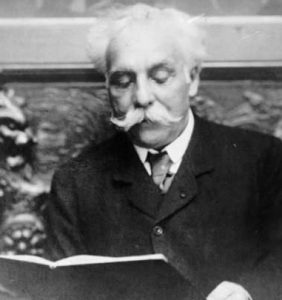
Fauré in 1907
The first Fauré “acolyte” in this musical coalition, Florent Schmitt (1870-1958), offers En révant, the first from the collection of “Evenings.” Louis Aubert (1872-1968) changes the tempo with his Lutins (Goblins), a ternary, bravura vehicle in rapid motion (a la Moszkowski) whose middle section becomes quietly mysterious, almost in the manner of Mussorgsky. Lili Boulanger (1893-1918) provides us a reflective moment, from the set of Trois Pièces, her “From an ancient Garden,” an intimate parlando that seeks out a passing chromatic, modal harmony. Her Prélude in D-flat Major at first casts a dark but delicate hue, much influenced by Debussy as much as by Fauré. The latter portion of the piece resonates a bit like Debussy’s “Sunken Cathedral.” Inspired by Liszt but dedicated to Fauré, Ravel’s 1901 Jeux d’eau transcends its Conservatory debts, exhibiting transparency of effect in its playful but bravura technique in watercolors. Here, Dehaene’s clarity of execution and poised sense of musical drama reminds me of my own idol in this music, Robert Casadesus.
Composer Mel Bonis (1858-1937) owes a debt to her mentor César Franck as much as to Fauré; it seems Bonis has come into her own spotlight of late, much to our grateful admiration. Bonis’s Ophélie – femme de legend explores the keyboard’s full range, unafraid of some Mussorgsky’s depths. Dehaene makes us fully aware of Bonis’s left-hand requirements as the music surges in passionate, arabesque-like periods. Another of her pieces, Au crépuscule, virtually defines the spirit of the entire album: the rippling, twilight world best embodied in the psychological, literary work of Marcel Proust. Jean Roger Ducasse (1873-1954) bears the mantle of Debussy and Ravel in his athletically quirky Sonorités, which plays like a dark, post-Romantic improvisation, a step away from a solid but intimate, jazzy nocturne.
Dehaene “encroaches” on the keyboard world of the late Dinu Lipatti by performing Georges Enesco’s “Pavane,” third movement from the Suite No. 2, Op. 10. Enesco’s gossamer, tonal palette evolves straight out of the Fauré and Debussy kingdoms, liquidly modal and insistent on modal scalar patters resonant with voluptuous trills.
Both Fauré and Aubert contribute Valse-Caprice compositions: the Fauré, the longest to perform of the collection, proceeds in a spirited A major, rather combines its ¾ waltz with an animated impromptu style. The lyrical content seems water-borne, allowing the treble free range, then suddenly mixing the impulse with a martial gesture. The occasionally gaudy dynamics of the piece ally it with spectacular gestures in Chabrier. The lyrical impulse wins the contest in a shower of flowing and martial arpeggios and block chords.
The Aubert Op. 10 Valse-Caprice also proceeds in A major; though written in 1902, its publication occurred in 1912. A “moderate waltz,” it insists on “expressively” as its defining rubric. The music becomes passionate momentarily, relenting only slightly as the uneven metrics urge the gestures to threaten eruptions beyond the scope of the form, the coda resolute.
Florent Schmitt resurrects the spirit of Schumann in his 1940 series Enfants dedicated to pianist Monique Haas (1909-1987), from which Dehaene gives us numbers 7 and 8, “Little Moses, Saved from the Waters” and “Little Terror.” “Moses” sways with a lullaby-like pulse, almost Chopin’s Second Ballade, before breaking into chime-like sonorities as a foil to the repetition of the opening. Impish jumps and percussive accent mark Enfant terrible, a wild dance that might have been realized by Shakespeare’s Puck.
The 1915-16 Landscapes and Seascapes, Op 63 of Charles Koechlin (1867-1950) testify to his affection for Nature. The “Promenade towards the Sea” offers a delicate, even exotic, parlando melody in odal harmony, reminiscent of contemplative Debussy but closer to Roussel in tenor. Roger-Ducasse reappears in two of his 1908 Six Preludes: the first, Très nonchalant in 6/8, in G, but gravitating to E minor, projects a nostalgia in dulcet harmonies, brief but touching. No. 3 “In a Very Precise Rhythm,” 4/4, bears a decidedly playful, martial quality, a mock-attack. Its percussive quality makes it a distant cousin of the Children’s March in Tchaikovsky’s The Nutcracker.
So we come to the explicit “Homage to Gabriel Fauré” (1922) by Paul Ladmirault (1877-1944), whose name I discovered via an orchestral work realized by Dimitri Mitropoulos. Assertive in its veneration of his master, the piece communicates an ardent sincerity barely able to restrain its urge to dance, even while exhibiting a distinctly étude demeanor. Via a well recorded Steinway instrument, pianist Dehaene has paid fine tribute to the author and teacher Fauré, whose passing a century ago in 1924, has not diminished his lasting influence. We have known the tree by its finely wrought fruit.
—Gary Lemco
FAURÉ en HÉRITAGE =
FAURE: 8 Pièces brèves, Op. 84: Allegresse;
RAVEL: Pavane pour une infante défunte;
F. SCHMITT: Soirs, Op. 5: En révant;
AUBERT: Lutins, Op. 11;
FAURÉ: Pavane, Op. 50;
L. BOULANGER: Prélude en ré bémol majeur;
RAVEL: Jeux d’eau;
BONIS: Ophélie, Op. 165;
DUCASSE: Sonorités;
ENESCO: Suite No. 2 for Piano, Op. 10: Pavane;
BONIS: Au crépuscule, Op. 111;
FAURÉ: Valse-caprice No. 1, Op. 30;
F. SCHMITT: Enfants, Op. 94: Nos. 7 &8;
KOECHLIN: Paysages et Marines, Op. 63: Promenade vers la mer;
DUCASSE: Six Préludes: Nos 1 &III;
LADMIRAULT: Hommage a Gabriel Fauré;
AUBERT: Valse-Caprice, Op. 10