Harry Blech and the London Mozart Players: The Complete HMV Stereo Recordings, Vol. 2 = MOZART: Symphony No. 36 in C Major, K. 425 “Linz”; Piano Concerto No. 24 in C Minor, K. 491; 12 Minuets, K. 568 – Louis Kentner, piano/ London Mozart Players/ Harry Blech – First Hand Records FHR 15, 81:10 [Distr. by Harmonia mundi] ****:
A complement to the 2009 issue of Harry Blech (1910-1999) inscriptions from First Hand Records, these “newly discovered tapes” of Abbey Road sessions, 1954 and 1959, extend the legacy of the suave London Mozart Players in delicious music by their namesake. Most impressive is the opening selection, the 1783 Linz Symphony (22-23 December 1954), performed in a streamlined style that does not drag, nor does it lack for warm sincerity of expression. While many would contend that the Linz “belonged” to conductors Sir Thomas Beecham and Bruno Walter and their respective styles, Blech brings an intelligent ardor to the entire concept, giving the 6/8 Andante a true walking pace whose interior lines back in sunny confidence in the midst of a rare siciliano in Mozart’s oeuvre. The sturdy Minuet lacks something of the girth Beecham brings to it in his esteemed London Philharmonic reading, but the light textures prove eminently charmed. The Presto Finale in sonata-form moves in plastic Mannheim Rockets and contrapuntal stretti, beautifully balanced among the LMP forces, especially in the bassoon and clarinet.
For the dark Piano Concerto No. 24 in C Minor of 1786 (rec. 23-24 May 1959), Blech and the LMP are joined by Hungarian virtuoso Louis Kentner (1905-1987) who provides the first movement cadenza himself. The salon intimacy Kentner and the reduced forces of the LMP achieve strikes us at once, a consistently reserved affect, lyrically melancholy. Unlike those pianists who try hard to inflate the dimensions of the work to adumbrate Beethoven’s C Minor Concerto, Kentner maintains a chastity and delicacy of contour both fluidly elastic and warmly modest. The playing, resilient and thoughtfully forceful, conveys a depth of thought consonant with his reputation for restrained classicism in music of that period. Kentner builds his cadenza in striking colors, poised, and ending on a lovely run to the entry of the chromatic winds and strings of the restrained yet tumultuous coda.
The E-flat Major Larghetto presents itself as the soul of mournful simplicity. Typical of all the great London Mozart Players recordings, the woodwind entries reign, even as Kentner makes his cantabile points in seamless periods. The music virtually becomes a poignant wind serenade with piano obbligato, delicate, magically heart wrenching, and thoroughly polished, at once. The Allegretto in C Minor proceeds with a kind of Thomas Hardy determinism, the variations moving fluently and ineluctably to a tragic destiny. Bassoonist Archie Camden makes his presence felt as strongly as does Kentner, the two veterans in that perfect harmony that makes late Mozart extraordinary.
Finally, Blech and the LMP grace us with the set of 1788 Twelve Minuets, K. 568 (rec. 4 December 1956). Performed with smiling precision, the dances strike us with their hearty and courtly spirit and Viennese predecessors of such later nationalist masterworks as Dvorak’s Slavonic Dances or Hindemith’s manifold efforts for wind band. The part-writing and interior wind lines of No. 2 in F Major certainly prove captivating. Recall that Mozart drops violas from the string alchemy. No. 3 in B-flat Major captures the essence of “outdoor music,” spirited and feathery light. The guttural humor of No. 5 in G Major seems to flow from a limitless vat of rustic energy. No. 6 in D Major emanates a pre-Elgar pageantry mixed with balletic and janissary impulses. More emotionally wrought than many of the others, No. 9 in B-flat Major throws a bit of thunder and dark clouds into the otherwise light-march ethos. Lovely turns and ornaments insure the eternal, Seraglio charm of No. 11 in G Major, while the last of the set, No. 12 in C Major, invites the piccolo and trumpet to join in the debonair frolic whose trio section lilts magic.
—Gary Lemco
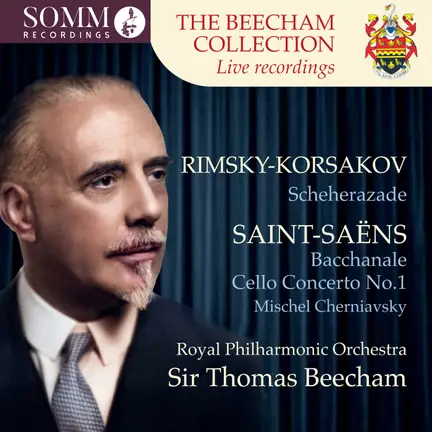
Sir Thomas Beecham conducts Rimsky Korsakov, Saint-Saëns – SOMM
Three mid-century concerts