Katsaris plays LISZT, Vol. 1 = Hungarian Rhapsodies Nos 2, 3, 7 , 5; 2 Elegies; Liebestraum No. 3; Klavierstuecke Nos. 1-4; Klavierstuecke Nos 2, 5; Piano Concerto No. 2 in A Major; Trauervorspiel und Trauermarsch; Unstern!; Nuages Gris; La Lugubre Gondola, Nos 1-2; R.W. –Venezia; Am Grabe Richard Wagners; Piano Sonata in B Minor – Cyprien Katsaris, piano/ Deutsches Symphonie-Orchester Berlin/ Arild Remmereit – Piano 21 P21 041-N (2 CDs), 74:17, 63:34 [Distr. by Allegro] ****:
Many connoisseurs of the piano consider Cyprien Katsaris (b. 1951) the legitimate heir to those Liszt legacies bequeathed us by Gyorgy Cziffra and Vladimir Horowitz. This Vol. 1 of Liszt performances extends from the privately recorded Liszt Sonata in B Minor (1973) to appearances Katsaris made in Heidelberg February and April 2011. The Klavierstuecke derive from a session at Fetes Romantiques de Nohant 20 June 1975. Four of the dark late works were recorded live at Tsuda Hall, Tokyo, 20 December 1989. The A Major Concerto (1 May 2007) was performed in concert at the Berlin Philharmonie. Piano 21 divides the two discs according to genre: CD 1: Gypsy and Romantic pieces; CD 2: Avant-Garde; Homage a Wagner, the Philosopher. Ten of the twenty-two tracks contain live performances.
A group of four Hungarian Rhapsodies opens the set, most appropriately with the ubiquitous No. 2 in C-sharp Minor. Katsaris relishes its obvious sonic allusions to the cimbalom, harp, violin, and clarinet, a perfect model for Bartok’s later Contrasts. The slides, fioritura, trills, added cadenzas, and manic energy of the rendition marks it for any tribute to this artist’s canny pyrotechnics in thunder and lightning. Every collector has his favorite pianist in this fireball moment of bravura, and this by Katsaris will raise hackles and goose bumps. More to the thrill of discovery lies Katsaris’ realization of the somber B-flat Rhapsody No. 3, whose use of Hungarian scales aligns this often shimmering piece more with Magyar Bartok than with “pure” gypsy elements. Its basso profundo moments grumble with tectonic menace. The D Minor No. 7 has had few adherents except those who favor integral surveys. In staggered motions, the piece imitates the cimbalom and perhaps a percussion ensemble. Eventually, its energy winds up like a frenzied spring and explodes in a series of convulsive gestures, in block chords and flying runs. The eminently romantic No. 5 in E Minor (“Heroide-elegiaque”) gains much from Katsaris’ plastic and legato molding, though few instantiations of the score can equal what Karajan achieved with his Berlin Philharmonic.
Whether the Elegies of Liszt affected the poet Rilke remains speculation, but the 1874 No. 1 reflects upon mortality with that same introspection we receive in Les Preludes. Liszt wrote that the often “liquid” piece was “more to be dreamed than played,” but Katsaris does both. The famed Villa d’Este at Tivoli inspires the Elegy No. 2 (1877), whose more audacious harmonies reach into Scriabin and Schoenberg before blossoming into Romantic conceits worthy of his three Liebestraume. So, naturally enough, Katsaris plays Liszt’s most famous love song on a Hamburg Steinway that literally has melted into sonic butter that soon congeals into marble ingrained with both strength and dignity. Liszt composed the majority his Five Klavierstuecke between 1865-1879, though a separate No. 2 in A-flat Major dates from 1845. All of them, each brief except No. 5, combine the lied with a sense of angst or foreboding. Most were not published until 1928; the No. 5 “Sospiri” in 1969. Play No. 3 for any music major and see whose work he thinks it is. The virtuosic aspect has been cleansed away, leaving parlando bits and arpeggios. No. 4, even more brief, has a plaintive character in askew modal harmony. “Sospiri” possesses some extension, but in hesitant groups and melodic clusters. The music is all sighs and gestures, theatrical or balletic mummery. Disc I ends with a ferocious collaboration in the A Major Concerto, worthy of those holy and diabolical, inflamed gestures taken from Weber’s Konzertstueck and realized by the likes of Richter, Siki, Cziffra, Petri, and Casadesus.
Disc 2 embraces Liszt the experimenter and acoustical visionary. The terrific and terrible ostinati in both Trauervorspiel and Trauermarsch (1885) offer none of the irony we relish in the presence of Death in Totentanz. Often, the progressions either quote or parody the B Minor Sonata. One may as well peruse Poe’s The Masque of the Red Death once more, seeking his own ineluctable mortality. The last pages hurl us into the iron bells Poe and Rachmaninov shared together. Unstern! (1885) gives us six minutes of gloom, each minute a foot of coffin depth. Nuages Gris (1881) casts us into eternal Limbo, as much polytonal Milton as atonal chthonian Dante. Rather than a voyage on the Styx or Acheron, Liszt oars the waters of Venice, the 1882 Mournful Gondola No. 1 a premonition of Wagner’s death six weeks later. Katsaris begs the question of where we divide water from dark flames. Even more chromatic and dissonant, Mournful Gondola No. 2 (1885) evokes tolling bells that require no John Donne to remind us of their liquidly ethereal import. The Venice group ends, appropriately, with R.W. Venezia (1883) and Am Grabe Richard Wagners (1883), a sinister triumphal march and an homage to Parsifal, respectively. Katsaris bestows a grim nobility on both. While Nietzsche sees in Parsifal apostasy, Liszt perceives transfiguration.
The producers offer a disclaimer about the quality of the monaural sound of the B Minor Sonata, performed in France, 1973. Banish any sonic reservations from your mind! Katsaris brings a religious devotion to this monumental “liberation of the spirit” as he calls it, while others refer to the B Minor as “Beethoven’s 33rd Sonata.” Granted, we can virtually dismiss any considerations of mere technique in Katsaris’ Herculean rendition, since his imagination now has earned the right to explore its labyrinths on his own poetic terms. The sense of magisterial breadth, the long-held caesuras, the nobility of line and exaltation of the trills, and the inevitability of affect contribute to a towering experience, certainly a fulfillment of Wagner’s response, that the piece removes the miseries humanity shackles to itself, a pure echo of Beethoven’s sentiments about his own music. Colossal and overpowering, intimate and heart-breaking at every turn, the ultimate aesthetic paradox, this performance. But don’t take my word for it. . .
Incidentally, Katsaris dedicates this album to Mr. Francis Romano, my old crony and the ardent disciple of Gyorgy Cziffra, Liszt, and all things keyboard.
—Gary Lemco
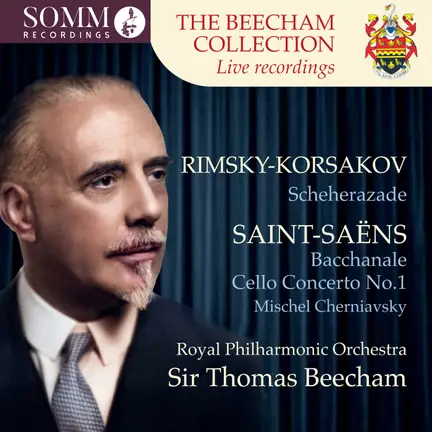
Sir Thomas Beecham conducts Rimsky Korsakov, Saint-Saëns – SOMM
Three mid-century concerts