Lynne Arriale, solo piano – Solo – Motéma MTM-83, 52:17 *****:
Pianist Lynne Arriale’s first solo album (titled simply Solo) is a long time coming and well worth the wait. Arriale spent 15 years working in a trio format and then recorded with two different quartets for 2009 and 2011 releases. Arriale explains in the liner notes for this 12-track, 52-minute solo sojourn the time was ripe for a solo venture and a singular type of challenge.
Erstwhile fans will notice three things. Ten of the tracks are new solo renditions of tunes Arriale previously performed with her trios or quartets, thus affording a sense of familiarity within a fresh framework. Secondly, Arriale returns once again to covering Thelonious Monk, one of her earliest and most lasting influences. And thirdly, melody is (as it always is) an essential part of each of Arriale’s pieces, where each lingering note, insinuating phrase and expressive line is beautifully rendered.
The material is split between seven Arriale originals, two Monk compositions, two Broadway standards (Cole Porter’s “What Is This Thing Called Love” and Lerner and Lowe’s “Wouldn’t It Be Loverly”) and a Billy Joel hit. The Monk translations are testaments to Arriale’s interpretive skills. She provides an introspective ambiance to “Evidence,” with finely stimulated and understated bop textures. This version does not swing like the one she did for her 2000 trio recording, Live at the Montreux Jazz Festival, but rather this puts a greater emphasis on Arriale’s graceful single-note lines. Arriale supplies a restrained stride and a reflective yet unpredictable assertion, which reaffirms Monk’s mixture of liberated surprise and elegant statements. She brings a similar sensibility to “Bye-Ya,” which was previously tackled on her 1997 trio imprint, A Long Road Home. The initial trio interpretation has a compelling percussive, rhythmic component due to contributions from bassist John Patitucci and drummer Steve Davis. Arriale does not abandon Monk’s supple rhythmic complexity, but for this solo rendition she concentrates on using her piano in a nearly orchestral way to articulate Monk’s intricate and explorative quality, while also slipping in a humorous undertone. Arriale mirrors Monk’s modernist ideas on her own “Yada, Yada, Yada” (from her 2009 quartet outing, Nuance: The Bennett Studio Sessions), which has an animated witty discourse highlighted by brisk chord runs and romping single notes.
Arriale also includes other cuts from A Long Road Home. “The Dove” has a meditative melody which eloquently echoes Arriale’s continual efforts to tell musical stories. Whereas the trio version uses bass and drums to accentuate the melody, here Arriale is impressive by recreating an impressionistic cadence with her left hand as she furnishes creative subtleties with her right hand. “The Dove” is an epitome of Arriale’s poetic perceptiveness. She states in her liner notes, “Like a writer looking for just the right word that will bring a phrase to life, I search for just the right notes and nuance of expression.” The lissome “Will O’ the Wisp” is also from A Long Road Home and is distinguished by Arriale’s refined keyboard cascades, where her harmonic dexterity comes to the fore. On Lerner and Lowe’s “Wouldn’t It Be Loverly,” Arriale retains the late-night feeling she earlier offered when she recorded this chestnut from the popular musical My Fair Lady. Arriale’s deeply-felt lyricism and sincere storytelling proficiency is at its apex in this open, blithe treatment, which tenderly replicates Eliza Doolittle’s wish for a better life.
Surprisingly, Arriale has never before presented Cole Porter’s standard, “What Is This Thing Called Love?,” which is practically an obligatory part of any jazz artist’s catalog and/or education. Here, Arriale executes the well-worn tune with a lively attitude which moves along with a limber drive within a post-bop setting. This is a first-rate example of how Arriale wields her significant technique as a tool for creativity, never for its own sake. Arriale has formerly undertaken contemporary pop material (Sting and The Beatles, for instance) and here she redoes Billy Joel’s despondent relationship ballad, “And So It Goes,” about Joel’s ill-fated and brief partnership with model Elle McPherson. Arriale preserves Joel’s bittersweet connotation, while heightening the piece’s hymn-like aspects with fluent fingering and haunting resonance.
TrackList:
La Noche; The Dove; Evidence; Wouldn’t It Be Loverly; Will O’ the Wisp; Yada, Yada, Yada; Arise; Dance; What Is This Thing Called Love; Sea and Sand; Bye-Ya; And So It Goes.
—Doug Simpson
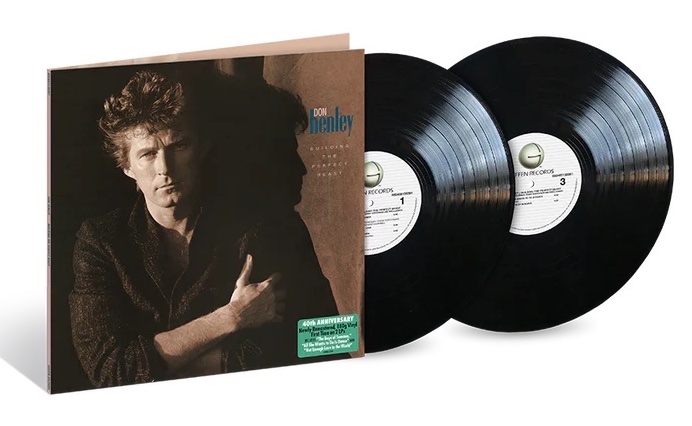
Don Henley – Building The Perfect Beast – Interscope Records
Interscope Records releases a vibrant re-mastered 180-gram double vinyl of Don Henley’s enduring solo album.