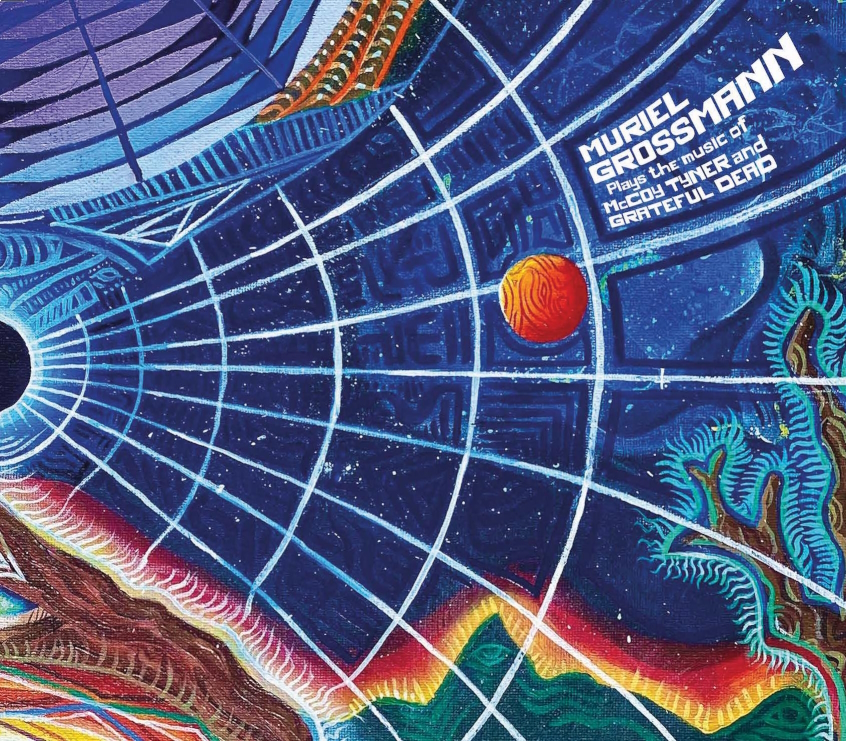
Something for Jazzheads and Deadheads.
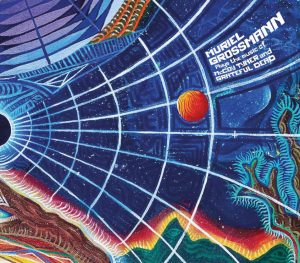
Muriel Grossmann – Plays the Music of McCoy Tyner and Grateful Dead – [TrackList follows] – Dreamland DR 19 CD; CD 1: 56:17; CD 2: 52:17 [12/29/25] ****:
(Muriel Grossmann – tenor saxophone, soprano saxophone (tracks 4, 8), harmonium (tracks 2, 4, 6, 8), tambura (tracks 4, 8), percussion (tracks 4, 8); Radomir Milojkovic – guitar; Abel Boquera – Hammond B3 organ; Uros Stamenkovic – drums)
Spain-based saxophonist Muriel Grossman (born in Paris, raised in Austria) combines seemingly disparate music into a one-of-a-kind spiritual jazz presentation on Plays the Music of McCoy Tyner and Grateful Dead, issued in late 2025. The title implies a tribute or homage but there’s more to it. Instead, Grossman – who shifts between tenor and soprano sax and also adds harmonium and tambura – showcases the underlying craft and creation which links the former John Coltrane sideman with the deans of San Francisco’s psychedelic music scene while producing music firmly her own. “We playead this music using a sort of filter,” Grossman explains, “so it sounds like when I compose, record, and perform our own music. It’s somebody else’s music, but it sounds like our music.” Grossmann’s quartet also includes electric guitarist Radomir Milojkovic, Hammond B3 organist Abel Boquera and drummer Uros Stamenkovic.
The album is available as a 2-disc CD (the second disc includes four bonus alternate takes), a limited edition two-sided LP, or a digital download which has all of the CD material. This review focuses on the CD and digital releases.
The opener is a nearly 15-minute rendition of Tyner’s “Walk Spirit, Talk Spirit” (from his live 1973 LP Enlightenment). Tyner’s 24-minute all-acoustic original had Azar Lawrence on sax, Juni Booth on bass, Tyner on piano and percussion, and Alphonse Mouzon on drums. It is a tour de force of tone and vigor, from subtle gradations to a fast-moving energy. Grossman excludes Tyner’s intimate introduction and goes straight into the groove spotlighted by a direct Hammond B3 organ bass line with some bluesy keyboard asides. Grossman equals Lawrence’s mood and style, which in turn was influenced by Coltrane. There is finessed back and forth between sax and guitar although the guitar seems a bit light in extemporization and somewhat rigid especially during Milojkovic’s solo.
“Contemplation” (see 1967’s The Real McCoy) is one of Tyner’s most covered compositions. His nine-minute original is both meditative and insistent and reflects on faith and one man’s introspective thoughts. It was previously done by Mal Waldron, Alvin Queen, Ronnie Scott and others. Grossman stretches her translation into a 15-minute transcendent commendation with a bluesier deportment, where her tenor sax glides and glistens while she limns Tyner’s search for inner meanings. There’s also an extended guitar and organ give-and-take which provides some soulful push and pull.
The Dead and jazz were adjacent to each other but perhaps not in ways overtly apparent. Dead guitarist Bob Weir – who passed away in early January 2026 – has cited Tyner and Coltrane as two of his major inspirations which can be heard during some of Weir’s rhythm guitar chordings.
There’s an identifiable groove to Grossman’s 14-minute adaptation of the Dead’s “The Music Never Stopped,” (found on 1975’s Blues for Allah) co-written by Weir and lyricist/poet John Perry Barlow. Grossman’s arrangement, particularly the multifaceted improvisational moments, bring to mind Weir’s iconoclastic guitar and Grossman’s soloing should remind Dead fans of Weir’s often unpredictable rhythmic process. Milojkovic and Boquera lock in solidly throughout the funkier portions and Milojkovic gets spatially psychedelic toward the conclusion.
It makes sense Grossmann chose to do “The Other One” since it furnishes space and room for improvisation. The song began life as “The Faster We Go, the Rounder We Get” (co-composed by Weir), part of the four-section suite “That’s It for the Other One” from 1968’s Anthem of the Sun, the second Dead studio effort. The tune eventually morphed into “The Other One,” a frequent live Dead concert highlight. On her rendering of “The Other One” Grossmann supplies a slightly dissonant soprano sax, then Milojkovic and Boquera take over with psychedelic and blues elaborations which rotate around each other, and Grossmann then steps forward again with some Coltrane-esque contortions. Listening to Grossman’s “The Other One” makes one wonder what Coltrane might have thought of the Dead’s spiraling psychedelia.
The four bonuses on the CD and digital albums offer some interesting tweaks and twists and are worth exploring to hear the differing details and choices.
—Doug Simpson
Muriel Grossmann – Plays the Music of McCoy Tyner and Grateful Dead
TrackList:
CD 1:
Walk Spirit Talk Spirit
Contemplation
The Music Never Stopped
The Other One
CD 2:
Walk Spirit, Talk Spirit (alt. take)
Contemplation (alt. take)
The Music Never Stopped (alt. take)
The Other One (alt. take)