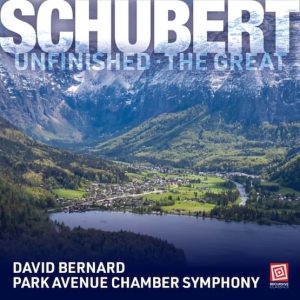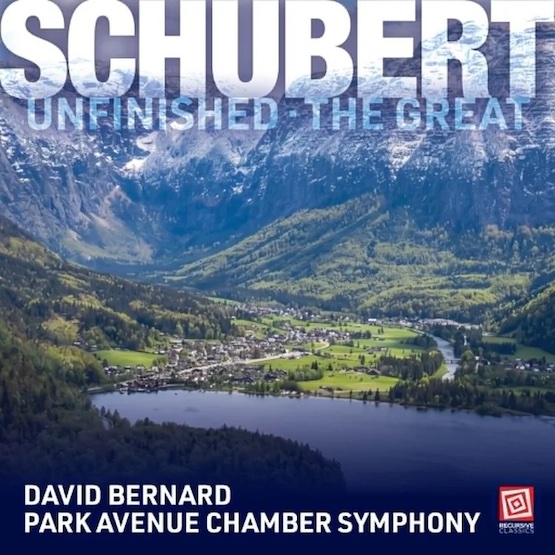
SCHUBERT: Symphony No. 8 in B Minor, D. 759 “Unfinished”; Symphony No. 9 in C Major, D. 944 “The Great” – Park Avenue Chamber Symphony/ David Bernard – Recursive Classics RC6758911 (76:27) [Distr. by Orchard/SONY] ****:
Conductor David Bernard has gleaned distinction for his Schubert interpretations, having earned prizes in the UK at a Schubert International Festival. Whether his current document of Schubert’s 1822 Unfinished Symphony will usurp in collectors’ minds those legendary renditions by Toscanini, Furtwaengler, Beecham, and my own favorite, Fritz Lehmann, will remain a matter of aesthetic tastes. Bernard’s trump card lies in his insistence on textural clarity, and his responsive Park Avenue ensemble delivers a performance of girth and dramatic presence.
For the first movement Allegro moderato 3/4, Bernard emphasizes the low, grumbling bass line, the strings shimmering as the first theme from oboe and clarinet haunts us. A long pedal takes us to the familiar G major melody, sung with a touch of rubato, justifying the claim that this work marks the “first Romantic symphony.” The tragic atmosphere becomes more pronounced when the trombones enter, instruments ordinarily associated with processional and funereal occasions. At moments, Bernard’s phrasing and nice intonations become precious, though he maintains the tension and takes the repeat.
The sudden intrusion by the horns and the urgency of the stabbing phrases invoke allusions to Beethoven, not the least of which are gambits from the Eroica Symphony. Bernard’s stretti enjoy power and incisive clarity, the progressing line taut to the extreme. Smooth execution of Schubert’s modulations for the recapitulation urges the mastery the composer exerted over his adjusted sonata form. The signature theme appears in a genial D major, almost bucolic and free from any sense of adversity. But the minor mode triumphs, the atmosphere having become almost of organ sonority, a resigned chorale.
The E major Andante con moto 3/8 evolves with two themes that prove a template for Johannes Brahms. Schubert will juxtapose the modes of C# to inject a bounteous pathos into the music, the combination of oboe and clarinet again central to the power of instrumental color. The dark hues in Bernard’s basses and horns over pizzicato strings provide a dialogue of anguished mystery. An elegiac march ensues, perhaps realized a bit too four-square for some tastes. The oboe leads us into a nervous A minor episode, answered by the clarinet and then a thunderous tutti. Depths of despair threaten to engulf the poignant atmosphere, but the graces of the initial E major provide succor. The coda’s menace of the march and its tympanic cadences suggest that the tragic muse has not abandoned us.
Much ink has been spilled on the etiology of Schubert’s Ninth Symphony of 1824, whose appearance in the concert hall had been much debated and much delayed. Here, we have potent precedents in the recorded performances of Toscanini, Boult, Mengelberg, Giulini, Kleiber, and Furtwaengler. The symphony as a whole serves as a template for Anton Bruckner, given its length and its melodic sense of discourse.
The forthright first movement annunciation of C major and its subsequent, bucolic harmonization enjoy a noble poise from Bernard, the antiphonal string and woodwind choirs relishing their colloquy. The long Andante introduction, a world unto itself, gives way to an energetic sonata form rife with cadential periods. Bernard’s French horns prove their worth in the course of the development. As in the Eighth Symphony, the trombone marks a rite of passage. A pervasive, chugging energy infiltrates the course of musical evolution, pregnant with fanfares and luxurious woodwind transitions. Buoyant and unmannered, the rendition may prove too literal for some tastes.
The second movement Andante con moto (in A minor) ranks among my preferred moments in the symphonic repertory. That Schubert will treat the latter section of the movement to an extended development becomes more grist for the Brahms mill. The basic impulse, martial in character, does not evince anger but resolve, even emanating moment of bucolic acceptance.
The secondary theme in F major (and A) generates a remarkable sense of bliss, especially when realized by the likes of Boult and Furtwaengler. Bernard’s approach remains literal, genial, poised, but somewhat pedestrian. His French horn, along with the complement of wind players, proves sonorously superb. The mode of A shifts to the major, and the march assumes more of a dance character. I wish the sforzatos and passing dissonances had more bite. Wonderful sonority from the orchestra’s violas and cellos, but set in a literal, direct tempo that avoids “personality.”
Willem Mengelberg made of the third movement Scherzo: Allegro vivace a study in orchestral control, of dynamics and ferocious discipline. Romantically eccentric to the core, Mengelberg’s rendition, but musically and dramatically thrilling. Bernard takes extreme delight in his woodwind section, and rightly so. The accuracy and buoyancy of phrase, the joie de vivre, proves infectious, perhaps Park Avenue’s most successful movement. The extensive development of this movement obviates any debts to the Classical age, and the central section, waltz impulses remind us that Schubert, as well as Weber, initiated and mastered the form.
Schubert’s obsession with musical and dramatic dualism pervades the last movement, dotted rhythm versus triplets, and an unrelenting sense of musical momentum. Bernard seizes the initial impulse by the throat and drives his concept forward. Busy strings and brass move us to the repetitive martial theme that never ceases to intensify in varying hues.
Clear polyphonic lines show off Schubert’s fertile harmonization, though the selective marcatos tend to retard some of the febrile impetus. When Bernard cuts the rope, his energies remind us of model Arturo Toscanini. The woodwind playing , loving in all respects, sells the performance for sheer musical veneration of its subject. Whatever of elusive mysticism may inhabit this volcanic movement, it dissipates in a frenzy of motivic fury at the coda, a C major blaze of glory.
—Gary Lemco