SCHUMANN: Manfred, Op. 115 – Sigrid Plundrich, soprano (Astarte) / Michelle Breedt, mezzo-soprano (Nemesis, Spirit) / Johannes Chum, tenor (Alpine Huntsman) / Florian Boesch, bass (Abbot) / Martin Schwab, narrator (Manfred) / Wiener Singverein / Tonkünstler-Orchester Niederösterrich / Bruno Weil – Preiser Records multichannel SACD PR 907888 (Distr. by Albany), 68:09 *****:
When I first heard Manfred on the radio many (many) years ago in Thomas Beecham’s classic English-language version, I thought the music was pretty compelling but that the text was strictly from hunger. I’ve since come to value Lord Byron’s echt-Byronic dramatic poem of 1816 somewhat more and Schumann’s music a bit less, but it’s undeniable that both are classic evocations of the Romantic antihero in the spirit of Goethe’s Faust. As with the opera Genoveva, the composer’s original inspiration produced a masterwork: the two overtures are among Schumann’s finest pieces for orchestra, the overture to Manfred perhaps his very finest. From the three off-beat chords that create an immediate air of restless uncertainty to the quiet yet unsettled final cadence, the Manfred Overture is a powerful musical portrait of the tortured hero and his unspeakable (and unspoken) crime.
Again, as with Genoveva, Schumann ran out of steam as he continued to work on his melodrama, and as a whole, Manfred is only fitfully effective, though it starts in strong fashion with the atmospheric Gesang der Geister (“Song of the Spirits”). Later in the work, Schumann takes a stab at the ranz de vaches (in German, Alpenkuhreigen, No. 4 in Schumann’s score), the Alpine cattle call that also takes a prominent place in the slow movement of Berlioz’s Symphonie fantastique. Like Berlioz, Schumann entrusts the melody to the English horn, and with the addition of jangling cowbells in this performance, the results are charming. The piece flows almost seamlessly into the light-of-foot, equally charming entr’acte (No. 5) that follows. However, apart from the Overture, the most imposing piece is No. 7, Hymnus Geister Arimans, scored for full orchestra and chorus, with crashing cymbals, skirling piccolo, and stentorian brass. On the other hand, the final scene represents one of Schumann’s unexpected missteps. For a composer so attuned to literature, Schumann sometimes misinterprets his source entirely, and so here. The chorus intones a brief requiem for the departed Manfred, who has died rejecting the Abbot’s plea to pray for forgiveness. A requiem for an unregenerate soul: Byron, dead himself for almost thirty years, was not around to offer his opinion on Schumann’s finale, but I doubt it would have been charitable.
From a literary standpoint, the best way to approach Schumann’s work is to read Byron’s original, especially if all you have at hand is Preiser’s booklet, which presents the text in German only—the 1839 translation by Karl Suckow that Schumann used as his source, along with spoken text supplied by musicologist Christian Lackner, who also wrote the notes to this recording. If your German is as rudimentary as mine, you can always skip over the lengthy narration and cut to the musical numbers or just let the narration fade into a lulling background noise. Whatever your choice, you will encounter the problems that Manfred faces in performance and thus come to understand why it’s never heard in concert, at least on this side of the Atlantic. Then again, for these very reasons, Manfred is the perfect work to listen to on recording: you can savor the best of Schumann’s music while choosing how to approach the lengthy narrative bits.
I confess my approach is to let them fade into the background, and thus I can’t offer informed criticism on narrator Martin Schwab’s performance. However, I can say that Bruno Weil and his forces turn in a mostly riveting performance of the purely musical numbers and musical snippets that accompany the melodrama. I’ve admired Weil’s performances of Haydn’s symphonies and choral music and Schubert’s masses; this is the first excursion into the Romantic repertoire that I’ve heard from him. But he’s clearly on Schumann’s wavelength, bringing a sense of deep drama to the great overture and a largeness of conception to Hymnus Geister Arimans, as well as a charming intimacy to the more tender moments in Schumann’s score.
I compared Weil’s recording to a rival by Michael Schønwandt with the Berlin Symphony Orchestra on the Danish Kontrapunkt label and found that both versions do full justice to Schumann’s score. One conductor may achieve better results in this or that number, but overall, there is little to choose between these two compelling versions. (Strangely, Schønwandt repeats the overture at the end of his performance of the score, giving dubious added value to his CD.) Where Weil’s version scores definitively is in Preiser’s truly exceptional live SACD recording. The sense of stage depth and spaciousness are immediately apparent and only grow in impressiveness as voices are added to the mix. This is one of the most successful live recordings I’ve heard; in fact, it’s one of the most successful SACD recordings I’ve heard, period. If you want to hear Schumann’s score in the original German, Weil’s version is now the one to turn to.
–Lee Passarella
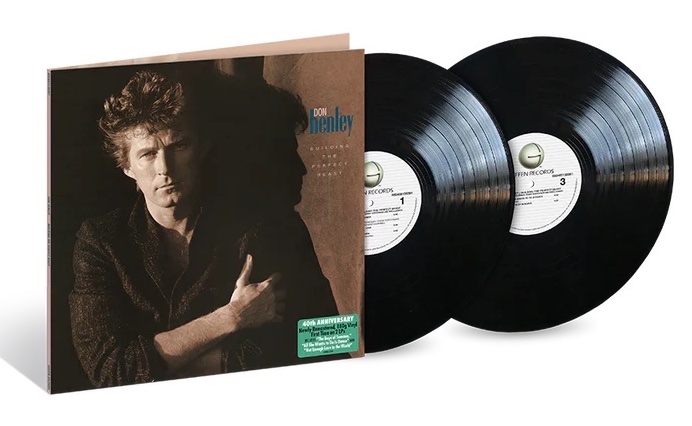
Don Henley – Building The Perfect Beast – Interscope Records
Interscope Records releases a vibrant re-mastered 180-gram double vinyl of Don Henley’s enduring solo album.