SIBELIUS: Symphony No. 5 in E-flat Major, Op. 82; Symphony No. 6 in D Minor, Op. 104 – London Symphony Orchestra / Colin Davis – LSO Live multichannel SACD LSO0537, 56:50 [Distr. by Harmonia mundi] ****1/2:
This is the kind of recording that critics like to respond to with the wise observation that so-and-so’s interpretation hasn’t changed substantially over the years. And there’s more than a grain of truth in the observation: major conductors, like us mere mortals, don’t want to mess with success. If I recall correctly, Davis’s interpretation of Sibelius’s monumental Fifth Symphony is not tremendously different from the one he recorded, again with the LSO, in the 1990s for RCA. Most critics (though there’s always the odd, rabid one out to prove the decline of Western civilization as evinced by “needless” recording projects) agree that Davis’s interpretation did not undergo a substantial change from the earlier and universally acclaimed one he mounted with the Boston Symphony Orchestra for Philips in the 1970s (or was it the 80s?). So it is with these new inscriptions featuring the LSO. Davis has certainly not mellowed with age. Davis’s Fifth is just as dynamic and craggy as his earlier RCA version. If anything, there is more impulsiveness in the accelerando close of the first movement and in the nervous opening of the third; perhaps we can chalk it up to the fact that this is the only live recording among the three.
Whereas Sibelius’s first two symphonies are prime examples of musical nationalism, in the later symphonies, it’s almost as if Sibelius abandons an extrovert form of nationalism for a more intimate, interior one. If the earlier works chart the spirit of the Finnish people, starting with the strange, unsettling Fourth, the symphonies increasingly chart Sibelius’s own spiritual journey—the journey of a Finnish Everyman rather than that of a whole people. Sibelius still explores the vast forests and fields of his Scandinavian homeland; the Fifth contains some of Sibelius’s mightiest nature painting. But as Sibelius revealed in his diary, nature suggested to him a darker theme swathed though it was in beauty: “Today at ten I saw 16 swans. One of my greatest experiences! Lord God, what beauty! . . . Their calls the same woodland type as that of cranes. . . . A low refrain reminiscent of a small child crying. Nature mysticism and life’s Angst! The Fifth Symphony’s finale-theme: Legato in the trumpets!”
An odd conflation of the two, mysticism and angst, as if they coexist in all nature, including human nature, as suggested in Sibelius’s reference to the child crying. As Stephen Johnson writes in his notes to the recording, there seems to be a contest between beauty and angst in the finale as the movement slows and the magnificent “swan theme” dissolves into grinding dissonances and minor-key utterances, finally to be replaced by those triumphant trumpet strains of Sibelius’s diary entry.
Davis reveals the magic in these last pages of the finale, for me perfectly capturing the conflicting ideas in Sibelius’s conception. There is an organic unity, an inevitability in this performance that makes for a powerful listening experience.
After the grand gestures of the Fifth, the Sixth must have come as something of a surprise, even a letdown, to Sibelius’s admirers. Even today it’s perhaps the least popular of the seven. For me, the symphony has more than its fair share of empty passages, where Sibelius seems to be spinning his wheels, bridging the gap to the next bright symphonic idea that might come to him. Yet the hushed radiance of the opening pages and the calm, hymnic strains that frame the agitated Allegro molto of the finale make their own special statement that finds expanded utterance in Sibelius’s life-affirming final symphony.
Davis is equally attuned to the quiet dignity of the Sixth as to the joyful noise of the Fifth, making his recording an evocative study in contrasts. This is a lovely performance, with especially alert playing from the LSO in the dancing Allegro molto. The famously dry sonics of the Barbican, as in the other installment I’ve heard in the series—Symphonies 1 and 4—is for me a plus, giving an added immediacy to the proceedings. Other listeners may prefer warmer sonics (as in Neeme Jarvi’s recording with the Gothenburg Symphony on BIS), but I’m happy with the sound, as I am with Davis’s bold conception and execution of the scores.
— Lee Passarella
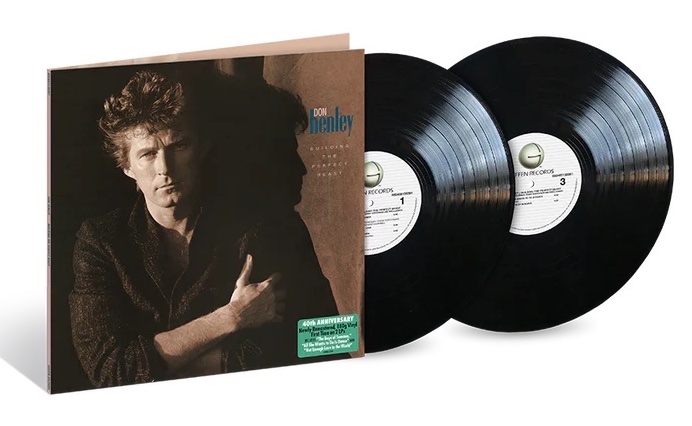
Don Henley – Building The Perfect Beast – Interscope Records
Interscope Records releases a vibrant re-mastered 180-gram double vinyl of Don Henley’s enduring solo album.