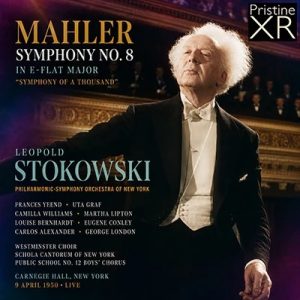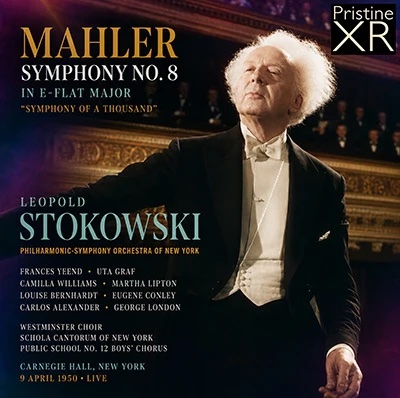
MAHLER: Symphony No. 8 in E-flat Major “Symphony of a Thousand” – Philharmonic-Symphony of New York/ Leopold Stokowski – Pristine Audio PASC 775 (77:50, complete credits detailed below) [www.pristineclassical.com] *****:
In the summer of 1906, Mahler wrote: “Try to imagine the whole universe beginning to ring and resound. They are no longer human voices, but planets and suns revolving.” The cosmic ambitions of Mahler’s musical imagination took the shape of his Eighth Symphony, conceived at a particularly trying time in his life: he would, in 1907, resign from his post as director of the Vienna Court Opera; his eldest daughter Maria Anna had died; he had been diagnosed with a possibly fatal heart condition; and he would, in 1910, become painfully aware of his wife’s affair with architect Walter Gropius.
The Symphony Number Eight aims to transcend such human frailty and finitude by invoking the power of creative thought: a fusion of oratorio, choral symphony, and dramatic-literary transmogrification appealing to a Divine Intellect. A solipsistic celebration of Mahler’s superior erudition or a spiritual addendum to Beethoven’s Ninth Symphony? A medieval Latin (Pentecost) hymn collaborates with Part II of Goethe’s Faust to reify “the eternal feminine,” the genetic essence of the ontological and aesthetic creative process. For all of the tumult in their relationship, for good and evil, Mahler dedicated this awesome work to “Mater gloriosa” Alma Mahler, since Goethe himself had once written, “From my great pains I make my little songs.”
Leopold Stokowski (1882-1977) bore a personal sense of attachment to this mighty score: Stokowski had attended Mahler’s own Munich premiere in 1910 and conducted the American premiere in Philadelphia six years later, giving this performance an unusually direct link to the work’s early history; he had no less programmed the work in his early tenure in Cincinnati, resulting in costs and controversy that led to the Maestro’s departure. In April 1950, Stokowski brought the work to Carnegie Hall and to the New York Philharmonic Orchestra, and so the resultant recording survives as among the earliest documents of the work in its entirety.
Mahler’s design calls for two “Parts,” the ninth century Pentacostal hymn and the second part of Goethe’s Faust, whose invocation of the “eternal feminine” in the “Chorus mysticus” concludes Liszt’s Faust-symphonie. The apparent non sequitur of association perhaps lies in Goethe’s remark in “Maxims and Reflections,” linking the hymn to the aesthetic of genius, that Veni Creator Spiritus appeals to the essence of genius. The huge Part I of Mahler’s work involves a grand sonata form, a development section marked by a double fugue, recapitulaton and coda. The dramatic context from Goethe’s monumental poem about ceaseless striving for knowledge consists of an Andante, Scherzo, Finale and the Chorus Mysticus. Mahler economically links the two parts via motifs that appear in the Part I, achieving an apotheosis in the orchestral postlude, a vision of other-wordly splendor.
A giant E-flat chord erupts with Stokowski’s leading the hymn, Veni, creator spiritus,” and the explosion transition to the soloists in meditation upon the immanence of celestial glory. The two sections devoted to the conceit Infirma nostri corporis beg the strength to endure earthly trials. Manichean in its sense of spiritual dualism, the hymn pits the forces of light against imminent darkness. Ascende lumen sensibus proffers as a double fugue a paroxysm of light, meant to dispel and vanquish the enemies of salvation. Qui Paracletus diceris, donum Dei altissimi, “Ye who are called the Comforter, gift of God most high,” literally strains the tessitura of the singers, the musical imagination barely competent to realize the exaltation of the moment. The collision of mortal and immortal energies finds agonized, ecstatic resolution in children’s voices at the coda, for “a child shall lead them.” The audience responds as if this had been the work’s finale.
A lyrical orchestral interlude, alternately calm and grieved, Poco adagio and Più mosso – Allegro moderato precedes the Andante proper at “Waldung, sie schwankt haren” and the song of the anchorites. Guarded, mysterious, the music appeals to Nature as a pantheistic incarnation of the sacred space, the temenos, of the Divine Spirit. George London’s Pater Profundis expounds on the “rocky ledges,” “abysses” and “foaming torrents” that prefigure the awesome power of Love to “cleanse and ameliorate” the contradictions of the human heart. Childen’s voices – the Angels – proclaim that “the Noble member of the spiritual world” is redeemed.
At the entry of the Younger Angels, the soul of the sinful Faust travels upward, the conquest of the lures of Mephistopheles. The ethereal character of the Philharmonic woodwinds intones a shimmering ascent. But the taint of the earthly life lingers, and the More Perfect Angels solemnly remind us of the mixture of pleasure and pain in the struggle of matter and spirit, as Stokowski negotiates polyphonic stretti that test the very acoustical limits of the Hall. Here lies the heart of Mahler’s persistent tension, and it resonates in an aura of the Fortunate Fall.
Camilla Williams appears as the Mater Gloriosa, who soars in the highest registers, signaling in majestic light the ultimate transition to the Transcendent, as embodied the Philharmonic string sections. Stokowski then addresses the transfiguration of Gretchen in the Faust legend – the Penitent Women – formerly known as Magna Peccatrix, Mulier Samaritana, and Maria Aegyptiaca, collectively intercede for Gretchen’s soul, who in turn pleads for Faust. Here, the human drama supersedes the celestial pose, and Stokowski imbues the moments with a generous poise and intimacy.
The advent of the final “Chorus Mysticus” enters delicately, as it does in Liszt’s account —a whispered Alles Vergängliche ist nur ein Gleichnis (All that is transitory is but a simile). Stokowski must execute a gradual crescendo whose breadth virtually stands alone in the symphonic repertory. The bridge between the timely and the timeless has been traversed, and the Philharmonic brass section sounds forth a stunning affirmation in the original, tonic E-flat of the “Eternal Feminine,” a cadence that Wagner, too, would have imbued with infinite inevitability. This 1950 musical context, soon upon the aftermath of the first Atomic Bomb blasts that ended WW II, suggests a spasm of optimism for Humanity, a moment of glory amidst the “century of death,” as Mahler termed it. Mahler had asserted that the symphony genre itself must embrace the universe, Nietzsche’s Amor fati, forward and backwards, that the Love of Life defines the heroic and creative impulse. Whether Mahler successfully balanced his proportions of ratio and eros remains for posterity to judge, but Stokowski and his dedicated ensemble deliver an aesthetic verdict of rare, ennobled power.
–Gary Lemco
Stokowski conducts Mahler: Symphony No. 8 in E-flat Major “Symphony of a Thousand”
Frances Yeend/
Uta Graf/
Camilla Williams/
Martha Lipton/
Louise Bernhardt/
Eugene Conley/
Carlos Alexander/
George London/
Westminster Choir/
Schola Cantorum of New York/
Public School No. 12 Boys’ Choir/
Philharmonic-Symphony of New York/