Van Kempen conducts BEETHOVEN: The Creatures of Prometheus: Overture and Ballet Music No. 8; Symphony No. 2 in D Major, Op. 36; Symphony No. 5 in C Minor, Op. 65- Dresden Philharmonic Orchestra/ Paul van Kempen – Pristine Audio PASC 327, 79:16 [avail. in various formats at www.pristine classical.com] ****:
Producer and restoration engineer Mark Obert-Thorn has assembled three Beethoven studio sessions of Paul van Kempen (1893-1955), 1940-1941, taken from the German Polydor label. Kempen, a conductor raised in the heroic tradition of Willem Mengelberg and his Concertgebouw Orchestra of Amsterdam, became noted for his deft attention to orchestral detail, complemented by a cultivated sense of musical architecture. His readings of the Tchaikovsky Fifth and Capriccio Italien on the Philips label, along with his natural affinity for the music of Brahms, Bruckner, and Mahler, sustain Kempen’s reputation. Beethoven collectors have long treasured his concerto cycle with pianist Wilhelm Kempff, and his Brahms B-flat Concerto with Adrian Aeschbacher maintains a kind of cult status for cognoscenti.
The opening excerpts from Beethoven’s ballet, The Creatures of Prometheus (rec. 7 July 1941) conveys a rugged, virile energy, especially in the ballet music, in which brass, tympani, and strings achieve some mighty harmonies in brisk motion. Curious, that Beethoven’s Symphony No. 2 elicited several German inscriptions from this fertile period in recording history: we have two potent readings from Fritz Lehmann and Paul van Kempen, to name but a pair. Kempen (April 1940) takes his cue from Mengelberg, but his approach bears fewer 19th Century atavistic practices in regard to tempo, phrasing, and rhythmic license. The broad cello line in the opening Adagio molto possesses singing energy and a dramatic sense of the figures as they move to fulfillment in the Allegro con brio. The latter section literally explodes with whistling excitement, the strings, woodwinds, and tympani in colossal motion, fervent and convinced of their collective mission.
The A Major Larghetto has reigned as the heart of this symphony, which Berlioz well admired. Kempen molds its delicate phrases in legato strings and hymnal winds with loving care, the phrases breathed in dramatically poised periods. The sustained pedal points achieve a muscular girth quite anticipatory of the Fifth Symphony, which shares honors in this fine restoration. A slight ritard or marcato infiltrates the tempo of the Scherzo, played for rustic lyricism rather than rough-house athletics. The tips of the violin bows bespeaks volumes about niceties of lithe articulation. Equally suave bassoon and French horn work in the Trio. The 2/2 Allegro molto rather hustles forward, yet it refuses to relinquish the naturally lyric buoyancy Kempen has established just by the minutest of rhythmic restraints. The influence of late Mozart, especially his K. 543, emerges at key points. The exquisite balances Kempen elicits from his excited, virtuoso forces might well have been attributed to the equally classical tradition in the music-making of the more famous contemporaries Eugen Jochum and Erich Kleiber.
The Beethoven Fifth (7 July 1941), from the same session as the Prometheus, announces its forward drive from the outset of the Allegro con brio, Kempen’s not opting for a halting sense of “profundity.” That Kempen raised the Dresden Philharmonic’s level of execution to stellar status has been long granted and finds ample testimony here. The textural alignments of differing masses of sound becomes a dramatic conflict as compelling as the organization and permutations of the ground-motif itself. The inevitability of the peroration rivals anything in the Germans’ conducting catalogue of the period, from Furtwaengler to Abendroth.
The A-flat Major Andante con moto receives a broad treatment from Kempen, its double-theme and subsequent variants eventually allowing the four-note motif in the bass to exalt the suspensions to heroic proportions. The Dresden cello line sings elegantly, the triplet arpeggios in the violas luxurious. The woodwinds reassert their aerial transparency before the brass and tympani, in march like procession, move the music into heraldry. Kempen underplays the graduated crescendos as the music moves to a poised, eminently noble conclusion. The melodic impulse dominates even the militant Allegro third movement, the interior counterpoint’s moving at a brisk, articulate pace. The diaphanous pizzicati pursue their ineluctable course to the transition to the timpani and string crescendo to the jubilant C Major finale. How many seeds of the Seventh Symphony already burst forth in the lusty throes of the Fifth! Brilliant rocket figures from the Dresden string and wind choirs reaffirm the tempestuous bravura of Kempen’s performance, perhaps unheralded in its own time, but now released with the quality of the sonic splendor its vision demands.
—Gary Lemco
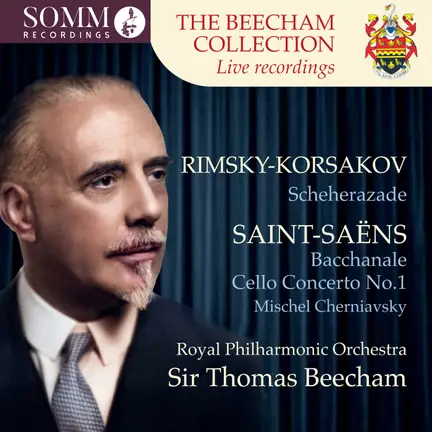
Sir Thomas Beecham conducts Rimsky Korsakov, Saint-Saëns – SOMM
Three mid-century concerts