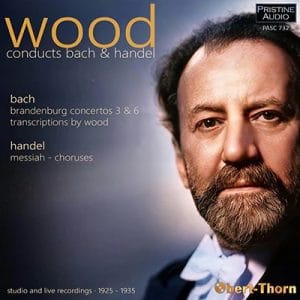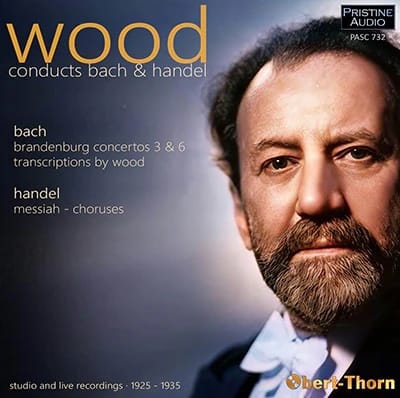
Henry Wood conducts Bach & Handel – Brandenburg Concertos Nos. 3 & 6, Orchestra Suite No. 6, Toccata and Fugue in D Minor; Handel’s Messiah (excerpts) – Pristine PASC 732 (76:20, complete contents detailed below) ****:
Recall well that the year 2025 marks the centennial of the birth of electrical recordings, an acoustical triumph over the horn-process that had dominated the art of musical preservation, with its obvious limits in timbre and dynamics. Conductor Henry J. Wood (1869-1944) was quick to adapt to the new and improved process: after having already worked with Columbia since 1915, he would remain with the label until 1934 and then sign on with the newer Decca label until 1938, when he returned to the Columbia organization. Like Stokowski, Wood had trained as an organist, and he brought the sense of organ timbre and diapason to the performances of his own transcriptions of Bach. In the realm of contemporary music, Wood gave serious consideration to the likes of Elgar, Delius, Bridge, Schoenberg, Bartok, Mahler, and Hindemith, many performances of which included British premieres. Wood seems to have cultivated in himself aspects of both the modernist style, as from Weingartner and Toscanini, and remnants of 19th Century, romantic license. For example, in the 16 June 1932 transcription (by both Wilhelmj and Wood) of the Air from the Orchestral Suite in D, we hear an old-world realization, rife with portamento, set in the transposed key of C!
The two Bach Brandenburg Concertos with Wood – 12 June 1932 and 12 June 1930, respectively – move briskly and firmly, with clear interior, polyphonic voicings, almost a forecast of what Trevor Pinnock would seem to have patented two generations hence. The G Major Concerto appears cut of one, muscular cloth, a fixated sense of moto perpetuo, with only the briefest of string chords for the Adagio. The 6th Concerto, that in B-flat Major, exhibits the same, breathlessly precise discipline in the string lines, the momentum in the opening Allegro perhaps so uncompromising that the “tragic” effect we glean from say, Koussevitzky’s reading, becomes sacrificed.
The so-called Suite No. 6 for Orchestra (rec. 5 February 1925) derives from Wood’s selection of solo violin and klavier pieces by Bach, beginning with the Prelude in C# Major from WTC I. Restoration Engineer and liner-notes commentator Mark Obert-Thorn points out that Mahler added to the Bach canon of orchestral suites by similarly compiling a suite from the B Minor and D Major Suites.
The most immediate effect of the 1926 item lies in its sound, rooted in the pre-electrical medium. The “Lament” from the keyboard piece, Departure of His Beloved Brother, exhibits the thin, tinny sonority in the winds and horns that often alienate my listening experience of old shellacs. The “Scherzo” from the piano Partita No. 3 in A Minor virtually explodes in reaction to the lugubrious Lament. The somber, pesant version of the “Gavotte & Musette” from English Suite No. 6 in D Minor projects a British stolidity to the occasion. The ensuing “Andante mistico” presents an orchestral version of Prelude No. 22 in B-flat Minor from WTC I, here played in the form of wind band. The “Finale” consists of a full ensemble’s rendition of the “Preludio” from the Violin Partita No. 3 in E, which Koussevitzky immortalized on record with the Boston Symphony string alone. Wood’s pedal effects in the low woodwinds and timpani prove dramatic in a way that might earn the epithet “camp.” On another hand, the same Bach “Preludio,” recorded 19 June 1929 (as Track 15) at virtually the same tempo, enjoys the sonorous potency of the electrical system.
Besides two small pieces – a pomposo “Gavotte” from Violin Partita No. 3 (16 June 1932) and the aforementioned “Air” – the Bach arrangements conclude with Wood’s orchestration of the ubiquitous Toccata and Fugue in D Minor (2 May 1935), a rather playful approach that savors in fast succession the antiphonal choirs of the Queen’s Hall Orchestra. The presence of the harp and cymbals makes for a most colorful sense of the music’s grandiose (Lisztian) assault on transcendence.
Wood and his Festival Choir and Orchestra recorded (12 June 1926) nine sides of Handel’s Messiah, of which six were issued. Slow tempos, sudden dropouts, and asymmetrical balances mark these serious, lofty excerpts from the early days of the electrical recording process. The diction remains muddy, despite our knowing the words. As Obert-Thorn well remarks, the Handel selections “document a lost era of Handel choral performance.” Given the labor of love involved in all aspects of this release, not the least of which lie in pitch adjustments of the originals, we welcome the Henry Wood Handel onto our historic-performance record shelves.
—Gary Lemco
Wood conducts Bach & Handel =
BACH:
Brandenburg Concerto No. 3 in G Major, BWV 1048;
Gavotte from Partita No. 3 in E;
Air from Suite No. 3 in D;
British Symphony Orchestra
Brandenburg Concerto No. 6 in B-flat Major, BWV 1051;
Symphony Orchestra
Suite No. 6 for Orchestra (arr. Wood);
Preludio from Partita No. 3 in E;
New Queen’s Hall Orchestra
Toccata and Fugue in D Minor. BWV 565 (arr. Wood);
Queen’s Hall Orchestra
HANDEL:
Messiah: “And the glory of the Lord”; “Behold the Lamb of God”; “He trusted in God that He would deliver him”; “Life up your heads, O ye gates”; “Let us break their bonds asunder”
Handel Festival Choir and Orchestra