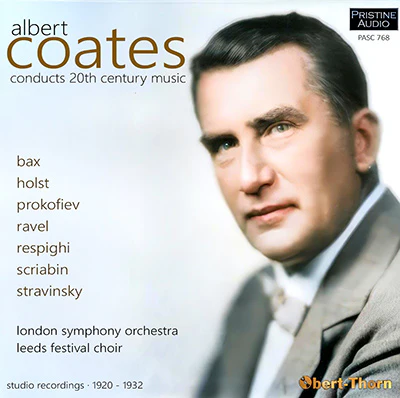
Albert Coates = WAGNER: Eine Faust Overture; Overture to Die Feen; LISZT: Les Preludes; BORODIN: Overture to Prince Igor; March to Prince Igor; Yaroslavna’s Aria from Prince Igor; Polovtsian Dances from Prince Igor; RIMSKY-KORSAKOV: Capriccio espagnole, Op. 34; MUSSORGSKY: Dance of the Persian Slaves from Khovantschina – Vera de Villers, mezzo-soprano/London Symphony Orchestra/Albert Coates
Historic-Recordings PAGCD 00021, 77:40 [www.historic-recordings.co.uk] ****:
The British conductor Albert Coates (1882-1953), along with Sir Thomas Beecham, embodied the finest Wagner tradition in England. At the same time, Coates had a natural affinity for the Russians, and to them he brought an immense energy borne of his huge physical presence and the essential elan vital of his intellectual sympathies. This disc offers us some rare electrical inscriptions, 1926-1935, all transferred by Terry Dobree of Pagodes Records, 2008. The primeval grumblings in the Faust Overture (1928) reveal strong allusions to Tristan, while Wagner’s early opera The Fairies (Die Feen, rec. 1932) leans more to the Franco-Italian origins of his pre-Germanic style. That Nikisch had been a major influence on Coates’s own musical pedagogy becomes powerfully obvious in vitality and clarity of the musical lines.
The 1928 Liszt Symphonic Poem No. 3 Les Preludes suffers a few unobtrusive cuts, but its muscular style rivals the Mengelberg version in sinew and heraldic pomp. Stylistically, one might compare the Coates frisson with the performances by Oskar Fried, also demonized and neurotically driven in ways that disturb and arrest at once. With the advent of Borodin’s Prince Igor on his disc, we enter into a stylized occasion for ceremony and gaudy grandeur. The Overture (1926) proceeds with a heavy tread at first, but the trumpets’ entry opens a molten virile world. The March (1932) from Act III paces and cavorts in pride and whimsy, alternately. Mme. De Villers intones in Russian (1935). The Polovtsian Dances (1927) with chorus in English moves perhaps too quickly for some tastes, but the idiomatic finesse cannot be denied.
I appreciate the Coates insistence on liquid virtuosity from his LSO for Capriccio espagnole (1929), but the few cuts in the edition make us wish Coates had taken it up again in the LP medium. Still, the rhythmic nuance, the colors, the innately Spanish electricity communicate a world of canny expertise from this master of many idioms. So, too, the final cut, Mussorgsky’s Dance of the Persian Slaves (1930)–even more extended than Stokowski’s venerated RCA LP version–blends exoticism and languorous melody. Too often unsung, Coates here receives a taste of the documentation his massive musical range demands, and we might hope his Mozart Jupiter Symphony, uncut, will emerge in the CD medium.
–Gary Lemco