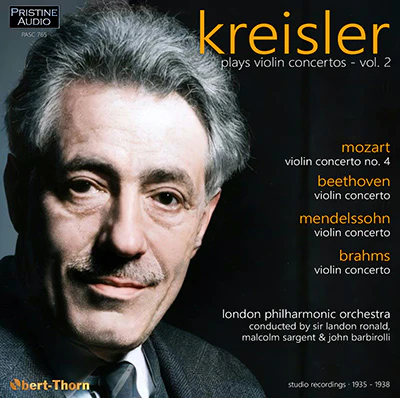
KREISLER plays Violin Concertos, Vol. 2 – Concertos by Mozart, Beethoven, Mendelssohn, Brahms – Pristine Audio PASC 765 (2 CDs = 2 hrs 14:48, detailed contents listed below) [www.pristineclassical.com] *****
Austrian violinist Fritz Kreisler (1875-1962) chose to re-record selected concertos in his repertory in order to take advantage of the improved electronic medium of the HMV studios in the 1930s. Though his early pedagogy embraced a Belgian tradition, Kreisler refined a decidedly Viennese approach to his music-making, founded on the performance style of Henri Wieniawski. Kreisler favored a showy, dramatic flair that emphasized large chords, virtuoso bowing techniques, double-stop and triple-stop fingering with tremolos and portamentos applied, delicate harmonics and pizzicatos, and always a fervent melodic line that urged his captivating, “liquid” tone. In the annals of great violin playing, perhaps Menuhin and Shumsky come closest to the pleading effect of Kreisler’s tone.
I began my audition of Mark Obert-Thorn’s meticulous transfers with the Mendelssohn Concerto (8 April 1935) with Landon Ronald. I find the performance compelling, if a bit mannered, in that Kreisler likes to underline every breathed phrase with a sighing effect, a product of his constant vibrato and emphasis on portamento. The gait remains leisurely, noble, ardently romantic, especially in the broad expressivity of the Andante movement. The innate charm and sincerity of Kreisler’s musical demeanor remain solid, despite the occasional nervousness of intonation. The sheer airiness of the last movement, its delicately brisk articulation, makes us admire the musician whose ease of phrase and sense of line require more study.
The Brahms Concerto, led by John Barbirolli (12 & 22 June 1936), enjoys a potent orchestral introduction from Barbirolli, whose career would soon take a fateful turn to New York to succeed Toscanini with the New York Philharmonic Orchestra. Kreisler openly admired Barbirolli, praising him as among the finest of accompanists. Kreisler’s projects a whiplash entry for the Allegro ma non troppo, rather gypsy in style, but rounding off in a delicate trill to a sweetly warm cantabile. Even the lengthy, parlando filigree enjoys a songful ease of motion until the arrival of the big melody over orchestral pizzicatos, intoned by Kreisler with burnished rapture. Kreisler’s aggressive attacks for the entry of the secondary episode heralds Barbirolli’s fanfare response, an ardent sense of the heroic line. That Kreisler can achieve a clean, chaste line no less finds occasional testimony in his quick adjustments of register and bow pressure. Having Kreisler perform his own, distinguished cadenza – as he does in the other two concertos – adds to the grandeur of the occasion.
The virtuosity of the London Philharmonic – itself the creation of the adventurous Sir Thomas Beecham – has a notable representative in oboe principal Leon Goossens, who does honor to the intimately persuasive Adagio. The last movement, the gypsy rondo, opens with an animal thrust that vibrates with feral passion. Kreisler applies a rasping effect and rapid strokes that border between staccato and spiccato effects, inspiring Barbirolli to exult in the occasion. The pace of the movement remains brisk, ardent without bathos or forced sentimentality. The momentum catches divine fire, and we should wonder with Lady Macbeth, who knew the old man had so much blood in him?
The Mozart D Major Concerto with Malcolm Sargent (11 February 1938) stands as Kreisler’s final, European commercial recording with orchestra. Like many violin soloists, Kreisler felt drawn to Mozart’s 1775 Concerto in D, with its French taste and courtly balances, capped by a “Strassburg” bagpipe melody that graces the last movement rondeau. The opening movement, Allegro, enjoys both ceremonial pomp and the luxuries of a serenade or cassation – given the elegance of the LPO woodwinds – with violin obbligato. Kreisler’s tone and technical fluency more than suggests why the Viotti Concerto No. 22 remained dear to his heart. A gracious, light hand guides the music to several dazzling displays of subtle, musical shifts in rhythm and inflection, suave and genial. The burnished sheen from Kreisler in this and all cadenzas warrant the price of admission.
The Andante cantabile second movement, though entirely lovely in execution, moves at a largo or adagio tempo, typical of virtually every performance I know, except that by Jiri Novak and Vaclav Talich. Richly lyrical and intimate as the performance by Kreisler realizes, the effect remains antiquated, but happily in the grand style. The last movement, Andante grazioso – Allegro ma non troppo, proffers a graceful, stately dance consisting of two themes, the second of which proves more animated. Kreisler plies his lowest string to invoke the hurdy-gurdy nostalgia of rural Austria or Italy. The leisurely canter concludes in a reprise of the animated version of the dance, intensified by a blaze of harmonious assistance from Maestro Sargent.
Fritz Kreisler had recorded the Beethoven Concerto in D in 1926 with Leo Blech and the Berlin state Opera Orchestra, a rendition some commentors find more classically controlled than the present version with John Barbirolli (16 and 22 June and 17 July 1936). The visceral, passionate impulse in the Barbirolli reading of the first movement Allegro ma non troppo, however, tends to support whatever tempo (rubato) decisions Kreisler may have imposed upon the linear progression of the concerto. The arioso passages in Beethoven sing with elegant grace, and Kreisler’s trill work maintains its diaphanous luster. Kreisler sustains his long line with taut control, segueing (via floating trills) to the marcato episodes with no loss of warm tension. The rapt sincerity of expression proves ubiquitous, and Barbirolli appears moved to gripping vehemence in his responses in the tutti sequences. As Richard Wagner points out in his 1870 essay on Beethoven, each musical element has become melody, testified to ultimately by the Fifth Symphony, where rhythm and melody become indistinguishable. It takes a discerning ear to catch the momentary finger slip in the contrapuntal cadenza, and to what end does one claim it? The coda provides the very soul of aesthetic closure, after some masterful playing has been accorded us.
A grand leisure suffuses the wonderful Larghetto second movement, a theme and variations in which Kreisler and the LPO woodwinds collaborate on an exalted level. Kreisler’s flute tone accompanies the LPO bassoon – and soon with pizzicato strings – in tender colloquy that springs from Orpheus himself. Another of Kreisler’s improvisatory cadenzas leads to the main impulse of the Rondo: Allegro, exerted with robust energy from both participants, with Kreiser’s demonstrating finesse in the various bowings at cadences required to add color to the warmly plastic proceedings. Barbirolli hustles to the suspended cadence for Kreisler’s final cadenza, a brilliant coloratura piece in itself that insists on elasticity of a sustained line. The hushed tones Barbirolli elicits from his ensemble gradually explode into what friend Richard Wagner called “the apotheosis of the dance,” the phrase I hereby transpose for my own, respectful purposes.
—Gary Lemco
KREISLER plays Violin Concertos, Vol. 2 (1935-38)
1MOZART: Violin Concerto No. 4 in D Major, K. 218;
2BEETHOVEN: Violin Concerto in D Major, Op. 61;
3MENDELSSOHN: Violin Concerto in E Minor, Op. 64;
2BRAHMS: Violin Concerto in D Major, Op. 77 – Fritz Kreisler, violin/
1London Philharmonic Orchestra cond. Malcolm Sargent/
2London Philharmonic Orchestra cond. John Barbirirolli/
3London Philharmonic Orchestra cond. Sir Landon Ronald
.