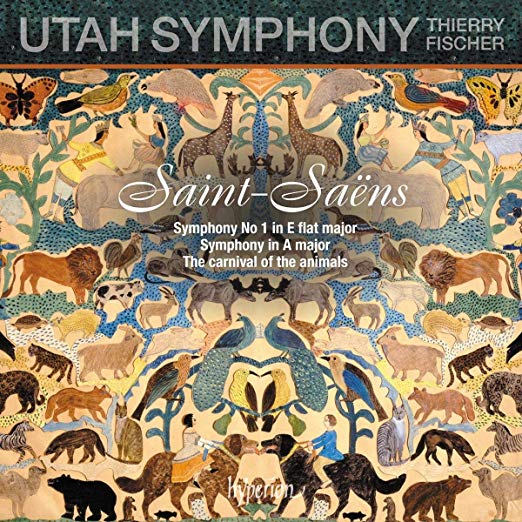
SAINT-SAENS: Symphony No. 1 in E-flat Major, Op. 2; The Carnival of the Animals; Symphony in A Major – Utah Symphony Orchestra/ Thierry Fischer – Hyperion CDA68223, 82:05 (11/29/19) [Distr. by Harmonia mundi/PIAS] ****:
Thierry Fisher extend his survey of the Saint-Saens symphonic ouevre with two, major, youthful works, the 1850 Symphony in A Major and his “official” Opus 2, the Symphony No. 1 in E-flat Major of 1853. A product of his studies with Charles Gounod – likely the first master of the French symphony – Saint-Saens reveals in his Op. 2 (rec. 23-24 February 2018) a distinct gift for harmonization and orchestral color, along with his naturally opulent melodic sweetness. The orchestra, large for the time, asserts any number of color combinations, the result of having been scored for four horns, three trombones, four harps, two tubas, and cymbals. Saint-Saens restrains the heavy brass for his final movement, but the first three enjoy an array of color ensemble that swells and swaggers in martial, dotted rhythms and a melodic contour based on a falling fourth. The most appealing movement, for rhythmic verve and folkish melody, comes in the form of the Marche-Scherzo. The 9/8 Adagio movement has its own seductions, including a lovely, harmonized melodic curve buttressed by the Gounod touch of flowing harp arpeggios. The end of the movement strikes up a hint Strauss or Waldteufel waltz. At first touted as an “anonymous” work, the symphony had the publisher’s urging its “German” authorship, testified to by the last movement – Allegro maestoso – penchant for fugal development. The initial, militant sensibility has returned, but now the brass section asserts a regal authority, rife with fanfare and processional flourishes.
The A Major Symphony (1850), composed at the tender age of fifteen, urges the influences of Weber and Schubert, if not Mendelssohn and Beethoven. Saint-Saens credited the relatively unknown Henri Reber (1807-1880) as an important mentor in his musical studies, an atavistic personality who delighted in Mozart and Haydn. The slow Poco adagio having passed, the main melody bears quite the similarity to the opening foray in Mozart’s “Jupiter” C Major Symphony. Saint-Saens telescopes his exposition, preferring to extend the return to the main materials, a la Beethoven. The Larghetto may recall the serene mood of the Beethoven D Major Symphony’s respective movement. The episodes between the three occurrences of the main theme project a decidedly Beethoven sensibility. Thee transparency of the Utah woodwind section benefits from the marvelous sound image, courtesy of Tim Handley (rec. 3 March 2018). An admirer of Mendelssohn’s incidental music for A Midsummer Night’s Dream, Saint-Saens artfully imitates the fleet, diaphanous flutter in his woodwind figures – flute, and oboe – along with strings, in a bucolic mood. The brief stretti and transitional pedal points easily recall Beethoven’s hand. The Finale: Allegro molto – Presto definitely acknowledges Mendelssohn’s handiwork, and perhaps the young Schubert. The Utah tympanist (George Brown) makes his presence well known. The quicksilver string playing – marked leggiero staccato – merely forecasts the dervishness of the Presto coda, at which the entire Utah ensemble .must adhere to the virtuoso demands made by the teenaged composer with a world of color at his disposal.
The Carnival of the Animals (1886; pub. 1922) has its curious etiology in the composer’s trip to Austria for a holiday, in order to create a cello work – Le cygne – for virtuoso Charles Joseph Lebouc. On playful impulse, Saint-Saens evolved the Grande fantaisie zoologique (rec, 8-9 December 2017) but suppressed the 13 movements other than the approved The Swan. For thirty years the charming foray into musical comedy, if not theater, lay in wait until one year after Saint-Saens’ death. Rife with allusions to popular melodies of Offenbach, Berlioz, and Rossini, the piece inhabits its own ecological space, clever in parody and orchesrtral finesse. Two pianos – Jason Hardink and Kimi Kawashima – create their own effects in the Kangaroos, Aquarium, Cuckoo, and Pianists and Final, as well provide an aqueous solution upon which The Swan (Pegsoon Whang) may float proudly. The long-eared creatures invoked by piercing strings could be short-sighted music critics. The stratosphere of the Aviary comes to us via piccolo Mercedes Smith. The chains and manacles of musical scales bind the Pianists in percussive captivity. Not immune to self-parody, Fossils entombs Danse macabre and folk bits of music, including Rossini. The grand Final passes our cavalcade zoological in review, each an energetic projection of that most fertile of wildernesses, the composer’s imagination.
—Gary Lemco