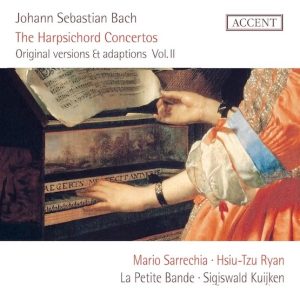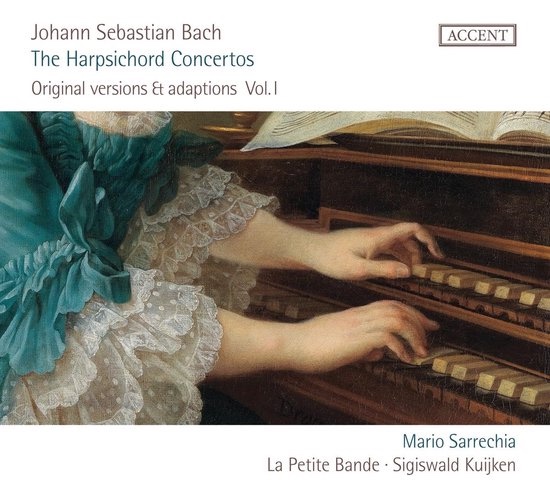
J.S. BACH: the Harpsichord Concertos, Vol. II = Harpsichord Concerto in D Minor, BWV 1052; Harpsichord Concerto in F Minor, BWV 1056; Violin Concerto in E Major, BWV 1042; Harpsichord Concerto in G Minor, BWV 1058 – Mario Sarrechia, harpsichord/ Hsiu-Tzu Ryan, harpsichord/ Sigiswald Kuijken, violin/ La Petite Bande – Accent ACC 24417 (64:31) (3/6/26) [Distr. by Alliance Entertainment] ****:
Recorded 13-16 July 2025, this set represents the second of a triptych devoted to Bach’s surviving harpsichord concertos, conceived around 1738, much in the manner of Antonio Vivaldi, whose Lombardic rhythms manage to infiltrate the Bach outer movements. Bach often arranged earlier compositions – whether they be sinfonias, chorales, and cantatas – in either full transcriptions or selected excerpts as appropriate for instrumental expression. My own model for authentic and original versions of Bach was Austrian violinist Edward Melkus (b. 1928) and his ensemble Capella Academica Wien, who, after WW II, recorded some 200 baroque works, featuring the wire E-string rather than that made of gut. Brussels-born Sigiswald Kuijken (b. 1944) devoted himself to the baroque violin and the “authentic” style in 1969, resting his instrument under the collarbone. His sound, especially nasal, lends itself to the dry clarity he wishes to project, with limited or absent vibrato.
The expansive Concerto No. 1 in D Minor relies on Bach’s Cantata 146 for its melodic-dramatic content, and it has had exponents on the grand piano as diverse as Edwin Fischer., Sviatoslav Richter, and Glenn Gould. Mario Sarrechia infuses motor propulsion and ornamental flourishes generously, the ripieno strings layered and sonorous. The harpsichord soon emerges from the texture with a solemn gravitas. The G minor Adagio, also from Cantata No. 146, projects a thoughtful, lamenting moment of dark contemplation in tripping, marcato figures. The passing, sighing dissonances project an eerie hue, over which the harpsichord offers a recitative-arioso. Elaborate and serious, the last movement Allegro owes its said energies to Cantata 188’s sinfonia. Kuijken does manage some virile hustle in the tempo, though few will ever compete with Glenn Gould and Dimitri Mitropoulos in Amsterdam.
One of my enduring memories of a realization of Bach’s F Minor Concerto derives from Grant Johannesen’s appearance at the Atlanta Symphony concerts. The second movement Adagio, in A-flat, clearly a transmutation of an oboe concerto, had in its poignant intimacy, my thinking of my idol in this music at the time, Edwin Fischer. “Isn’t that curious,” offered Johannesen at our intermission meeting, “I was thinking precisely of Edwin Fischer while I played.” Hsiu-Tzu Ryan does the honors in the solo part here, limpidly thoughtful, lyrically affectionate. Rich ornamentation marks the last movement, Presto, a bit slow for my taste but resolute and athletic.
Bach’s Violin Concerto in E Major has been a concert staple for me ever since I first encountered it via Giaconda da Vito and Rafael Kubelik. Hearing the sparkling work with the great Leonid Kogan and Dimitri Mitropoulos did me no harm. Sigiswald Kuijken leads the ensemble from his solo part, strict baroque tradition. Tempos remain brisk, the articulation clean, the passing grace-notes generous in nasal sonority. The piece had been originally set for harpsichord, 1717-1723, and then recast. Bright in color, it represents a rare violin concerto in E major – except for the ubiquitous Vivaldi – and we don’t see one again until Paganini’s (recently uncovered) Third Concerto. The Adagio in C# minor bears a haunted, melancholy temper, its opening ground bass seeming to imply a chaconne concept over which the solo violin muses nostalgically. The spirit of the dance invests the last movement, Allegro assai, a joyful, confident rondo that invites variants from Kuijken.
Bach arranged his own Violin Concerto in A Minor, BWV 1041 as a harpsichord concerto, now in G minor. The solo part for BWV 1058 has expanded, the string part transposed down a whole tone. In a staid 2/4 time, the opening Allegro proceeds in a variation of antiphonal voices between the concertino solo and the ripieno ensemble. The Italianate second movement, Andante in B-fat major enjoys the lyrical, highly ornamental color of the solo harpsichord – once more the gifted Mario Sarrechia – in a pattern of short notes in the solo against long notes from the strings. The last movement Allegro assai, set in a contrapuntally scored 9/8, moves in the spirit of a rustic jig, almost a stomping dance in boisterous polyphony. The music moves so effortlessly, we have hardly savored its charms when it becomes time to rehear it.
—Gary Lemco