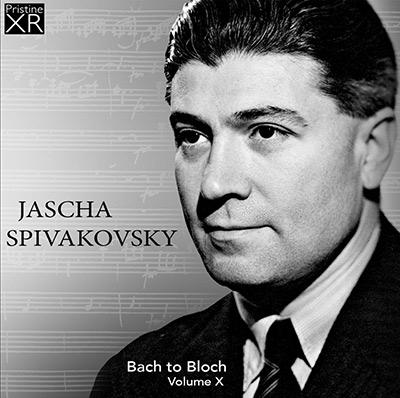
Jascha Spivakovsky, Vol. X = MOZART: Piano Concerto No. 23 in A Major, K. 488; BEETHOVEN: Piano Concerto No. 4 in G Major, Op. 58; CHOPIN: Nocturne in F-sharp Major, Op. 15, No. 2; LISZT: Liebestraum No. 3 in A-flat – Jascha Spivakovsky, piano/ San Francisco Symphony Orchestra/ Pierre Monteux/ BBC Northern Orchestra/ Stanford Robinson (Beethoven) – Pristine Audio PASC 579, 57:59 [www.pristineclassical.com] ****:
This striking addition to the ongoing, Spivakovsky recorded legacy – almost entirely due to the efforts of Mark Ainley and producer Andrew Rose of Pristine Audio – presents Spivakovsky in two concertos and in his one appearance (19 November 1927) before the studio microphones for Parlophone in Berlin for two pressings, which originally did not pass the artist’s muster. The somewhat questionable habit of the San Francisco Symphony’s Standard Hour broadcasts of having guest artists perform selected movements from concertos (here, 6 April 1952) finds justification in the sterling sound image Spivakovsky and Monteux achieve in the Mozart Concerto in A Major, whose second movement Adagio (in the relative F-sharp minor) conveys a tragic wisdom for the ages. The melodic line extends in carefully modulated, breathed phrases that retain their tautness and their eminently vocal character. We immediately wish that Monteux had dedicated more of his commercial work with RCA to Mozart, but we may still be thankful for his one collaboration in Concerto No. 18 with Lili Kraus. The last movement of the Mozart, Allegro, wishes to impart surprise as well as brilliance, given Spivakovsky’s fluid and transparent runs, trills, and sudden ff bursts of exalted verve, supplemented by Monteux’s own rhythmic injections that manage to stay within the means of his gifted soloist. The sense of collaborative response between Spivakovsky and the San Francisco ensemble generates a palpable, emotional velocity that occurs when real musical magic reigns.
Listening to Spivakovsky’s opening, solo foray for the 1808 Beethoven Piano Concerto No. 4 in G Major 28 January 1956) and the ensuing potency of the orchestral tutti in response, we find it inconceivable that for several generations – until the advent of Artur Schnabel – the work bore the epithet “the ladies’ concerto” for its alleged delicacies. Nothing effete marks this sturdy collaboration between Spivakovsky and conductor Robinson, which, despite some distant sonics, projects a dramatic fluency in the first movement that would indeed qualify as the “softer” version of elements in the Fifth Symphony. Robinson seems to have instructed his BBC wind players to focus their open-work directly towards the keyboard for the full benefit of Beethoven’s lyrical impulses. Dramatically speaking, the transition to the recapitulation occurs with a potent sense of aesthetic closure. The singularly vocal character of the score and its present realization confirm my own estimate of the G Major as the most excellent of the five Beethoven concertos, even in spite of herculean moments in concertos three and five. The piano tone for Spivakovsky’s whirlwind cadenza has a bit of hollow reverberation, but the lyricism of his upper register shines in pearly play, and his trill has the same strong flexibility as anything in Serkin.
The marvelously modulated Andante con moto proceeds as a graduated dialogue of stress and reconciliation, once more allowing the Spivakovsky trill to beguile our senses, proceeding runs that diminish in intensity to a soft E minor that transitions to the suspensions prior to C Major and the last movement, the Rondo: Vivace. Here, the fundamental bravura of which Beethoven remains a master asserts itself but interrupted by lyrical digressions that assume a music-box clarity from Spivakovsky’s keyboard. The almost mystical tension between Apollinian and Dionysian energies finds that happy balance in the sheer self-possession of all participants, and the waves of Beethoven’s harmony prove as intimately convincing as does his thundering among the stars.
The Chopin Nocturne in F-sharp Major presents us with languid, drooping figures that sigh wistfully in the manner of the Bellini bel canto. A pregnant pause from Spivakovsky invites the doppio movimento drama in dotted figures that suddenly breaks off into ornamental filigree from the original motif. The easy rubato Spivakovsky imbues into his polished song well hints at what other wonders his solo Chopin contains. In the Liszt love-song, Spivakovsky pays close attention to the harmonic-rhythm, underlining his modulations with subtle shifts in the beat. Spivakovsky lamented to narrow frequency range of the Parlophone shellacs, but here from Pristine the vibrancy of his color palette quite shimmers. The natural melodic lines of both Chopin and Liszt works never wavers, as though each were cut of a seamless, magical cloth. A rare treat in every sense, this disc.
—Gary Lemco