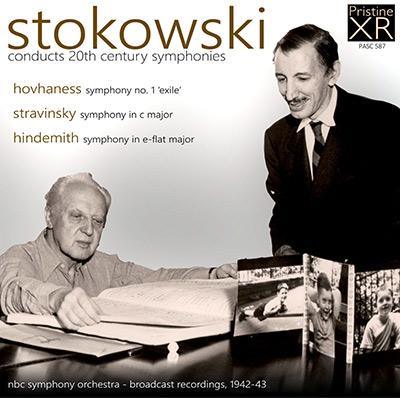
Stokowski conducts 20th Century Symphonies = HOVHANESS: Symphony No. 1, Op. 17 “Exile”;
STRAVINSKY: Symphony in C; HINDEMITH: Symphony in E-flat – NBC Symphony/ Leopold Stokowski – Pristine Audio PASC 587, 76:42 [www.pristineclassical.com] ****:
Leopold Stokowski enjoyed a satisfying working relationship with Armenian-American composer Alan Hovhaness (1911-2000), and the apocryphal story Hovhaness tells attributes the opus number for the popular Symphony No. 2 “Mysterious Mountain,” Op. 132, derives from a Stokowski whim. The Hovhaness style appealed to Stokowski, with its Eastern influences – like Armenian Gagaku, troubadour music – choral episodes, exotic orchestral textures, ostinato figures, and heroic gestures in winds and brass. The 1936 Symphony No. 1, the “Exile” Symphony, captures the martyred spirit of those Armenians exiled and then murdered c. 1916 by the Ottoman Turks. Stokowski and the NBC Symphony Orchestra deliver the premiere American performance 6 December 1942, especially significant because Hovhaness revised the work in 1970 with a new second movement, making this document unique in preserving the composer’s first version.
The opening movement, “Lament,” carries a series of chants over a plucked ostinato, rather delicate, but soon invaded by more sinister elements. The latter half speeds up considerably, the strings having become quite intense and frenetic, with stentorian punctations in tympani and brass. A solo oboe emerges, soon joined by clarinet and harp and bassoon, and the initial atmosphere of exotic tension resumes. The relatively brief second movement, “Conflict,” would later be replaced with one entitled “Grazioso.” Here, the music assumes a potent, declamatory quality, answered by the flute and clarinet in a manner reminiscent of Shostakovich, but more intricately scored. The last movement, “Triumph,” opens ominously with both clarinet and tympani, interrupted by pungent brass that Stravinsky could claim as his own. Winds and harp extend the idea of Eastern glamour, dramatic and insistent. A wild dance erupts in fugal form, soon transformed into a hymn and played against its opening riff. The chorale proper seems a distillation of Mendelssohn and Smetana, cross-fertilized by Ippolitov-Ivanov. The string entry of the theme, mixed with winds, has a vaguely British character. This motif, too, proceeds in a fluid and plastic manner. The opening motive shares elements (B-C-G) from Beethoven’s Fifth, in rhythm and repeated eighth notes. Stravinsky likes to raise the key of the theme by a tone, from C to D. The constant harmonic tension – traversals into G minor and E-flat minor – avoids any clear preference for the major or minor mode in C. This NBC radio premiere (21 February 1943) projects lusty energy, a brazen interjection of competing effects. The second movement, Larghetto concertante, allows the NBC winds – especially the oboe and flute – to play against a solo string quartet in what might be construed as ariosos. An agitated, passionate middle section, heavy in the cellos, basses and brass, interrupts the wind reverie, only to return in conciliatory gestures, to the opening motifs.
Stravinsky conceived his Symphony in C (1940) at a particularly trying point in his life, if not in the life of the world at large. The work fell into two halves, given the composer’s flight from Europe to America, and its first half might be construed as relatively conservative and neo-Classical, while the last two movements indulge in more aggressive, risky metric energies. If Beethoven serves as a model, so do the works Pulcinella and Mavra for harmonization and texture. The chorale proper seems a distillation of Mendelssohn and Smetana, cross-fertilized by Ippolitov-Ivanov. The string entry of the theme, mixed with winds, has a vaguely British character. This motif, too, proceeds in a fluid and plastic manner. The opening motive shares elements (B-C-G) from Beethoven’s Fifth, in rhythm and repeated eighth notes. Stravinsky likes to raise the key of the theme by a tone, from C to D. The constant harmonic tension – traversals into G minor and E-flat minor – avoids any clear preference for the major or minor mode in C. This NBC radio premiere (21 February 1943) projects lusty energy, a brazen interjection of competing effects. The second movement, Larghetto concertante, allows the NBC winds – especially the oboe and flute – to play against a solo string quartet in what might be construed as ariosos. An agitated, passionate middle section, heavy in the cellos, basses and brass, interrupts the wind reverie, only to return in conciliatory gestures, to the opening motifs.
The Allegretto follows, easily reminiscent of the Stravinsky of his jazzy post-WW I energies, with a buzzing, edgy scherzando, with tricky, nervous agogic accents and repeated riffs. A busy movement, we can appreciate Stokowski’s preparation in keeping the ensemble moving, however manic. The Trio section slows down, only to yield to a modified version of the “A” section, whose coda features a trumpet solo. The last movement, Largo, Tempo giusto, alla breve, has two low bassoons slowly making fun of Tchaikovsky; then the tempo picks up considerably, abetted in its mischief with the B-C-G from the first movement in raucous parody of Beethoven. Even the slow opening recurs, then a muscular fugato, with grudging nods to Classical procedure. With a series of brash, resounding C Major chords, we might be witness to an honest echo of Beethoven, but Stravinsky adds an extended, misty coda that at moments sounds like Sibelius. Long, muted chords hint at something significant, but it plays as if Stokowski were intoning, Quo vadis, Domine?

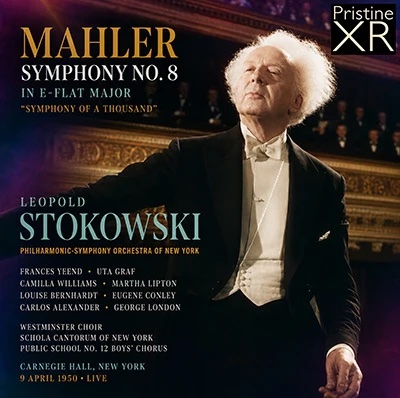
Leopold Stowkowski
Carnegie Hall, 1947
Dimitri Mitropoulos premiered Paul Hindemith’s Symphony in E-flat in Minneapolis on 21 November 1941, not long after the composer had fled the dubious amenities of the Nazi regime. The obvious militancy of the first movement, Sehr lebhaft, finds a rare moment of relief, but the angry polyphony and dark coloring might serve for 1950s film noir, like scores from Alex North or David Buttolph. Under Stokowski (28 February 1943), the latter development of the music seems even less compromising in its outbursts. The Sehr langsam proffers an uneasy and haunted melos, rich in the colors of the low strings.
The NBC oboe brings some “rural” consolation, but we remember how Virgil Thomson characterizes Hindemith as the least of ‘landscape’ composers. Hindemith consistently lacks melodic inspiration, but he compensates with a mammoth sense of personal force. The NBC woodwinds engage in some tender dialogue over plucked and then heavy strings as the music rises to a dread declaration of will.
The third movement, Lebhaft, injects another accelerated blend of color energies, some of which resemble William Schuman. The music seems to invite a vision of chaos and calamity, finally relenting with that same, bucolic oboe and responses from horn, clarinet, strings, and flute. The wind colors and swirling strings for a moment taste of Bartok. Then, the ferocity returns, clashing, warring, insisting. Is this Hindemith’s answer to the Shostakovich 7th? The last movement, Massig schnelle Halbe, revels in heavy, punctuated outbursts and brassy effects. A kind of Roman march emerges, soon treated in counterpoint, as is Hindemith’s (classical) wont. A new section, light and over bassoon pedal. Returns to the twittering, angular irony we associate with Bartok. But dense forces dominate; and despite the polyphony, the mood barely lightens, and its martial procession might raise an admiring nod from Miklos Rosza. The last moments accede momentarily to the darkness of the strings, moody and sad; but their presence must yield to the ineluctable march of time, events, fate, and the composer’s grim will to power.
—Gary Lemco