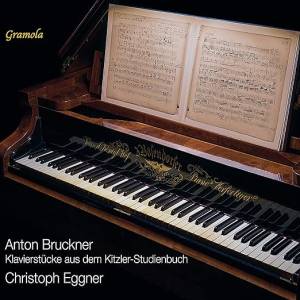
BRUCKNER: Klavierstücke aus dem Kitzler-Studienbuch Christoph Eggner, piano – Gramola Records 99282 (56:48) (11/30/22) [Distr. By Naxos] ***
Pianist Christoph Eggner (b. 1972), born in the village of St. Florian and having graduated from the Bruckner Conservatory in Linz, 1990, would properly claim responsibility for this enterprise, a resurrection of Anton Bruckner’s keyboard workbook, 1861 through 1863, comprised of 163 pages of autograph sketches, commentaries, and completed and partial constructs, all in the service of a tuition in musical formatting and instrumentation. The 24 entries gathered here embrace musical form: exercises on the keyboard to serve as possible orchestral pieces and larger forms, such as Bruckner’s Overture in g andthe early Symphony in f. Eggner plays a restored Bösendorfer fortepiano once owned by the composer that adds an exotic, intimate luster to the occasion.
The title of the collection derives from Bruckner’s private studies with Linz theater director Otto Kitzler (1834-1915) in 1862. Ever insecure in his own talents, Bruckner at first took lessons with Simon Sechter while serving as cathedral organist in Linz, then moving on to studies with Kitzler, who introduced Bruckner to the scores of Berlioz, Liszt, and Wagner. Kitzler himself involved himself as a Kapellmeister, mounting Wagner operas for the Linz stage. Kitzler’s authoritarian demands had Bruckner’s writing complete pieces and not mere fragments or practice exercises. The works embrace the Austrian salon tastes of the period predisposed to Schubert’s style, even while serving a didactic function for advanced piano students. The chronological order reflects the degree of Bruckner’s desire for mastery, and difficulty in accommodating the transition from one-movement dance forms, often in four-bar or eight-bar lengths, to the prospects of large compositions found at the end of the book, the G Minor Sonata and String Quartet in C Minor. As the pieces become extended into eight and sixteen bar lengths, they also graft on middle sections or trios to form ternary pieces and dances of some charm.
The opening Etude in G enjoys a lyrical character whose challenge lies in smooth execution of arpeggios under a theme that could pass as something from Mendelssohn. The Chromatic Etude in F rather overtly imitates Chopin’s alternating hands, though on a simpler level. The four-square bass part would fatigue us if it went any further. The two waltzes convey a rustic energy without much audacity harmonically. The Etude in C opens aggressively but dies an early death. Bruckner likely had to read Beethoven for his model in rondo form, and his own two, relatively broad, examples conform to the classic, palindrome pattern: A-B-A-C-A-B-A. The reprises of the main theme are granted a degree of variation. The more serious Andante in E♭ proves ambitious in the manner of Haydn, with a minor key middle section of intense, color interest. Of the two marches, in C and d, respectively, only the latter escapes the potent influence of the venerated Wagner and suggests Schubert’s martial style.
The most expansive work in this collation, Theme and Variations in G, demonstrates more variety in the shape and mood of originally four-square, melodic lines, utilizing parallel harmony, syncopations, counterpoint, and minor key modulation that manages to color the final, fifth variant, a sprightly dance. As opposed to this large canvas, many of the small pieces, the Duo in a, Mazurka in a, Theme in F, Polka in C, and Minuet in C last barely one minute, almost akin to bagatelles in Beethoven or to the briefest of Schubert’s ländler.
Eggner proffers four of Bruckner’s fantasies, somewhat alarmingly different textures that strike us as having been informed zby W.F. Bach, in color, drama, and effect. Their melodic style and harmonic adventurousness adumbrate the symphonic works that lay ahead, still tinted by Schubertian principles but expansive in their “periodic” sense of musical progression. The last of these, Fantasia in F, evolves a yearning sensibility that might owe debts to Schumann. Despite the dedication invested into this enterprise, the album serves more a musicological audience than one devoted to love of the composer’s more famous orchestral and choral works.
—Gary Lemco
Christoph Eggner, Piano
Bruckner’s Klavierstücke aus dem Kitzler-Studienbuch
Etude in G.
Waltz in C.
Chromatic Etude.
Waltz in E♭.
Etude in C.
Rondo in G No. 1.
Andante in E♭.
March in C.
Duet in a.
Andante in d.
Minuet with Trio in G.
Galop in C.
Mazurka in a.
Theme in F.
March in d.
Rondo in G No. 2.
Musical Periods in C.
Theme and Variations in G.
Polka in C.
Fantasy No. 1 in d.
Fantasy No. 2 in c.
Fantasy No. 3 in E♭.
Fantasy No. 4 in F.
Minuet in C