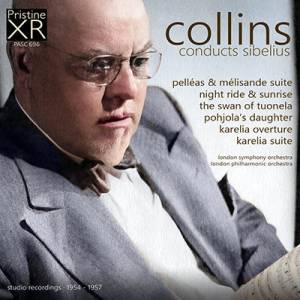
Collins conducts Sibelius – Symphonic Poems and Karelia Music [complete contents below] – London Philharmonic, London Symphony Orchestra – Pristine Audio PASC 696 (73:22) [www.pristineclassical.com] ****:
British conductor Anthony Collins (1893-1963) gleaned repute for his being the second conductor to record a complete Sibelius symphony cycle, the first to be done outside of Scandinavia. Pristine Producer and Engineer Andrew Rose has selected from among the LSO and LPO recordings Collins made with Decca and EMI of the shorter Sibelius tone poems and suites to create a sturdy compendium that augments the symphony cycle already available on the label.
Collins opens with the Sibelius 1906 symphonic poem Pohjola’s Daughter, based on an episode from the Finnish national epic, Kalevala, in which the great bard, Väinämöinen, attempts to convince “the maiden of the North Farm” to join him on his sleigh journey. But the lovely maiden sets Väinämöinen a series of labors that he can only partially complete, and so must go on alone. The performance from Collins and the LSO (from 5-6 May 1954) generates a fierce, muscular energy, considerable competition for the rendition on Sony from Leonard Bernstein in New York. The LSO brass, particularly, benefit both from the Decca “ffrr” miking process and the XR remastering from Pristine.
The etiology of the Sibelius tone poem Night Ride and Sunrise (1908) remains uncertain, although Sibelius provided two alternative accounts: the first concerns a journey he made to Rome, Italy, in 1901. The other is a slight ride Sibelius made from Helsinki to Kerava, during which he witnessed a spectacular sunrise. The Collins reading (2-3 June 1955) pre-dates the more famous account by British conductor Sir Adrian Boult and the LPO in 1956. The work reveals the transitions in modal syntax Sibelius had begun to experiment with, in which woodwind and brass dissonances mix with hymn or chorale motifs to produce a unique depiction of the Northern climes and sensibility.
Like Fauré and Schoenberg, Sibelius found the 1892 play, Pelléas et Mélisande by Maurice Maeterlinck attractive, eventually setting his 1905 score in nine episodes as a suite. Collins begins with No. 2, “Mélisande,” which features a lovely melody from the English horn and surrounding strings and winds. The ensuing “Pastorale” (No. 6) extends the idyll. “Mélisande at the Spinning Wheel” (No. 7) conveys a much darker picture than the excerpt created by Fauré, here imbued with a disturbed sense of fate. The No. 8, “Entr’acte,” throbs, Allegro, with bucolic energy, a rustic dance quite capable of gaining girth and power. “The Death of Mélisande” (No. 9) concludes the tale of doomed love, scored in the manner of somber chamber music and performed with utmost sympathy by Collins and the London Symphony. The work from the strings and timpani proves memorable.
The Karelia Overture of 1893 was written for the Vilpuri Student Association as part of a series of orchestral tableaux to celebrate Karelia, source of much Finnish folklore and myth. The piece anticipates motifs from the subsequent Karelia Suite, Op. 11. The orchestral sheen of Collins’ performance (2-3 June 1955) overwhelms us, easily competitive with renditions from Eugene Ormandy and Alexander Gibson. The sensibilities of grandeur and pageantry resound in palpable, vivid colors.
Collins recorded the two remaining selections with the LPO between 11 and 13 September 1957. The Karelia Suite’s three parts project a healthy, stalwart energy and lyricism, as required. The “Intermezzo” has never had a more manic performance than that of the classic reading by Robert Kajanus, but Collins sets a poised, regal pace. The second movement “Ballade” first caught my ear from Hans Rosbaud, since Sir Thomas Beecham recorded only the first and last sections. This reading from Collins seems to be the music’s debut on records. Principally written for strings, it has some dark hues thrown in as the stately procession achieves lyrical grandeur. The most familiar section, Alla marcia, has enjoyed a long, fruitful life on record, and Collins invests the required pomp and circumstance to the occasion. The brass and battery of the LPO each benefits from the Decca recording process, projected in Technicolor.
The last item, the ubiquitous 1895 The Swan of Tuonela, has the gifted Leonard Brain at the English horn to persuade us of the allure of Sibelius’ death song, played over a reverberant timpani, and later, with a resplendent harp part. The nuanced, dynamic control exerted by Collins produces a singular, intensely compelling narrative, worth the price of admission, as are the Pelléas excerpts. Recommended for all connoisseurs of Sibelius discographies.
–Gary Lemco
Anthony Collins conducts Sibelius
London Symphony Orchestra:
Pohjola’s Daughter, Op. 49;
Night Ride and Sunrise, Op. 55;
Pelléas et Mélisande Suite, Op. 46 – excerpts
London Philharmonic Orchestra
Karelia Overture, Op. 10;
Karelia Suite, Op. 11;
Lemminkäinen Suite, Op. 22: The Swan of Tuonela
More Information through Pristine: