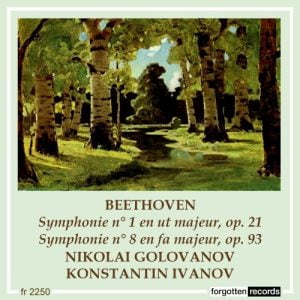
BEETHOVEN – Symphony Nos. 1 & 8; Nikolai Golovanov, Konstantin Ivanov – Forgotten Records 2250 (50:54, complete credits below) [www.forgottenrecords.com] ****:
Earlier this summer, in June to be exact, I reviewed the Forgotten Records issue of Beethoven’s Triple Concerto as conducted by veteran Russian/Soviet conductor Nikolai Golovanov (1891-1953). To be exact, Forgotten Records has remastered original Melodiya recordings as here in the Beethoven C Major Symphony from c. 1949. While his often manic intensity earned Golovanov the sobriquet “the Russian Furtwaengler,” this rendition of the Beethoven First Symphony might well redefine Golovanov as “the Russian Mengelberg,” so energetically willful does this reading impress us.
What stands out throughout the four, superheated movements of Beethoven’s first published attempt at a symphonic score, remains the level of orchestral discipline and homogeneity Golovanov exacts from his ensemble. Golovanov takes the repeat of the opening Adagio molto, which we might assume would impose a staid, classical dignity to the proceedings; but no, the slow introduction merely prefaces the musical hurricane in Beethoven’s temperament. The Allegro con brio refuses to relent in its sweep and forward motion, subsuming tonal colors, rocket figures, and harmonic shifts to the winds of primal energy. The same commitment to emotional velocity will mark the last movement, perhaps sacrificing Beethoven’s pert humor to the tempests of orchestral bravura. Within the bounds of the written score, Golovanov, like his Dutch predecessor Willem Mengelberg, indulges in tempo and agogic fluctuations that bespeak an “individual” outlook, to say the least.
For startling uniqueness of approach, listen to the slow, etched Andante cantabile con moto second movement, which manages to ingratiate the orchestra members to each other, applying deft diminuendos to create a throbbing intimacy. With the swell of Beethoven’s melodic line, the orchestra sets a lyric tension throughout the variants of the theme whose sforzandos seize us as they accelerate the pungent momentum of the progression. Again, Golovanov allows the thinning, dance texture to assume the quality of a ballet in galant style, even as the romantic tension lurks beneath, the brass quite lying in wait. The “innocent” coda subsequently sparkles with dry wit.
How the violins maintain discipline in the driven Allegro molto e vivace third movement presents one of those mysteries of ensemble – Mravinsky succeeded through sheer terror tactics. We feel only Beethoven’s gruff humor here, his toying with established form in order to prepare better the seething torrent Golovanov unleashes. Breathless. Suffice it to state that whatever hesitancy Beethoven plays with in his last movement Adagio, it magically disperses at the first touch of the Allegro molto e vivace. The whiplash rigor of the execution, even as it thunders, slows down, then catapults forward, has our musical jaws drop. The tips of the strings’ bows seem to coalesce into the bassoon and brass tones, coming to a glorious pause before the musical lunacy sweeps us away, wishing our collective enthusiasm could reach backwards.
Conductor Konstantin Ivanov (1907-1984) has not been a musician with whom I had any prior familiarity, but the Forgotten Records label offers an extensive selection of his work – taken from Melodiya – in predominantly Russian repertory. His 1953 reading of the Beethoven Eighth Symphony – the composer’s favorite of his works in the genre – exhibits the alert discipline of his USSR orchestra, Ivanov’s being the third leader of the ensemble. The suave energy of the opening Allegro vivace e con brio reveals a master of canny accents and thoughtful colors. Ivanov favors startling contrasts in his delivery, from a graduated andante pace to an explosive presto. Beethoven’s counterpoints enjoy a richly vibrant texture, a propulsive drive we know from the Eroica, but here infinitely more compressed. Sizzling string work, high and low, accompanies the whistling brass and timpani. A better hall acoustic would have amplified the natural, witty excitement of the music-making.
The inventive second movement, Allegretto scherzando, mocks the newly fashioned metronome, and Ivanov is quick to suggest the machine might run down or amok. As a study in orchestral colors, the USSR woodwinds maintain a light touch, while the strings deliver an elegant, elongated line. The galant figures of Beethoven’s rich Tempo di menuetto enjoy a plastic girth from Ivanov, the wind color well layered. Pompous and ceremonial, the movement exerts an archaic but muscular beauty. Ivanov takes the Trio section very slowly, treating us to a wind serenade or cassation with poised string support.
The last movement, enshrined on record by the likes of Toscanini, Kleiber, and Walter, finds in Ivanov a passionate advocate, his Allegro vivace a wealth of competing tempos and inner voices. Ivanov reduces the dynamic as he enters the sonata-form development, the structure – in spite of its quick polyphony – indebted to Haydn. Soon enough tempos and dynamics increase, inducing a startling tension that has the lyric episode, too, eager to resume its flight. Of course, Beethoven’s rustic wit prevails through the late pages’ syncopes and counterpoints, a virtual Devil’s Brew of Classical techniques that hustles its wisdom without pedantry, throwing a final brick bat at the academy with a stubborn coda that makes the Fifth Symphony finale look pale.
—Gary Lemco
BEETHOVEN:
Symphony No. 1 in C Major, Op. 21;
Symphonic Orchestra of the USSR Radio/ Nikolai Golovanov/
Symphony No. 8 in F Major, Op. 93
State Symphony Orchestra of the USSR/ Konstantin Ivanov