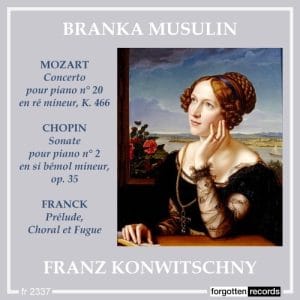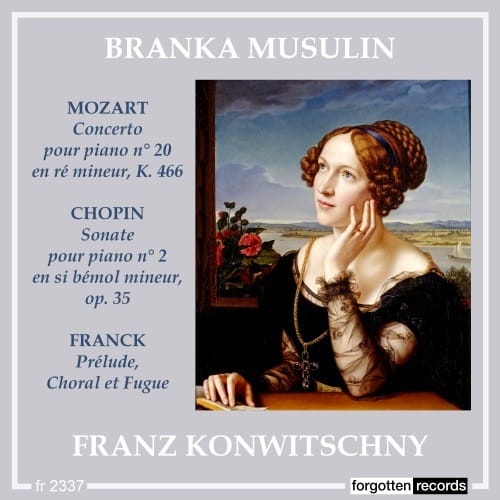
MOZART: Piano Concerto No. 20 in D Minor; CHOPIN: Piano Sonata No. 2 in B-flat Minor; FRANCK: Prélude, Choral et Fugue – Branka Musulin, piano/ Orchestra of Radio Leipzig/ Franz Konwitschny – Forgotten Records FR 2337 (73:47) [www.forgottenrecords.com] ****:
Branka Musulin (1917-1975) enjoyed a pedagogy that embraced the German and French traditions. Musulin was born in Croatia in Zagreb. As from the age of eight, she studied with celebrated Croatian pianist Svetislav Stančić in Zagreb and played in public at that time. After her concert diploma, she travelled to Paris in 1936 to study with Alfred Cortot and Yvonne Lefébure. As from 1938, she studied with Alfredo Casella in Siena; after 1941, she tutored with Max von Pauer in South Germany. Her wartime venue in Germany did not seem to inhibit her career, as it would, more or less temporarily, for artists like Karajan, Furtwaengler, Bustabo, Ney, and Gieseking.
Branka Musulin played under the baton of Hans Müller-Kray, Willem Mengelberg, Hermann Abendroth, Franz Konwitschny, Karl Böhm, Georg Solti and Sergiu Celibidache. In 1958, she became lecturer, later professor at the Hochschule für Musik und Darstellende Kunst in Frankfurt. She died in 1975 in Schmallenberg. Forgotten Records returns Musulin’s appearance in Leipzig, 13 June 1956, the radio orchestra under the able direction of Franz Konwitschny (1901-1962), well known both for his distaste for rehearsals and his uncanny ability to whip ensembles into crisp shape.
Mozart’s 1785 Piano Concerto No. 20 in D Minor has had no shortage of fine proponents, and the number of legendary collaborators includes several of my own favorites, like Gieseking and Rosbaud, and Geza Anda from the Salzburg keyboard. Forgotten Records restores the 13 June 1956 collaboration that appeared originally on Eterna records of Mozart’s 1785 Piano Concerto No. 20 in D Minor. From the outset of the opening Allegro, Konwitschny has the menacing syncopations vibrating, in constant threat of a true sturm und drang explosion. Musulin’s entry, etched and articulate, bespeaks her tutelage under Lefébure, lyrical and transparent, only a touch away from Scarlatti. The intermix of color elements, like the tones of the bassoon, add a melancholy pathos to the occasion. The solo cadenza’s polyphonic moments allow us to speculate on Musulin’s powers in J.S. Bach.
The alternately lyrical and dramatically operatic Romanza in B-flat major offers the arioso we easily label Romanticism. Whatever association we made to Mozart’s Don Giovanni in movement one enters in palpable convulsions in the middle episode in G minor. This storm passes, returning to the now disturbed dream of the original material. With the final movement Rondo – Allego assai, Mozart once more confronts his demons, so even the rather hasty concession to the major mode feels an emotional compromise in the face of dire tragedy. Musulin and Konwitschny have effected a persuasive and often volatile rendition of a concert staple that avoids affective clichés.
The Chopin and Franck selections, from the Opera label, 1958, bespeak Musulin’s tutelage under Cortot and Lefébure. The ubiquitous “Funeral March” Sonata wastes no time in establishing a bitter, resolute journey of the soul. Pungent, urgent, the Grave – Doppio movimento proceeds aggressively, phrased in spasmodic, convulsive periods whose brief moments of relaxation allow no real respite. The gnarly transition to the major mode, here too, feels a mere artful concession without any loss of angry impetus.
The sense of outrage extends into the initial chords of the E-flat minor Scherzo, in which Musulin at last relents in the countertheme, a tender reflection of nostalgic anguish. The atmosphere of our intruding into some personal intimacy in the G-flat major Trio becomes palpable, especially with Musulin’s slow tempo and softened dynamics. The huge chords that signal the da capo reveal a powerful and sweeping technique, in a word, “fateful.”
To avoid sentimental redundancy remains the eternal challenge of the third movement, the Marche funebre in B-flat minor. Musulin imposes a noble, taut line from the very first, stately without bathos, resolute without empty, theatrical rhetoric. The utter simplicity of effect in the D-flat major Trio, with its light, dragon-fly trill, proves a balm in the desert. The sustained lyric holds us in thrall, the sweet power reminds us of the characters in James Joyce’s “The Dead.” The rude, sudden return of the march shatters our collective reverie with an ugly, existential truth. As for the Finale: Presto, Musulin throws a lasso around a mumbling, drunken whirlwind, staggering and careening, moto perpetuo, in parallel octaves. The final chord, in a perverse form of B-flat, sounds what becomes Mahler’s “hammer blow” of fate.
Franck’s 1884 Prélude, Choral et Fugue (in B minor) gives Musulin the opportunity to deliver J.S. Bach and chromatic, cyclic Romanticism in a novel approach. Musulin soft-pedals her opening, moving in organ-tone fashion to thicken the textures, deliberate and introspective, at once. Her pps declare Musulin an artist of refined sonic ability. The alternate, flowing and sweeping cascades of sound and measured parlandos quite convince us of Musulin’s innate sympathy for this veritable organ piece fashioned on lines combining Bach, Liszt, and Wagner. To make Franck’s chromatic fourths sound lyrical and dramatic proves no obstacle to Musulin’s seamless execution of the style, and so she moves – in my opinion – from a relative unknown to a singular pianist of serious consideration for more comprehensive revivals. To wit, Forgotten Records does offer an all-Chopin disc on their invaluable site.
—Gary Lemco
Branka Musulin
MOZART: Piano Concerto No. 20 in D Minor, K. 466;
CHOPIN: Piano Sonata No. 2 in B-flat Minor, Op. 35 “Funeral March”;
FRANCK: Prélude, Choral et Fugue