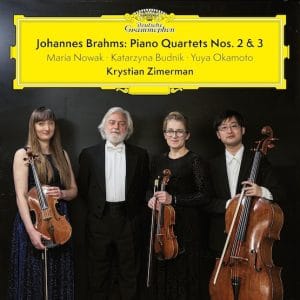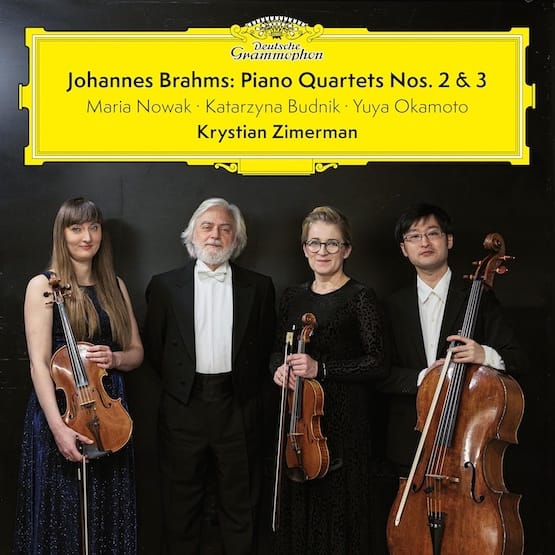
BRAHMS: Piano Quartet No. 2 in A Major, Op. 26; Piano Quartet No. 3 in C Minor, Op. 60 – Krystian Zimerman, piano/ Maria Nowak, violin/ Katarzyna Budnik, viola/ Yuya Okamoto, cello – DG 486 4650 (2/6/25) (79:10) [Distr. by Universal] ****:
Recorded at LAC Lugano Arts e Cultur, Sala Teatro, 6/2021 and 4/2023 respectively, these collaborations between pianist Krystian Zimerman and selected chamber music colleagues testify to his enduring passion for making music on intimate terms, a residual effect of his musical childhood in Zabrze, Upper Silesia. The 1981 Lockenhaus Festival directed by Gidon Kremer solidified Zimerman’s notion of the quartet ensemble, which resulted in his collecting 500 pieces for diverse instruments. Of the three piano quartets by Johannes Brahms, Zimerman opted for the latter two, given the relative familiarity of the No. 1 in G Minor, Op. 25.
The A Major Piano Quartet of 1862 results from residences Brahms enjoyed between his native Hamburg and a visit to Vienna, where he absorbed the creative impulses he relished from the likes of Beethoven and Schubert. The first movement, an expansive Allegro non troppo, sets the keyboard part in triplets, answered by the cello’s flowing eighth notes, and the two motifs play off against each other fervently as the accompanying instruments enrich the texture. The typical Brahms maneuver, two versus three in the metrics, follows a course that leads dramatically to a rich C minor, resonant both of Schubert’s “Trout” Quintet and much of Beethoven. The lyrical interplay of Zimerman and his affectionate colleagues manages virile and tender utterances from Brahms that Production & Recording Engineer Lukas Kowalski has captured in vibrant sonics.
The second movement, Poco Adagio in E major shimmers with textures reminiscent of Schumann, in which a broad, arching theme in the piano finds soft ambiance in the muted strings. The lyrical gesture breaks off suddenly, as the piano introduces a passionate aside, a kind of dramatic, fantasy-episode rife with arpeggios that appears twice, typical of a rondo, answered by subtle syncopations in the strings when the original melody recurs. The stirring violin-cello duet that emerges late in the movement almost anticipates much of the later Double Concerto, and it likely pays homage to Hungarian virtuoso Joseph Joachim. The ensuing Scherzo: Poco Allegro, opts for a lightly playful sensibility. The Trio, however, ventures into the minor and a forceful display of polyphony, by way of an explosive canon, even as the music evolves in sonata form. Zimerman resists the temptation to expound percussively while maintaining emotional fervor, matched by Maria Nowak and violist Budnik.
The last movement, Finale: Allegro resorts to the composer’s old association with violinist Remenyi, and their mutual love of Hungarian folk and gypsy tunes. The swirling motion dares us to identify where the beat should fall, and this rhythmic insecurity drives the dance forward with astonishing pep. The violin part becomes animated and forceful, gypsy-insistent, with a sudden, dark turn into fervent introspection. The low colors of viola and cello contribute to the autumnal beauty created that serves as a foil to the folky energies of the main theme that, in rhythmic variation, lead to the breakneck coda which virtually blazes beyond the musical page.
The Brahms Third Piano Quartet in C Minor, Op. 60 had an extended etiology, begun in the 1850’s during Robert Schumann final collapse and then shelved until 1875, when the piece acquired an emotional connection with Goethe’s The Sorrows of Young Werther, given that Brahms confessed that a suicidal illustration should decorate the score, an emblem of a young man’s self-destruction due to unrequited love and failed personal ambitions. In the case of Brahms, a schizoid impulse motivated him: witnessing the dissolution of his musical mentor Schumann’s mind, while coveting an amorous relationship with Schumann’s beloved Clara. The appearance of an identifiable “Clara” motif (C–B–A–G♯–A) allies this dark, even dire, composition with the Op. 99 Bunte Blätter (1841) of Schumann, works that exploit a solemn introspection.
To add to the music’s admitted angst, Brahms adjusts his opening movement, Allegro non troppo, so that the recapitulation will occur in an alien G major, breaking with Classical sonata-form convention. The music opens with hesitant keyboard octaves, soon establishing, in chromatic harmonies, two contrary impulses, aggressive and lyrical. Suddenly, the energy thrusts forward to some personal unease, Once the music modulates to E-flat by way of Zimerman, Brahms introduces a theme-and-variations procedure, ever maintaining the fierce, compulsive tension that seems to invoke Beethoven as his guiding spirit. Soon the tonality of E minor dominates the mood, now informed by selective counterpoints. Ms. Budnik’s viola asserts a new theme, rich in nostalgia, bringing with it yet new variants. The remained of the movement extends the Manichean struggle between C major and minor,, but the concluding cadence lies inconclusively, in mystery.
In intricate, duple-meter Scherzo: Allegro in C minor follows, fraught with Romantic Agony. The piano asserts a series of step-wise chords, initially on G, while the stings pulsate with fury. Brahms continues his strategy of developmental variation, his penchant for classical economy. Given the brevity of the movement, the effect extends the gloom of the first movement and leaves us spellbound. Ms. Okamoto’s serene cello in high register begins a sweet Andante in E major, an oasis in the midst of the maelstrom. The Brahms gambit of descending thirds asserts itself, and we hear echoes of the Schumann Piano Quartet. Op. 47, whose slow movement sounds similar. The music divides into three thematic groups, with the violin’s gaining melodic precedence, while Zimerman often inserts triplet, parlando musings of lyrical intimacy. The interactions between violin and cello anticipate further beauties in the later Double Concerto. Prior to the coda, some mysterious chord progressions suggest an emotional cloud, just before the music, pp, restores the tonic mode.
The last movement, Allegro comodo, begins as a violin sonata, the texture close to the Op. 78 “Rain Sonata.” Commentators note that Brahms has borrowed the motif from Mendelssohn’s Piano Trio in C Minor, Op. 66. The difference soon lies in the application of the “fate motif” from Beethoven Fifth Symphony, informed by an antique chorale, ‘Vor deinen Thron tret ich hiermit’ (“Before Your Throne I Now Appear”). An unnerving series of broken chords from Zimerman interrupt the flow and increase the ambling sense of exploration in minor keys – A minor, E minor, B minor – that dominates this journey. Piano and viola will lead us to one more eerie locale, before the cello’s low C has Zimerman follow suit, until he utters two massive chords, forte, that end a perilous but haunting exploration of human desire.
—Gary Lemco
More information through Amazon