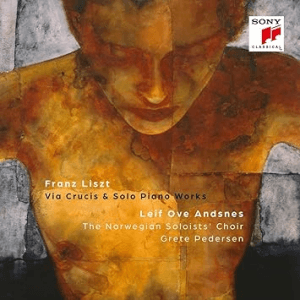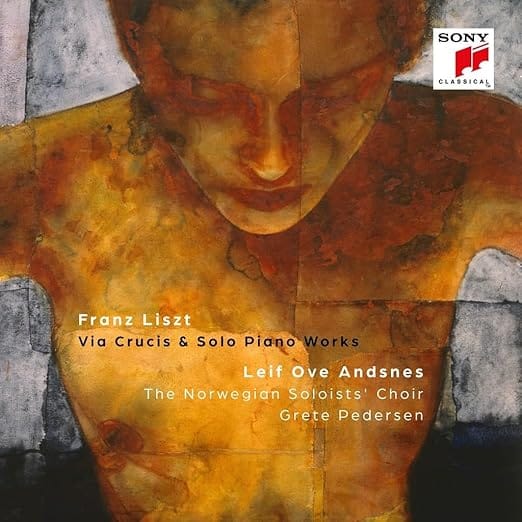
LISZT: Via Crucis, S. 53; 6 Consolations, S. 172; Harmonies poétiques et religieuses, S. 175: No. 9 Andante lagrimoso; No. 8 Miserere, d’après Palestrina. Largo – Leif Ove Andsnes, piano/ Oystein Stensheim, tenor/ Olie Holmgren, bass-baritone/ Ditte Marie Braein & Magnhild Korsvik, sopranos/ Mari Askvik, mezzo-soprano/ The Norwegian Soloists’ Choir/ Grete Pedersen, conductor – Sony 19802856672 (2/8/25) (58:43) *****:
In 1861 Franz Liszt left Weimar, moving to Rome, where in 1865 he took minor orders as an Abbé in the Catholic Church. Perhaps the outward conversion to overt religious ideals confirmed his constant need for ecstasies of experience, sacred and profane. In 1869 Liszt began his vie trifurquée, his transits between Rome, Weimar, and Budapest. The visionary in Liszt set liturgical texts in the form of motets, oratorios, and masses, meaning to raise the level of sacred music to the artistic standards of lay compositions. The 1879 Via Crucis, for soloists, chorus, and orchestra (or organ), serves as an experiment for his idiosyncratic, radical chromaticism, often straining the boundaries of the tonal system
Pianist and conductor Leif Ove Andsnes calls his 23-27 August 2024 recording of the Via Crucis “an encounter with Liszt’s soul,” a confrontation with the issues of faith, human suffering, and the mystery of redemption. The accompanying works, the Consolations and Poetic and Religious Harmonies, reassert the affective bond between Liszt and his audience, their collective fragility in the face of a tragic fate. Andsnes celebrates the “blend of reverence and Romantic intensity that has Liszt’s personal stamp all over it.”
Conceived between 1866 and 1879, the Via Crucis remained unperformed until 1929, when it received a Good Friday debut at the Liszt Academy in Budapest. The music follows a “pictorial” procession, the fourteen stages, or Stations of the Cross, of Christ’s progress to crucifixion and death. Like many of Liszt’s late works, the use of modal harmonies and selective dissonance, as in the piano solo No. 4 Lento, proves Liszt’s daring innovations in instrumental texture. No less true for V, X, and XIII, these piano solos allow Andsnes an organ sonority rife with the Gregorian traces from the original hymn, Vexilla regis prodeunt, “The banners of the King advance.”
Via Crucis opens, Andante maestoso, with the chorus’ intoning the Vexilla chant, the piano in strong, staccato octave figures. Austere and spare in texture, the chorus breaks off, leaving the piano with the resonance from the Amen prior to the chorus’ conclusion, a cappella. Station I proclaims Jesus is about to die, set by a grim keyboard solo in dissonant harmony, to which the bass adds the sad “Innocens ego sum.” The grimly swirling figures continue into Station II, a Lento in which Jesus accepts the cross, Ave creux! In phrases closely resembling the Dies Irae. Station IV, divided between male and female voices – the latter’s invoking the Stabat Mater – depicts Jesus’ first fall from the burden of the cross. A musical line close to Wagner’s Tristan intones Station V, in which Jesus meets his holy Mother. The sighing figures in the keyboard, simple in plainchant style, suggest a world of weeping.
Station V, Andante – Come prima (meno lento) – offers a moment of spiritual sympathy, as Simon of Cyrene helps Jesus to bear the weight of the cross. Most closely aligned with his late, dark works like Lugubrious Gondola, the piano harmonies prior to the chorus’ entry ring of another world for Station VI, the appearance by way of a German Lutheran chorale, Andante, of Saint Veronica, whom the Apocrypha credits with providing Jesus a veil to wipe his face en route to Calvary, his image inscribed onto the veil for posterity. At Station VII Jesus falls a second time, the female chorus a cappella, singing Stabat mater dolorosa, with each entry a semitone higher. The staggered impulse infects Staton VIII, Andante ma poco mosso, in which the male voice tells us of the reaction of The Women of Jerusalem. A heavy tread marks Station IX, in which Jesus falls for the third time. Male voices and a ff piano cede to the dire sympathy of the women’s chorus. When, at Station X, Jesus is stripped of his clothes, Lento, the solo piano line delivers an askew, modal scale only a moment away from Schoenberg and Webern.

Franz Liszt
XI could not be more explicit: Crucifige, Andante, as Jesus suffers the nails of the cross. The piano ends the sequence in almost invisible pps. In the longest of the episodes, Station XII, Jesus dies upon the cross, once more Liszt intones a German Lutheran chorale, the piano part’s ascending inexplicably to a sense of glory – Consummatum est – amidst the lamentations of the male singer. The chorus cries, “O Traurigkeit, o Herzeleid,” the sadness of the bereaved heart, akin to the emotions expressed in the Bach passions. A descending piano line rather literally follows Jesus’ being taken down from the cross, the harmonies close to a theme by Ligeti. Yet the move to a major mode indicates the hope of salvation and release from the bonds of death, the three-note motif similar, indeed to late, almost atonal piano pieces like Unstern. The mezzo-soprano invokes the last setting at Station 14, where Jesus is placed in the tomb. Ave crux! Praise the cross seems to confirm what the literati call The Fortunate Fall. The mysterious serenity – via unresolved harmonies – Liszt establishes surpasses understanding. The solo piano leaves us mystified by the eternal enigma of the Crucifixion.
Liszt conceived his cycle of six Consolations around 1845-1850, this second version having altered and simplified aspects of the originals of 1844. Liszt’s literary inspirations cite two sources, the poems of Alphonse de Lamartine and the Consolations of the French critic Charles Sainte-Beuve. Resembling the Chopin nocturnes, the pieces tend to the ternary form, each set in a major key and often achieving a reflective, vocal character for the keyboard, gently pious and eminently melodic. The first two Consolations are set in E major, the terse No. 1 (in 25 measures) serving to introduce, attacca, No. 2, an exalted lyric. The No. 3 remains the most celebrated, in D-flat major, Lento placido, modeled after Chopin’s Nocturne in D-flat Major, Op. 27/2. This piece replaced the original Third Consolation, set in C# minor. When Liszt in 1883 received a Steinway piano, he rescored the piece to accommodate this novel instrument’s sostenuto pedal. A lied by Maria Pavlovna, Grand Duchess of Saxe-Weimar-Eisenach and a Liszt pupil, provides the basis of No. 4 in D-flat major. The parlando, chorale-like theme reappears in the Sonata in B Minor. No. 5, in E major, is marked Andantino and reworks material from a piece Liszt called Madrigal from the 1844 version. Andsnes plays its syncopations in a clear, clarion style, limpid and charming. The last of the set, No. 6 in E major, extends for 100 measures and rather struts its aggressive energies over several octaves in competing voices. Liszt reportedly realized the piece in a languid manner that dramatically imposed a kind of stasis on the occasion.
Liszt labored for several years to effect his 10-movement cycle, Harmonies poétiques et religieuses in 1853. The Lamartine inspiration dates from 1830. The two selections chosen by Andsnes typify the inward, meditative facet in Liszt’s sensibility, rather than his tumultuous virtuosity. The “Miserere after Palestrina,” Andante latrimoso, projects an improvised character. The middle section rings with a delicate, shimmering beauty that recommends Andsnes’ florid technique. The coda moves in a step-wise motion that may indicate the progress of a sincere, deep repentance. The quoted chant “Miserere mei, Deus, secondum magnam misericodiam tuam” (Have mercy upon me O God, according to Thy great mercy), first appears twice in high register, and suddenly thrusts forward in middle and bass arpeggios of resonant power. The words of Lamartine speak of “silent tears [that fall] on a soil without pity.” Kudos to Recording Producer John Fraser for the sonic resonance of this ambitious, many-faceted project.
—Gary Lemco
More Information through Amazon