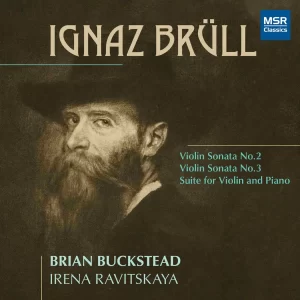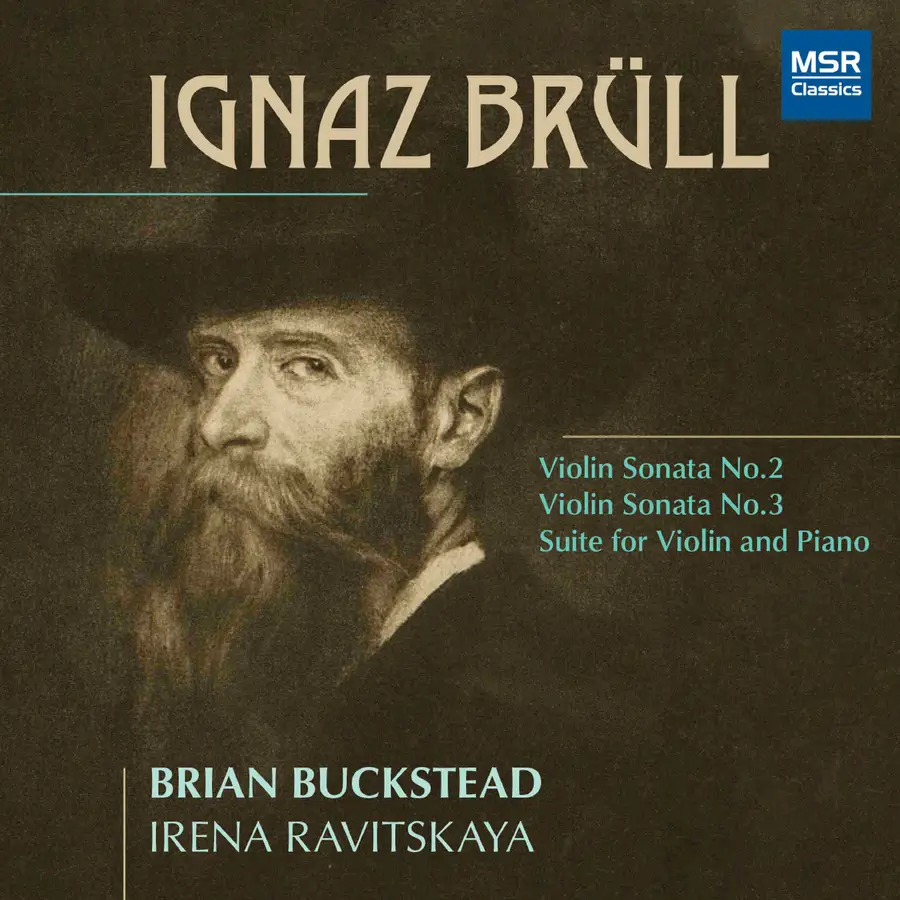
BRÜLL: Violin Sonata No. 2 in A Minor, Op. 60; Violin Sonata No. 3 in E Minor, 81; Suite in A Major for Violin and Piano, Op. 42 – MS 1797 Brian Buckstead, violin/ Irina Ravitskaya, piano – MSR MS 1797 (4/8/25) (64:55) [Distr. By Albany] ***
Austrian-Czech composer Ignaz Brüll (1846-1907) assembled an impressive catalogue of works in various genres; but despite his receiving praise from Brahms and Liszt, his music fell into an obscurity only recently gleaning new appraisal. The three violin compositions performed here by Brian Buckstead and Irena Ravitskaya span the years 1882-1899 and reveal his gift for melody, expressed in the conservative harmonic style of Schumann, Mendelssohn, and Brahms. My only quibble with this document, considering the scarcity of the repertory, lies in Bucksteady’s unsteady and thin tone, which detracts from the immediacy of the effect. I offer the repertory in its objective form, with little commentary on the execution, assuming that the works themselves may appeal to interested listeners.
Violin Sonata No. 3 in E Minor, Op. 81 (1899) opens with dramatic flair, Moderato, and then settles into a lyrical mode, especially as the keyboard part remains active and rich in harmonized continuity with the violin. The passionate, initial motif returns more urgently, resembling at times a vocal ballad. A brief solo transition by the piano invokes the last measures of the movement, ending quietly. The second movement, Andante con moto, presents a long violin line over a lulling, repetitive bass line in the keyboard. The music resembles that of Schumann, in its nostalgically intimate gentleness, though the bass harmonies resemble those of Brahms. The violin’s frequent use of double-stops intensifies the richness of the textures. The last movement, Rondo – Allegro commodo, projects a folk-style vitality, a chugging motif’s dominating the texture, moving with easy finesse to the coda in E Major, a typical maneuver in Romantic music to conclude by dispersing whatever clouds had gathered prior.
Suite in A Major for Violin and Piano, Op. 42 (1882) provides five character-pieces that simultaneously evoke a Romantic and antiquated style. The opening Praeludium conveys a processional majesty, lyrical and impassioned. The Scherzo sets a perpetual-motion energy, witty and buoyantly active. In the tonic minor, it momentarily moves into A Major for the trio section before returning to the churning da capo. The third movement Brüll entitles Reigen, a soft dance in triple meter that serves as an extended moment of repose. In scalar motion, the music enjoys a gentle series of symmetrical phrases. In D Major, the fourth movement, Theme and (7) Variations, consists of a series of contrasting moods and intensities. At the coda,the violin sails upward to its top register, while the keyboard part has become declamatory and wistful. The last movement, Alla Giga, is a rambunctious romp, indulgent in bravura antics and shifting moods. The violin’s double stops inject a “symphonic” sound into the proceedings.
Violin Sonata No. 2 in A Minor, Op. 60 (1896) in four movements generally feels more ambitious and sweeping in emotional intent. The opening Allegro ma non troppo projects a restless energy countered by a secondary tune in C that sounds as if composed by Schumann. The structure, a typical sonata-form, evolves the dialogue in rapid inter-changes between violin and piano. A huge pedal point leads to the keyboard enunciation of the lyric theme, to which the violin joins in, and both move to a thoughtful, florid coda. The second movement, Cavatine – Andante proclaims its intent to intone a song of wistful yearning, a melody typical of a Romantic’s desire to create what Mendelssohn had labelled a “song without words.” The musical line becomes increasingly ardent as it evolves. Movement three, a lively Scherzo (Allegro vivace), whose witty, flighty filigree brackets a central, expansive Andante, abounds with folksy energy. The last movement, Allegro ma non troppo, enjoys the signature flair of a Hungarian rondo (‘alla Zingara”) that indulges the virtuoso musicianship of both participants. The music generates the atmosphere of the village tavern, where a gypsy ensemble engages the spirited, rural sensibility of the village folk.
This is definitely recommended repertoire, hoping more artists explore Brüll’s works.
–Gary Lemco