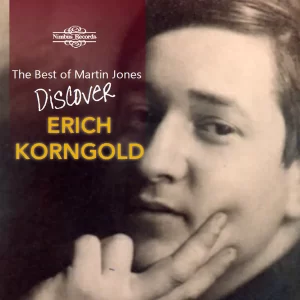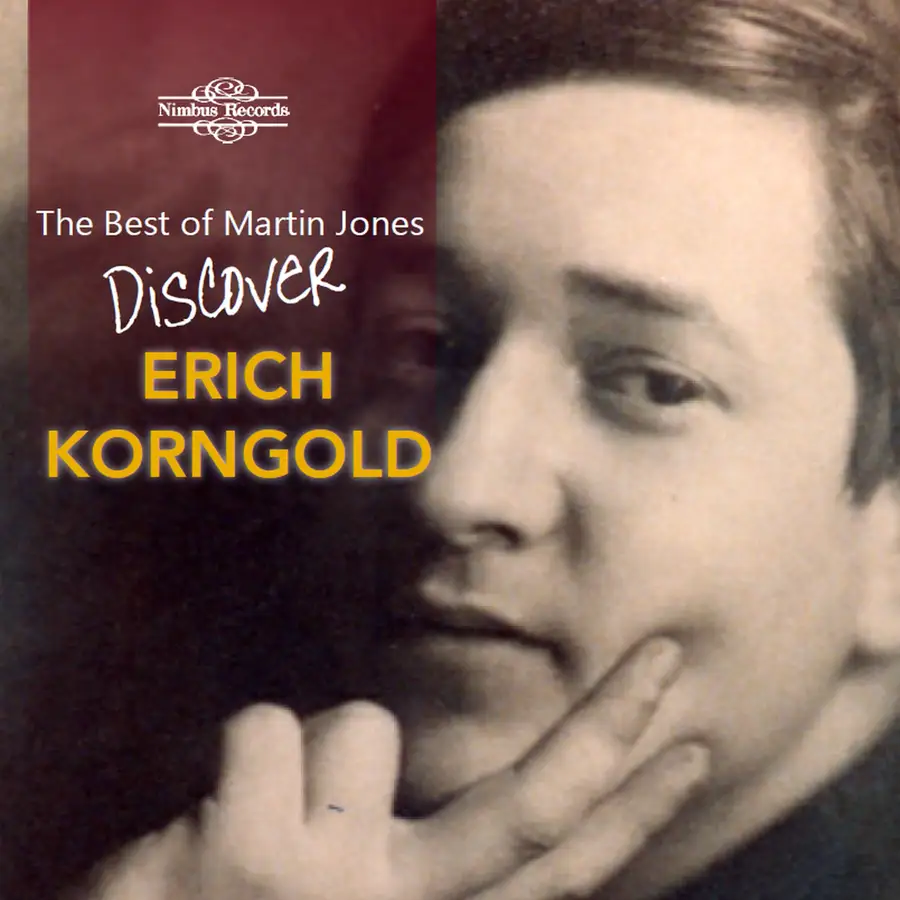
DISCOVER ERICH KORNGOLD = Grosse Fantasie aus der Oper Die Tote Stadt (arr. Rebay); Piano Sonata No. 1 in D Minor; Vier Kleine frohlische Walzer (1911): Two Waltzes; Six Character Pieces on the story of Don Quixote (1907): 3 Pieces; Fairy-Tale Pictures, Op. 3 (1910); Intermezzo, Act III from The Miracle of Heliane; Vier Kleine Karikaturen für Kinder, Op. 19 (1926); Piano Sonata No. 2 (1910) – Martin Jones, piano – Nimbus NI7743 (70:30) [www.wyastone.co.uk] ****:
British pianist Martin Jones (b. 1940) explores selected keyboard music of Austrian composer Erich Wolfgang Korngold (1897-1957), chiefly remembered for his Hollywood scores for such films as The Sea Hawk, Another Dawn, and Elizabeth and Essex, all these starring Errol Flynn. Jones surveys several of Korngold’s serious contributions to classical keyboard music, which exhibits influences from folk music, Schumann, Schoenberg, Stravinsky, Bartok, and Hindemith. The recordings were produced in December and May, 2000-2001 at Wyastone Leys, Monmouth, UK. Both neo-Romantic and modernist in color, texture, and harmony, these pieces deserve more notice.
The Grosse Fantasie aus der Oper Die Tote Stadt (arr. Rebay) comprises tunes from Korngold’s 1916-20 opera that recounts a man’s obsession with his dead wife, convinced he has met her phantom double. He proceeds to strangle this double with a braid of his wife’s hair. The Fantasie – rather Lisztian but more the arranger Rebay than Korngold – combines the main themes, polychromatic and harmonically luxurious.
Piano Sonata No. 1 in D Minor (1908), composed when Korngold was 11-years-old, borrows the harmonic language of late Romanticism and early Alban Berg. Two themes evolve during the one-movement, the first harshly, militantly percussive, the second softly lyrical. We can hear touches of Brahms and Scriabin via the chordal statements. The development juxtaposes the diametrically opposed energies against each other.
From the set of Vier Kleine frohlische Walzer (1911), Jones plays two, No. 2 Margit: Espressivo and No. 3 Gisi. The “happy waltzes” appeared in print in 1997. The names refer to old girlfriends. The highly chromatic writing blends the light, suave glitter of Richard Strauss and the sentimentality in Franz Lehar.
Six Character Pieces on the story of Don Quixote (1907) present us three, all based on Cervantes’ classic anatomy of courtly love in Spain. This music by a 10-year-old only appeared in 1996. Something of Richard Straus or Robert Schumann’s sense of characterization blends with harmonic language we find in Debussy. In the Sancho Panza episode, we have humor in the form of a burro’s braying. The last section proves most virtuosic in runs and leaps for the performer.
The three Fairy-Tale Pictures, Op. 3 (1910) allude to Schumann directly. Korngold was 13 when he penned these charming invocations to youthful imaginings. “The Princess and the Pea” exploits high registers. “The brave little tailor” swaggers in a manner reminiscent of Grieg. “The Fairy-Tale’s Epilogue” offers a meditation that reminds us of Schumann’s Kinderszenen, childhood scenes.
The Intermezzo, Act III from the 1927 opera The Miracle of Heliane addresses the redemptive power of love over adversity and injustice. The style is virtuosic, incorporating passing dissonance. A love theme rises up in a more diatonic mode, with bass grumblings below the upper-voice, clear-texture parlando. The love theme becomes impassioned and searchingly polyphonic. A militant element enters but gradually subsides as the music dissipates into space.
Vier Kleine Karikaturen für Kinder, Op. 19 (1926) are four children’s pieces that mock Korngold’s contemporaries: Schoenberg, Stravinsky, Bartok, and Hindemith. Their brevity, almost minimalist, echoes musical experiments from Berg, Webern, and Schoenberg.
Piano Sonata No. 2 (1910) is marked Moderato in one movement. Set in E major, the piece proves moody, graduating from a reflective opening to a galloping energy and then returning to a dark descent into the abyss. The middle part becomes sentimental in an Austrian folk mode, then abruptly declamatory and virtuosic, especially in the bass part. The harmony includes whole tones that Debussy favors. The last page feels improvised and dreamy, touched by nostalgia. This piece often received attention from Artur Schnabel in recitals.
—Gary Lemco