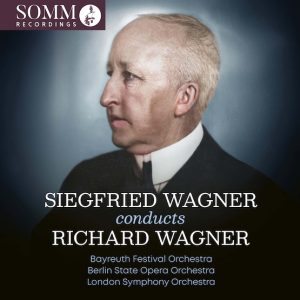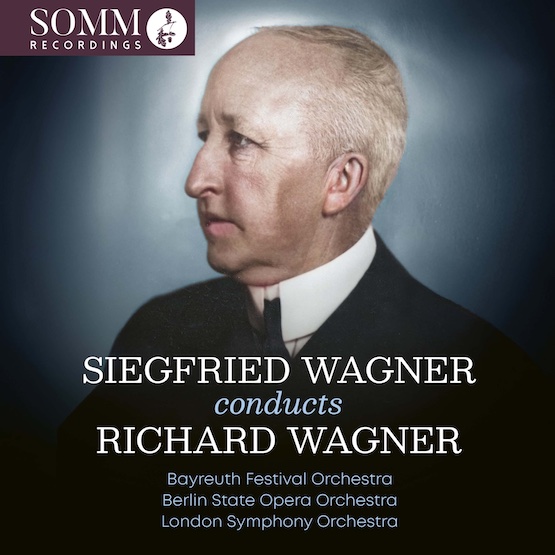
Siegfried Wagner conducts Richard Wagner = Excerpts from Das Rheingold, Die Walküre, Parsifal; Tannháuser; Lohengrin; Tristan und Isolde – Bayreuth Festival Orchestra/ Berlin State Opera Orchestra/ London Symphony Orchestra SOMM Ariadne 5043 (2 CDs = 115:30, detailed content listings below) [Distr. by Naxos] *****:
Ever in the pursuit of musical authenticity, audio engineer and producer Lani Spahr has assembled the 1926-27 Parlophone and Columbia recordings by Siegfreid Wagner (1869-1930), the son of venerated composer Richard Wagner, of whose legacy Siegfried became the rightful curator. Trained in music by his father and grandfather Franz Liszt, Siegfried Wagner went on to study conducting with Hans Richter and composition with Engelbert Humperdinck, who was no less an acolyte of Richard Wagner. Originally focused on the study of architecture, Siegfried found a musical destiny via Felix Mottl (1856-1911), one of the principal conductors at Bayreuth who led the first performances of Tristan und Isolde. By 1896, after having served as an assistant at Bayreuth since 1892, Siegfried had one of his own compositions, Sehnsucht, performed, and he made his Bayreuth conducting debut in the Ring cycle.
With the introduction of electrical recordings in 1925, Siegfried Wagner could take advantage of the improved sound medium, devoting his efforts to preserve his ideas on his father’s music by way of three companies in Germany and one in England, all between October 1926 and August 1927. George Bernard Shaw, serving as a music critic, had noted of Siegfried’s manner of conducting in the 1890’s that he exhibited “a perfect comprehension of his father’s and his grandfather’s music. . .but also an instinctive gentleness and strong patience of handling of the finest masculine qualities, complemented by a sensitiveness of feeling of the finest feminine quality.” We do hear these exact characteristics of Siegfried Wagner’s style in the proffered collection before us.
The all-Wagner program opens with the orchestral version of “Entry of the Gods into Valhalla” from Das Rheingold, in which a rainbow bridge facilitates the gods’ ascension, Donner’s having invoked the colossal spectacle. In the far distance we hear the Rhinemaidens’ “Rhinegold! Rhinegold!” instigation of the cosmic drama that will later urge Siegfried to assume a moral position superior to the deceitful gods who betray Alberich. Already, we hear the soft, non-pompous approach from conductor Wagner, who seems convinced that his father’s innate lyricism will triumph over orchestral histrionics.
The blockbuster “Ride of the Valkyries” has little of Colonel Kilgore’s lust we find in Apocalypse Now. Siegfried Wagner imparts a leisurely girth to the aerial warriors, who generate more confidence than terror. Frankly, I miss the vocal part for the baritone Wotan in the “Wotan’s Farewell,” here intoned by the orchestra. A few years later, in 1934, Leopold Stokowski would record the excerpt in Philadelphia with Lawrence Tibbett, an exemplary combination of vocal-dramatic characterization and orchestral sheen. Siegfried Wagner’s “Magic Fire Music” has sparkle but little excitement. A true Wagnerite might consult the live Bayreuth appearances in the 1950’s by Clemens Krauss for illuminated, dancing sparks.
The 1864 Homage March meant to celebrate the birthday of the nineteen-year-old Ludwig II of Bavaria. Conceived for a military band, in ostentatious and inflated style, alternately lyrical, contrapuntal, and declamatory, the piece, in the words of the composer, offered something “from Lohengrin and Tannhäuser.” Ludwig II emerged as Wagner’s most significant benefactor, perhaps even a kind of victim of his own beneficence, sponsoring opera productions in Munich and helping to inaugurate the Bayreuth Festival House in 1876, specifically designed for Wagner’s operatic enterprises, especially the Ring Cycle. Son Siegfried imparts a cocky festivity to the piece, but its melodic content does not rise above the pomp of the occasion. The “Entry of the Guests,” here in an extremely abridged format, feels the least satisfactory restoration, given its hollow, acoustical resonance. I recommend, by way of extreme contrast, that 1988 version by Giuseppe Sinopoli and the Philharmonia Orchestra and the Chorus of the Royal Opera, Covent Garden on DG.
The Lohengrin Prelude and the familiar Prelude and Love-Death from Tristan, however, evolve with patient clarity and detailed articulation of the amassed, contrapuntal voices. The sustained A major veil of mysticism in Lohengrin resonates with affectionate ardor, while the tender approach to the familiar Tristan diptych illustrates what one country singer extolled as “a slow hand.” The sense of comfortable relaxation in the rising tension of the Tristan passion offers a strong alternative to those conductors who merely wish to present the libido in all its self-indulgent fury.
Siegfried Wagner led the Bayreuth Festival in his father’s final music-drama, Parsifal, but once, in 1909. For his recording from the famous Festival Theater he chose two eminent vocalists, tenor Fritz Wolff1894-1957), noted for his Loge characterizations in Das Rheingold, here as Parsifal; and bass-baritone Alexander Kipnis (1891-1978), whose silken voice lends itself to Gurnemanz. The two vocalists’ interchange, punctuated by the “Dresden Amen” and motifs of spiritual transformation and regeneration, creates a luminous presence quite ineffable, and worthy of the investment into the set entire. The orchestral rendering of the Good Friday Spell without voices and the Parsifal Act III Prelude – the latter which I find a relatively static piece of music until its last pages’ sense of menace – enjoy a direct, potent development of the various motifs, at once slowly forceful and intimate, as required. Wilhelm Furtwaengler remains my model for Parsifal interpretation, but obviously limited to the selected excerpts he recorded, while Hans Knappertsbusch acquired a wealth of studied luminosity in his various readings.
Finally, we have Siegfried Wagner’s claim to independent fame as a composer: he leads the Berlin State Orchestra in the Overture to his 1899 folk-tale opera Der Bärenhäuter (“The Bear-Skin”), after the Brothers Grimm. Inspired to the task by his teacher Engelbert Humperdinck, Wagner adopted two tales and merged them in a setting after the Thirty Years’ War. The music, per se, seems light, twitteringly vapid, and intellectually trite, especially after a long session of his father’s music. Better to concentrate, even indulge in, his deeply committed realization of A Siegfried Idyll, his father’s celebration of Siegfried’s own birth. While not so as intense as my favorite reading by Bruno Walter in New York, the reading has grace, eloquence, and a natural flow that resonates in the various choirs of strings and selected winds and brass. So far as historical, music documents are concerned, we have a rare artifact of immense import.
-—Gary Lemco
Siegfried Wagner conducts Richard Wagner
bDas Rheingold: Entry of the Gods into Valhalla;
bDie Walküre: Ride of the Valkyries; Wotan’s Farewell and Magic Fire Music;
1aParsifal: Good Friday Spell; Prelude to Act III Good Friday Spell (orch. version);
bSiegfried Idyll; Huldigungsmarsch;
bTannhäuser: Entry of the Guests;
cLohengrin: Prelude to Act I; Tristan und Isolde: Prelude, Act I and Liebestod;
S. WAGNER: Der Bärenhäuter, Op. 1
1Fritz Wolf, tenor/ Alexander Kipnis, baritone/
aBayreuth Festival Orchestra/
bBerlin State Opera Orchestra/
cLondon Symphony Orchestra/ Siegfried Wagner