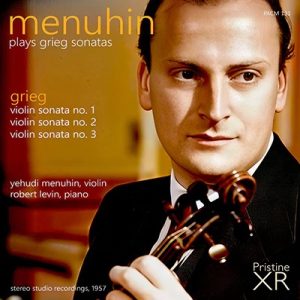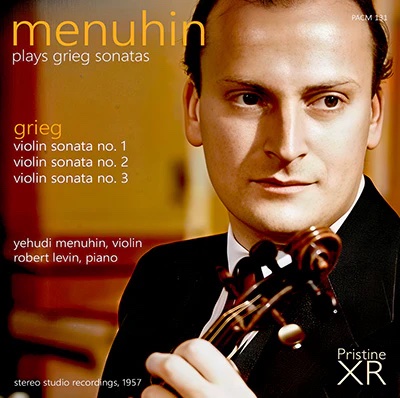
GRIEG: Violin Sonata No 1 in F Major, Op. 8; Violin Sonata No. 2 in G Major, Op. 13; Violin Sonata No. 3 in C Minor, Op. 45 – Yehudi Menuhin, violin/ Robert Levin, piano – Pristine Audio PACM 131 (63:40) [wwwpristineclassical.com] ****:
Yehudi Menuhin (1916-1999) and pianist Robert Levin (b. 1947) recorded the three Grieg violin sonatas for HMV 9-11 October 1957, originally in monaural sound, but Pristine and Andrew Rose’s XR process has revitalized the sonic impact to fill out Menuhin’s sweetly searching tone and Levin’s ripely idiomatic accompaniment. Grieg’s three sonata cover a 20-year period, 1865-1887, and they each bear aspects of his Norwegian folk heritage and his Germanic, musical disposition. Sonata No. 1 in F may exert the most “Romantic” elements, “rich in models” (as Grieg put the case), meaning that its influences lie in Schumann and Mendelssohn as purveyors of immediate, gratifying melodies.
Grieg was twenty-two at the time of his F Major Sonata, and perhaps the two opening chords – in E minor, A minor (for Grieg) – of Beethoven’s Eroica Symphony left their echo in Grieg’s imagination for his (contrarily) melancholy Allegro con brio. So, too, Beethoven’s Op. 24 “Spring Sonata” in F may carry over to Grieg for vigorously dramatic spontaneity and tenderly lyrical assaults. The second movement, Allegretto quasi andantino, however, opts explicitly for the folk effects of the Hardanger fiddle and the springar dance form. The use of fervent double-stopping over pedal points in the Trio section imitates the Hardanger’s limited division of nine strings, four of which are bowed while the five remaining strings vibrate sympathetically.
Grieg’s studies with Ole Bull fired his love for Norwegian folk idioms, albeit Danish at first. Menuhin’s hearty, throaty tone compels us, as it did Franz Liszt, to recognize a major talent in the young Grieg. The last movement, Allegro molto vivace, generates brisk energy qualified by reflective musing, even as the music feels an urge to dance and stretch its wings. The academic side of German training comes forth in the fugato section, but Grieg’s natural rhapsodic power dismisses the schoolbooks. Levin’s piano part becomes audacious in spurts, the keyboard arpeggios and runs quite bold, only to retreat in gently rhythmic filigree. The coda dances limberly in high, unbuttoned spirits.
Grieg had been recently married, aged 24, when he conceived his Violin Sonata No. 2 in G Major, Op. 13. After a slightly disturbed Lento doloroso, the first movement cascades into the Allegro vivace, rife with national, folk touches that seem to call for Peer Gynt or Troldhaugen. Despite the heavy reliance on German classical form, the sheer exuberance of the violin line, in soaring figures from Menuhin, captures the sizzling repartee set in Norwegian impulses. The yearning to dance rather overwhelms the tone of the fitful second movement, Allegretto tranquillo, opening and closing in the minor mode, but often exuding the thrill of life and then retreating into pensive reflection. At key cadences the music would seem to exhaust its sensibility, only to begin the dance anew. A brief solo cadenza by Menuhin precedes the quiet coda. A sort of bravura dazzle permeates the last movement, Allegro animato, leisurely and whimsical, at once. The dance becomes buoyantly infectious, even intoxicated, in its passionate ardor, and whatever melancholy may have informed the opening movement has been utterly dispersed in the ecstasies of abundant vitality.
Grieg spoke of his 1887 Third Violin Sonata, Op. 45, composed at Troldhaugen, as conveying “wider horizons.” The dramatic possibilities of the C minor mode Grieg exploits immediately, Allegro molto ed passionato, exuding a feverish intensity from Menuhin. The secondary tune ripples with Norwegian sentiment, combining with the intensely expressive capacities in Grieg, here summing up his chamber music energies in a final piece of which he felt justly proud. Violin and piano collaborate in an openly operatic dialogue of consummate, concentrated power. If Beethoven has not marked this (fiery) aspect of score, then perhaps Wagner has made a passing impression.
Marked Allegretto espressivo alla Romanza, the second movement bears the imprimatur of Grieg’s gorgeous melodic gift, here vulnerable to Menuhin’s especial capacity for lyrical tenderness. The sustained arioso carries us into a briefly syncopated dance sequence, with piercing pizzicato effects and high violin tessitura. The athletic vigor of the central section only intensifies the aching return of the ardent opening melody, with Levin’s adding his own intimate coloration. The last movement, Allegro animato, begins as a village dance, literally throbbing with life. Menuhin’s violin in multiple stops affords us an orchestral sound. The dance becomes alternately muscular and mischievous, then it yields to Grieg’s penchant for sweetness cast in national colors. The whirling-dervish dance resumes, intent on a trajectory that refuses compromise. Willpower alone seems to sustain the course, wherein, to quote Yeats, “a terrible beauty is born.” Despite the exertion of volatile emotion, the consoling power of the dolorous melody returns, just before the feral dance impulse brings the resonating structure to a close.
—Gary Lemco