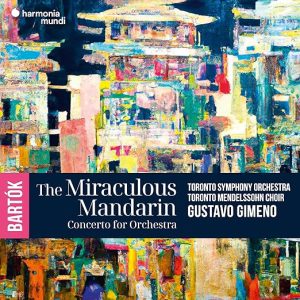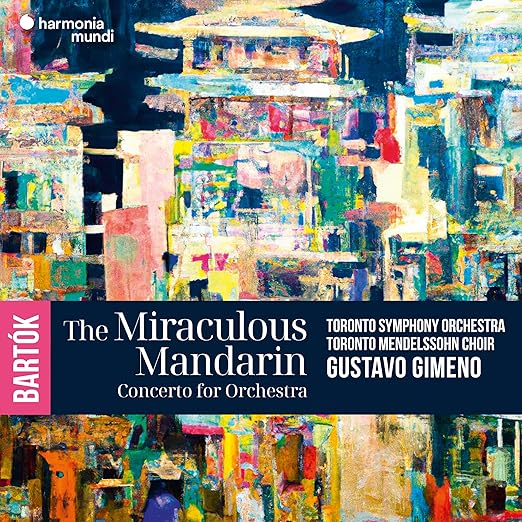
BARTOK: The Miraculous Mandarin, Op. 19; Concerto for Orchestra; LEBEL: the sediments – Toronto Symphony Orchestra/ Toronto Mendelssohn Choir/ Gustavo Gimeno – Harmonia mundi HMM 905365 (12/11/25) (80:13) [Distr. by PIAS] ****:
After my first encounter with the suite from Bartok’s 1926 pantomime The Miraculous Mandarin (via the RCA recording by Jean Martinon), I retained the impression of a violent, expressionist score, quite without any sense of its theatrical merits. But then, around 1974, I accepted an invitation to attend a performance of the complete version – though lacking the chorus included in this recording – by the Rochester Philharmonic under the direction of associate conductor Isaiah Jackson, with the assistance of the Claude Kipnis Mime Theater. With the orchestra situated behind a thin scrim, and the mime artists directly forward, Bartok’s dark, political allegory of love and death suddenly made the composer emerge as a true man of the theater, and so I wrote my review, “Cruel Beauty,” for my college newspaper at SUNY Binghamton.
A most visceral Beginning announces, in violent, discordant energies, the rising of the curtain, with the setting as depicted by the Hungarian author Melchoir Lengyel, of a vacant city street that a gang of thugs use to attract and to attack strangers. Their chief lure is a young girl who poses in a window to seduce unwary travelers. The first two “seduction games” involve an elderly, debonair gentleman and a timid young man, both of whom the gang victimizes.
The third game, however, introduces a mysterious, Chinese Mandarin, whose eyes emit a demonic luster, especially when he beholds the young girl. The woodwinds in this piece rage and squeak in uncanny, frightful shrieks and twitters, their intervals leaping with feverish abandon. The brass and battery section of the orchestra, much expanded, invoke a colossal menace in modal and pentatonic scales, an aroused power of which the thugs have no concept. Attempts to stab and to strangle the Mandarin prove futile, and only when he possesses his inamorata does he succumb to death.
The fifth section, The Girl’s Dance, seems less a dance than a series of ugly, spasmodic gestures that manage to achieve an erotic waltz buried in conflicting rhythmic pulsations. Bartok’s means have borrowed much from Stravinsky’s barbaric convulsions of Le Sacre du Printemps. Section six, The chase – The tramps leap out, had a most effective realization from the Kipnis troupe, who ran in place with exhaustion’s suffusing the futile pursuit of the Mandarin.
After having been suffocated from a lamp bracket, Suddenly the Mandarin’s head appears shimmers and froths in misty ecstasies, a musical equivalent of some Aubey Beardsley nightmare that Richard Strauss overlooked. Bartok builds a dissonant, multilevel Liebestod from the morass of musical elements, the chorus now sighing according to the laws Debussy set forth in his third Nocturne, Sirènes. The wordless chorus breaks off in agony, leaving the last section, The Mandarin falls to the floor, not with a bang but with a whimper.
Emilie Cecilia Lebel (b. 1979) received a commission from the Toronto Symphony for the sediments, a one-movement, nine-and-one-half minutes long tone poem that plays like an extension of what used to pass as “space music.” It emerges as a series of dynamic effects for a large ensemble, heavy on the percussion that alternates with water and bird motifs. Long pedal points with cymbal sostenuto extend the “emotion,” if you will, of the composer’s reaction to the writing of Rachel Carson, who years ago alerted us about our fatal stresses on the Earth. This is the work’s world premiere recording.
Bartok’s Concerto for Orchestra (1943) already enjoys a thorough etiology of its commission by Koussevitzky (whose performance exists despite its non-commercial source) and at least two monumental recordings, by fellow Hungarians, Ferenc Fricsay and Fritz Reiner. Conceived as a hybrid symphony and concerto grosso, the piece relies on the use of diatonic harmony, for the most part, despite the versatility of the scoring and its colors drawn from the music of Bartok’s native land. Like his Third String Quartet, the Concerto proffers an arch-form in five movements, in the course of which every orchestral choir enjoys a brief, virtuoso status. The opening Introduction by Gimeno roes streamlined, driven linearly and recorded (21-23 November 2024) in sterling sound.
A snare drum announces (and concludes) the second movement, Giuoco delle coppie, “Game of the Pairs,” in which woodwind duets savor alternating intervals: bassoons in sixths, oboes in thirds, clarinets in sevenths, flutes in fifths, and the muted trumpets in major seconds. A brass chorale intrudes, only to cede to triple woodwinds at the da capo.
The slow introduction to movement one supplies the vibrant, thematic fodder for the mournfully anguished Elegia third movement. The fourth movement, Intermezzo interrottto, opens with a lyrical recollection of his native Hungary, presenting a beauty that appealed to comic Ernie Kovacs for a brilliant scena on his TV show. The “interruption” of the title occurs with wicked, parodic allusions from the Shostakovich 7th Symphony “Leningrad,” popular at the time. Bartok combines the coarse humor with a quote: a Lehar march from The Merry Widow.
Gimeno opts for the elongated version of the last movement, Finale, a potent rush to judgment that includes some pert fugal writing. Elegant brass fanfare work from the TSO illuminates the swift energy of this colossal movement, which just as suddenly breaks off into a moment of mock-pastoral, likewise treated in extended fugato. The clarity of line defines a polished, intelligently sculpted version of Bartok’s Concerto, which along with the full score of The Miraculous Mandarin, make a compelling case for Gimeno’s inclusion into the pantheon of fine Bartok interpreters.
–Gary Lemco