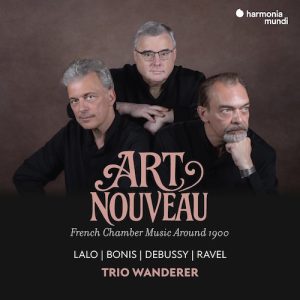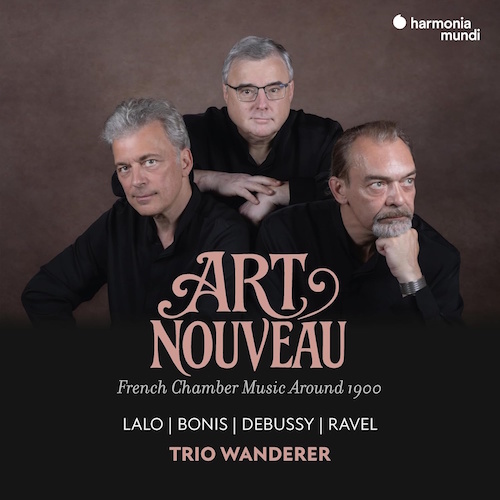
ART NOUVEAU: French Chamber Music Around 1900 = LALO: Piano Trio No. 3; DEBUSSY: Piano Trio; Violin Sonata; Sonata in D Minor for Cello and Piano; BONIS: Soir – Matin, Barcarolle in E-flat Major for Solo Piano; RAVEL: Sonata for Violin and Cello; Piano Trio – Trio Wanderer – Harmonia Mundi HMM 902394.95 (2 CDs = 59:36; 70:37, detailed content listing below) (1/20/26) [Distr. by PIAS] *****:
As a corrective to what composer Camille Saint-Saens noted as a dearth of French chamber music in the late 19th Century, a number of French musicians made a concerted effort to alleviate the situation with a spate of refined works in the genre. Recorded in July 2025, the eight compositions addressed by Trio Wanderer embody a diverse palette of rewarding musical expression by artists well aware of their Gallic heritage.
The gem of the collection appears early, Piano Trio No. 3 in A Minor (1880) by Edouard Lalo (1823-1893). Too often pigeonholed as a “singular success” with his Symphonie Espagnole, we hear in this chamber work French expressivity in the grand manner. The opening Allegro appassionato surges forth in the violin and cello, and then displays powerful alternations of the dramatic home key and the serenity of the relative major in C. The keyboard part, rendered by Vincent Coq, proffers potent octaves that often seem inexorable.
Some years ago, on my radio program, “The Music Treasury,” during my tribute to Ernest Ansermet and his Suisse Romande Orchestra, I aired a fine Scherzo in D Minor for orchestra by Lalo, unsuspecting that this essay in ostinato and marcato rhythm provided the second movement of this Trio. Violinist Phillips-Varjabédien has a fecund arena for his decisive, pungent attacks. Even the middle section bristles with alert pizzicatos. The “very slow’ third movement does not diminish the intensity, although the early, somber harmonies prophesy a journey into darkness. The model here seems to be Franck, especially in the grand keyboard octaves. But the intense melody becomes more lyrical as it progresses, eventually achieving luminescence.
The last movement, marked Allegro molto, evinces a clear resonance with the music of Robert Schumann, rife with dotted rhythms and triplet figures. Even the con fuoco marking does not belie a certain mirth detectable in the course of the movement, which ends in a series of canny “wrong notes” that imbue the cadences with a sense of irreverence. The entire course of this muscular and lyrical composition has been rendered with an undeviating authority and directness of purpose and warrants the price of admission.
The year 1880 found young Claude Debussy in the employ of Madame Nadezhda von Meck, the wealthy Russian aristocrat noted for her support of composer Peter Tchaikovsky. A derivative but sweetly ingratiating work, the four-movement Trio in G Major pays homage to Massenet, certainly, but no less to the circle of Russians, like Borodin and Mussorgsky, led by Balakirev. The haunted sense of melody in the first movement, Andantino con moto allegro, betrays many a touch from Schumann. The second movement, Scherzo: Moderato con allegro in B minor, the Trio in B major, assumes a more exotic color, with pizzicato effects and pentatonic scales, gently but suggestive of those further evolutions when Debussy’s musical character became solidified. The third movement, Andante espressivo, may well have been touched by Debussy’s constant contact with Meck’s idol, Tchaikovsky, and his own penchant for graceful melody. The Finale: Appassionato enjoys a fervent, restless energy, again somewhat recollecting the music of Schumann and Schubert. Occasionally, a modal harmony seeps through, a subtle touch of non-academic rebellion. The flamboyant keyboard part finds a delicate counter in the voices of the strings in high register. The last pages, resolute and grandly poised, urge a sense of drama hard to assign to other influences, and so we must applaud young Debussy’s originality.
Composer Mélanie “Mel” Bonis (1858-1937) has emerged from temporary obscurity to claim her rightful place among those French, male contemporaries who dominate much of the recognition. From Bonis’ prolific catalogue, Trio Wanderer offers two works, the1907 diptych Soir – Matin for piano trio, and the Barcarolle in E-flat Major (1906). Lush harmonies from violin and cello begin an ardent dialogue in the twilight piece, supported by an equally voluptuous keyboard. The liquid warmth of the piece echoes much of Fauré, climaxing in passionate figures. As the cello line evolves, we feel “The Swan” of Camille Saint-Saens lurking in the watery background. Matin evokes Nature’s awakening, but in more liquid medium than we find in Grieg’s “Morning Mood.” The flowing upper line of the piano and the whimsical flight of the violin bestow a sense of frivolous contentment to this brief Andantino. The Barcarolle, also Andantino, occupies a sonic space somewhere in the confluence of Fauré, Scriabin, and several Spaniards. Vincent Coq superimposes right hand fleetness as the left hand creates an arpeggiated cocoon around the melody.
After 1893, Claude Debussy had avoided the chamber music medium; but beginning in 1915, he embarked on a project of six sonatas that would justify his “discovering music,” as he expressed his feelings to conductor Désiré-Émile Ingelbrecht. Debussy’s prolonged illness would frustrate his ambition, allowing him to complete only half the cycle meant to celebrate the age of Couperin and Baroque clavecinistes. The 1917 Violin Sonata in G Minor offers the last of Debussy’s completed works before cancer claimed him. Modally ambiguous, the work evolves in lyrical patches, rhythmically restless from the first, the two instruments competing in 2/4 and 3/4. The first movement conforms to sonata form, but its mood swings from whimsical to sadly melancholy, until its climax seizes Spanish fire.
What the composer called “joyous tumult” continues in the second movement entitled Intermède (Fantasque et léger), a gypsified improvisation that invokes skittish, clownish figures from the commedia dell’arte. The biting sonorities of the keyboard play against the angular melancholy of the violin. Debussy invites the “cyclic” structures into his last movement, using the first motif of movement one, “like a snake biting its own tail.” Spanish gypsy impulses drive forward, gain a militant air, then relent into a dreamy meditation. The keyboard part resembles much in Debussy’s piano suites and preludes, often rippling, thundering, or cascading in various registers. A false ending that halts and then reascends in dire chords that presage the entirely new mode of the composer’s existence.
The 1915 Cello Sonata in D Minor exacts a lyrical approach to its entirety, a baritone troubadour who sings in times of trouble. The first movement, slowly sustained and resolute, casts a grim air of melancholy. The second movement, Debussy calls a Sérénade, again demanding his Fantasque et léger dynamic. Both canny humor and lyric tenderness emerge as competing affects. Once more, the Renaissance figure of Pierrot stumbles forth in irregular rhythmic patterns, disparate tonalities, with long held notes over pizzicatos in both instruments. The light, nervous finale, makes virtuoso demands on cellist Raphael Pidoux, who sails – accompanied by a lithe Vincent Coq – through all and any challenges with classical flair and grace.
Maurice Ravel (1875-1937) approached his 1922 homage to the late Claude Debussy, the Sonata for Violin and Cello, with a sense that his own style had evolved, striving for an “austere sense of melody” that eschewed his former, “impressionistic” sensuality. Zoltan Kodaly had provided a model with his Op. 7 Duo for Violin and Cello in 1914. But despite the new economy of his musical means, Ravel’s sense of color dynamics impresses us with its bristling, acerbic, bitonal textures that exploit the full range of both instruments.
Ravel opens his Allegro with alternating major and minor triads against aggressive seventh chords, the violin’s carrying a scurrying, dance melody while the cello provides a throaty syncopation. That the evolution proves more melodic than harmonically interested makes the sound compelling in its idiosyncratic classicism. The second movement scherzo plays arco passages against biting pizzicatos, the stinging sounds both voluptuous and punishing. The pulsation has a martial energy, a dark procession through insect labyrinths that likes to end glissando. The third movement indulges Ravel’s melodic gift, first through the somber solo cello, a kind of chorale which induces the violin to elaborate. The use of harmonics attaches an eerie beauty to the occasion. A moment of extended turbulence borrows the first movement’s seventh intervals. If a demure chastity has informed the music until now, the Finale, quick, sheds the restraint and offers a throaty, galloping rhythmic impulse that gains color and acerbity in its variety of attacks. Has Ravel borrowed a rhythmic riff or two from Kodaly? The “orchestral” sonority of the two instruments lets s know that Ravel’s control of color proves equal to the master whom he celebrates, the inimitable Debussy. The last chord from our duo lasts forever.
Dedicated to counterpoint teacher Andre Gédalge (1856-1926), Ravel’s Piano trio in A Minor (1914) possesses a unique blend of academic scholasticism and Basque and Eastern exoticism. The opening movement, Modéré, relies on the repetitive 8/8 rhythms from the Basque zortzico, unusual in refusing to modulate for the second, nostalgic theme away from the tonic minor. Pidoux’s cello line proves grippingly rich. The theme moves in small, mysteriously scalar increments until it jumps a fourth as it concludes.
The second movement proves the most original: a pantoum, a Malaysian verse form in
which two themes interlock through lines 2 and 4 of each four-line stanza, to become the first and third of the next stanza. In essence, this haunted movement embodies a scherzo and trio, juxtaposing ¾ injections by the string payers against the long 4/2 notes of the keyboard. Violin and cello execute fiercely quick repeated notes, even in left-hand pizzicato, while the piano seduces us with melody. The coda literally whistles with ecstatic fervor from the Wanderer ensemble.
The slow Passacaglia movement testifies to Ravel’s penchant for Baroque taste. Marked Très Large ¾, the polyphonic technique taught Ravel by André Gadalge manifests itself in an 8-bar, processional theme – appearing first in the piano’s lowest register – reiterated eleven times, a concession to the Great War a step away from his Tombeau de Couperin suite. The pungent last movement Final: Animé, relies on two antagonistic rhythms, 5/4 and 7/4, a Basque construction that has the violin’s having to negotiate, with precision, arpeggios and trills in harmonics. Trio Wanderer performs this demanding but quixotically satisfying music with seamless aplomb. Sound mastering by Hugues Deschaux provides the most reverent fidelity one could require.
—Gary Lemco
Art Noveau – French Chamber Music Around 1900
LALO:
Piano Trio No. 3 in A Minor, Op. 26;
DEBUSSY:
Piano Trio in G Major;
Violin Sonata in G Minor;
Sonata in D Minor for Cello and Piano;
BONIS:
Soir – Matin for Violin, Cello, and Piano, Op. 76;
Barcarolle in E-flat Major for Solo Piano, Op. 71;
RAVEL:
Sonata in A Minor for Violin and Cello;
Piano Trio in A Minor