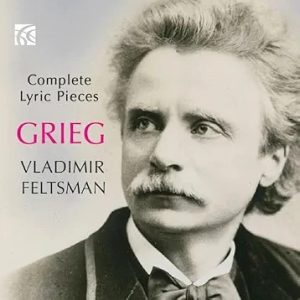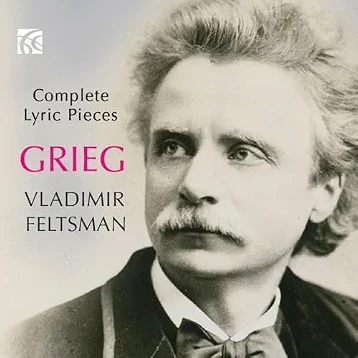
GRIEG: Complete Lyric Pieces: Opp 12, 38, 43, 47, 54, 62, 65, 68, 71 – Vladimir Feltsman, piano – Nimbus NI 6467 (3 CDs = 3 hrs 26 min, detailed listing below) (8/7/26) [www.wyastone.co.uk] *****:
Pianist Vladmir Feltman (b. 1952) recorded the complete sets of Edvard Grieg’s characteristic miniatures, his Lyric Pieces (1867-1901) in sessions at Wyastone Leys 27-29 March 2023. Norwegian composer Edvard Grieg (1847-1903) had assumed the mantle of Robert Schumann in these 60 short pieces, mostly conceived in ternary form that remains homophonic in syntax but decidedly faithful to the folk and dance impulses of his native land. Romantically expressive, artful and melodious at once, these relatively brief pieces present a surface charm undergirded by rigorous harmonic and structural acumen. Taken as a cycle in 10 books, we find that the three-voiced Arietta, Op. 12/1 recurs in parody as Efterklang, Op. 71/7, the Alpha and Omega of his musical journey.
Prior to this release, two pianists – kindred spirits, really – Artur Rubinstein (on RCA LM 1872) and Emil Gilels (on DGG 2530 476) recorded selected examples from the various books of pieces, each rendering the works with suave affection, perhaps even with Romantic affectation. The compendium created by Grieg has no inherent, narrative unity, as such: the miniatures stand as mood pieces and spontaneous utterances of Norway’s meadows and forests, of imaginative legends, of emotional musings, or of the folk-dance tradition ingrained for the composer by Ole Bull (1810-1880) and Rikard Nordraak (1843-1866).
A set like this allows any number of approaches beyond the chronological: The Op. 12 set of miniatures sets the tone for the entire project, from the pert Vals and the more literary Watchman’s Song, the spirit of the Nordic dance rushes in, on both a realistic and preternatural level, while the No. 5 Folkevise could be construed as a Chopin mazurka. The concluding piece, “National Song,” has Feltsman in a more stentorian mode, Maestoso, the last chords of which linger for some time.
The seductively rocking Berceuse which opens the Op. 38 (1884) set of eight pieces seduces us in high registers and soft arpeggios, the melodic line simplicity itself. Folk melodies and a playful Halling ensue, endemic Norwegian impulses, inflected judiciously. Feltsman evinces tonal beauty as a key asset for these gems. The Elegie projects an intimacy that rival music – especially their lieder – by Schumann and Brahms for its immediate effect. Another Vals appears, a bit virtuosic as well as melodious, it might reflect the influence of Tchaikovsky. The lengthy Kanon reveals more debts to Schumann than to Bach, concealing its learned points in the falling intervals of poignant emotion. The middle section sings of Norway proudly.
The set of six pieces of Op. 43 (1888) contain some of Grieg’s most quoted miniatures: I recall a Walter Gieseking 78 rpm of Little Bird and To the Spring. Both Rubinstein and Gilels immortalized Butterfly and the more chromatic Erotik. The light touch required for these concise miracles aligns them with Mendelssohn’s various. Songs without Words. “In My Homeland” may recall Bedrich Smetana as a possible source, but its artful parlando style bears Grieg’s own imprint. Butterfly and Little Bird nod to Schumann’s pictorial scalar passages. To Spring literally ripples with life-giving energy, a throbbing heartbeat that deepens as the passion of living becomes an enchanted paean worthy of Liszt.
Book 4, Op. 47 (1888) offers several masterpieces: the opening Valse-Impromptu challenges angular, rhythmic accuracy and subito legato, all the while altering tempo and accents. Feltsman’s sensitive trill makes a singular impression. Albumblatt, the longest of the set, proceeds in the modal formula well established in his native Norway, which at times prefigures improvisatory jazz elements. Melodie proves eminently vocal, the tune close to Borodin of the Second String Quartet. The drone-saturated Halling ripples with jabbing, folk excitement. A lovely Largo, entitled Melankoli, appears to be static, a piece by Satie, but it accumulates a lyrical breadth and concentration quite beguiling. By contrast, Springdans cuts an ungainly caper brusquely athletic. The concluding Elegie possesses the liquid, intimate nostalgia in passing dissonances that haunts our imagination long after the final cadence.
Grieg’s 1891 Book 5 has become better known in its orchestral guise (with the help of conductor Anton Seidl), the Lyric Suite, Op. 54. Feltsman imbues The Shepherd Boy with an expressive yearning, perhaps for the pleasures of Nature to remain untouched. The ensuing Peasants’ March enjoys a chime-like sonority, quite capable of a percussive, obsessive resolve. The March of the Trolls became the last of the set in the orchestral version, and here it insists on a clarion, staccato sensibility in the outer sections, while the middle part offers a wistful, diaphanous intimacy. The dream-scape Notturno bask in a refined aether not far from the Debussy sensibility, although the scalar progression hints at Schumann. Grieg’s virtuosic Scherzo: Prestissimo leggiero demands a series of contrasted touches, of which the ballade-like middle section, a beautifully harmonized parlando, has its own folk character. The final section, Bell-Ringing, had been meant to conclude the orchestral version, but Grieg chose otherwise. Once again, shades of Debussy (his Sunken Cathedral) invade our sound recollection, as the carillon advances in a martial but gently lyrical Andante.
The most significant piece from the Op. 57 Book 6 (1893) may be Gade, a tribute to the Danish composer (1817-1890) who instigated the so-called “Golden Age” in Denmark. After the extensive opening piece, Vanished Days, with its ballade-like, sectionalized structure and chorale impulses, the Gade, Allegro grazioso, presents a brightly affectionate “domestic” portrait, much in the narrative, duet-style of Schumann. The modally ambiguous Illusion may owe something to Schumann’s Prophet Bird, but without the skittishness. Secret lingers, Andante espressivo, in hesitant progressions, but we still wonder if any revelation occurred. Do we hear echoes of Grieg’s song, “Ich liebe dich?” If so, the secret is out. “She Dances” offers a sturdy, syncopated waltz, ardent and intimate, at once. The coda flitters away, gracefully. “Homesickness,” a consistent trope in Grieg, concludes the set, a moody key Andante whose middle, carillon section might recall an intimate family fest.
I well recall hearing Walter Gieseking play “French Serenade” (No. 3) from the Op. 62 Book 7 (1895), a delicate, slightly mercurial miniature, Andantino. Feltsman injects wistfulness amidst its figures. The opening piece Sylfide finds another allusion to impulses in Schumann, nervously settling into its main motive, fond of non-harmonic notes. “Thanks” takes some time to express its parlando gratitude, given the middle section’s graduated, repeated crescendo before the ritornello main theme. “The Brook” surely owes debts to Schubert, though these nervously bravura waters, Allegro leggiero, could run a menacing course through Liszt. The waters flow more serenely legato in “Phantom,” a liquid impression, if not of Ondine, then some more genial spirit. An extended trill casts the sense of evanescence forward. “Homeward” proffers a confidently assertive march, the middle section anther of Grieg’s hymnal tunes, gently yet urgently nostalgic.
I threw chronology temporarily aside for Book 8, Op. 65 (1897), given my predilection for No. 6, the ubiquitous “Wedding Day at Troldhaugen,” a broad, celebratory anniversary piece (the Griegs’ 25th) for wife Nina and for their home, “The Hill of the Trolls.” Like many of Grieg’s Lyric Pieces, subdominant harmonies and plagal cadences will feature in the stunning sound progressions; here, an infectiously buoyant waltz in C major. Feltsman applies a light hand though maintaining a firm grip on the rising of the ardent melodic line. We hear his sensitive application of Grieg’s idiomatic syntax in the first piece, “From Days of Youth.” There, the influence of Norwegian folk melody and indigenous harmonic syntax suffuses what seems a meandering recollection. The simple parlando of Bondens Sang (“Peasant’s Song”) bridges the gap between folk song and chorale. Several Grieg scholars note the similarities in “Sadness” and the “Folk Melody,” Op. 38/2, with their reliance of the subdominant coloring and the use of plagal cadences. Another waltz lyric, Salon (Allegretto con grazia) plays in an impressionistic, broken style, not far from Ravel. I Balladetone is marked Lento lugubre, and its somber progression lies somewhere between Brahms and Tchaikovsky.
Suddenly, Grieg’s music approaches the 20th century, but he holds the “advances” of Wagner, Schoenberg, and Scriabin at a conservative distance. Book 9 begins with “Sailors’ Song,” a hefty chorus, as it were, with a touch of Handel. “Grandmother’s Minuet,” on the other hand, enjoys an antique daintiness. “At Your Feet” suggests romantic homage, and its luxuriant, nocturnal harmonic language approaches progressions both in Fauré and Anton Rubinstein. “Evening in the Mountains” adds a touch of mystery, built from tiny, melodic kernels and ostinato rhythm, perhaps indebted to the likes of Liszt and Mussorgsky, a dark shepherd’s melody. “Cradle Song” appears on many interpreters’ music stands, since its simple lyricism invades the heart. Feltsman’s touch in the high register warrants the price of admission. Valse mélancolique nods to Chopin and Schumann both, a salon piece unafraid to allow the bass part is sonorous due.
Book 10, Op. 71 (1901) will, at the last piece, “Remembrances,” recall, in openly nostalgic terms, the Op. 12/1 Arietta in waltz tempo. But prior we have six pieces whose entrance to the 20th century call upon us: “Once Upon a Time” speaks to the fairy tale element of our lives, Andante con moto. Feltsman does not over sentimentalize its easy, parlando and clarion lyricism. “Summer Evening” is no less an effective orchestral piece by Delius, a Thomas Beecham staple. Grieg’s lyric casts a plaintive glow, tranquilly urgent. “Little Troll” might have served as an affectionate appreciation of wife Nina, though its spunky, staccato 16ths carry their own, folk motion. “Woodland Peace” could look to Schumann or to America’s MacDowell for kinship, but its elegantly extensive modal harmonies, Lento, belong singularly to Grieg. A last Halling, the echt Norwegian dance, makes a lively, even clangorous, appearance, hopping and skipping in unbuttoned pleasure. Altering the festive mood, Grieg submits Forbi (“Gone”), Op. 71/6, marked Andante doloroso, to intimate the juxtaposition of Life and Death. The passing, briefly contrapuntal, dissonances remain in the realm of Liszt and Mussorgsky.
As a complement to the collection of Lyric Pieces, Feltsman includes (in Disc 2) Grieg’s 1878 four Albumblatter, Op. 28. Identified only by their tempo markings (Allegro con moto – Allegretto espressivo – Vivace – Andantino serioso – Allegro giocoso), each offers a laconic mood, thoughtful or energetic, pieces pianist Feltsman characterizes as “charming and elegant.”
I venture that the entire project intends to be a tribute to Feltsman’s beloved teacher, E.M. Timakin, who bequeathed the world of Edvard Grieg to all of his piano students.
—Gary Lemco
GRIEG: Complete Lyric Pieces – Vladimir Feltsman, Piano
8 Lyric Pieces, Op. 12;
8 Lyric Pieces, Op. 38;
6 Lyric Pieces, Op. 43;
7 Lyric Pieces, Op. 47;
6 Lyric Pieces, Op. 54;
7 Lyric Pieces, Op. 62;
4 Albumblatter, Op. 28;
6 Lyric Pieces, Op. 65;
6 Lyric Pieces, Op. 68;
7 Lyric Pieces, Op. 71;