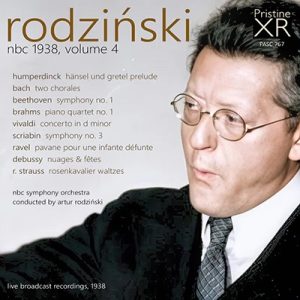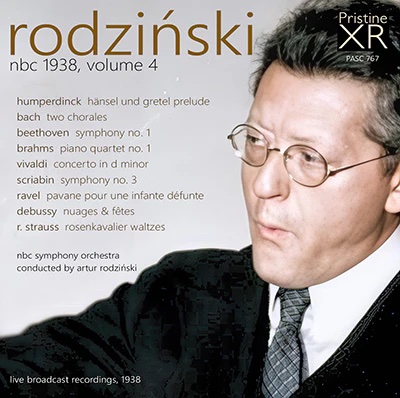
RODZIŃSKI NBC 1938, VOL. 4 = Humperdink, Bach, Beethoven, Brahms, Vivaldi, Scriabin, Ravel, Debussy, R. Strauss – NBC Symphony Orchestra/ Artur Rodzinski – Pristine Audio PASC 767 (2 CDs = 79:45; 78:01, complete contents detailed below) [www.pristineclassical.com] *****:
Andrew Rose and Pristine Audio conclude, with this Volume 4, their fascinating revival of the NBC Symphony concerts led by Artur Rodzinski (1892-1958) that preceded the assumption of the post of Music Director by Arturo Toscanini. The two programs here included, from December 24 and 31, 1938, respectively, offer a wide range of musical styles, some of which Toscanini did not embrace; and so, we have extremely rare documentation of the catholic taste Rodzinski brought to the podium in New York City. The Pristine XR sound process delivers a visceral, vibrant array of orchestral colors throughout.
The 24 December concert opens with Humperdinck’s 1893 Prelude to Hansel und Gretel, a Christmas-Eve delight, given the composer’s utterly lyrical application of Wagnerian procedures. Rodzinski elicits an extravagant, persuasive sheen from his NBC strings, and of the passages of brass in a militant aspect retain their hearty luster. Rodzinski had served with Stokowski in Philadelphia, doubtless imbibing that maestro’s affection for Bach chorale transcriptions. The Respighi arrangement of Nun komm, der Heiden Heiland proceeds with somber contrapuntal – and slightly, romantically mannered – dignity, ardent in its anticipation of Grace. My own affection for Wachet auf, ruft uns die Stimme derives from WNYC’s “Masterwork Hour” of yesteryear, a call to this faithful servant of classical music. Devotional and stately in tempo, this rendition lets us savor the festive richness of the NBC low strings and supporting brass.
The first major work for this evening, the Beethoven 1799 First Symphony, represents Rodzinski’s only document of this pioneer work of the composer who would redefine the symphony genre. The very opening, with its deliberate withholding of the tonic key, alerts us that a fecund mind drives the musical imagination. Once the Allegro con brio arrives, Rodzinski relishes – including the repeat – his athletically energetic element, the NBC woodwinds brilliantly pointed. The second movement, Andante cantabile con moto, after its canonic beginning, saunters with gently abandon within its repetitive structure, alternately martial and buoyant. Particularly vivacious, the Menuetto frolics in a most rambunctious manner, no longer willing to abide by courtly standards. A note of menace marks the Finale: Adagio – Allegro molto e vivace whose momentum discards anything like polite convention. Rodzinski has the music serve as an explosive, virtuoso vehicle for his NBC ensemble, which after any pause and hiatus, renews the energy with unfettered panache. Once the audience frees themselves from the grip of Rodzinski’s musical spell, the applause flows generously.
In 1937, the “progressive” composer Arnold Schoenberg decided to orchestrate the 1855 Brahms Piano Quartet No. 1 in G Minor. Schoenberg claimed that when performed in its original, chamber music medium, the pianist too often drowns out the strings, “and I want to hear everything!” In order to achieve a broad, symphonic effect, Schoenberg re-scored the piano quartet, now featuring percussion, glockenspiel, xylophone, cymbals, bass and snare drum, triangle, and tambourine. The E-flat clarinet will execute some folk-like motifs, and the trombones play glissandos, as they must do in Schoenberg’s own Pelleas und Melisande, Op. 5. If the Beethoven symphony had not confirmed the NBC virtuoso prowess, certainly this score under Rodzinski’s febrile direction dismisses any and all doubts!
The music itself, as in the first and third movements, projects large arcs of contrasting moods, consolingly lyrical or sternly martial in affect. The second movement Intermezzo emerges as kin to the early Brahms serenades, Opp. 11 and 16, though it, too, has some dark moments. Arguably, the center of gravity occurs in the Andante con moto third movement. Beginning in the manner of a hymn, the new orchestration assigns the music a girth that compares to an excerpt from Mendelssohn. Suddenly, a series of dotted chords invoke a quick, martial impulse that soon gains ascendancy of no mean order. In ternary form, however, the opening motifs reappear in a more resignedly placid, serenade guise. The last movement, a throwback to the Brahms gypsy days with violinist Eduard Reményi, whirls playfully in a series of color variants, especially using Schoenberg’s spliced-on battery instruments. This lusty Rondo alla zingarese only lacks a Universal Pictures set from Curt Siodmak to complete its “kitchen-sink” sensibility of motley effects. For the last pages, Rodzinski has the NBC move from a chamber music combination of robust urgency and tender sentimentality. For the last pages, Rodzinski moves from an intimate chamber music sequence to an after-burners manic coda, obviously to bring down the house.
Disc 2, the New Year’s Eve concert, opens its diverse color-program with Siloti’s arrangement of Vivaldi’s Concerto grosso in D Minor from L’estro armonico, a piece equally popular with Serge Kousssevitzky in Boston. The thick harmonization of the NBC strings notwithstanding, the rendition displays warmth and discipline, at once. The second movement, Adagio e spiccato, conveys a deep, ecclesiastical feeling, especially befitting the tides of the season.
Rodzinski next addresses the monumentally solipsistic ego of Alexander Scriabin, whose Third Symphony of 1905 claims an unbroken succession of vision in three interlocked movements that embraces the competing and playful forces of creation. A dire sense of menace opens Luttes, the conflict between God and Humanity. By harmonic twists and turns tossed among diverse choir members, the music appropriates post-Wagnerian, hymns and orisons, yearning motivic kernels, the periods “oceanic,” for want of a better term. Almost imperceptible at first, the second movement Voluptés enters, a call from the seductive and erotic impulse in Nature. Do we hear evocations of Wagner’s Forest Murmurs and later, Gliere’s Ilya Mourometz? The ardor of the music seems interrupted by competing forces, especially by the trumpet. Suddenly, we find ourselves in the throes of the Jeu Divin, the cosmic play of eternal forces. The trumpet call asserts itself forward and inverted, perhaps Scriabin’s attempt at the ouroboros, the cyclical mystery of creation. A rhapsodic militancy takes possession of the momentum, the syntax of Scriabin’s harmonic progress tonal but no less boundless. A solo violin has consistently uttered some response to the dynamics proffered by the Universe, whose totality Scriabin would eventually try with his concept, Mysterium. With the final drumbeats here, The Divine Poem receives an enthusiastic, earthly response.
An immediate contrast ushers forth in Ravel’s dreamy 1910 Pavane for a Dead Princess, orchestrated from the original 1899 piano piece. In suggestive modal harmonies, Ravel invokes a sense of placid acceptance and spiritual repose. Rodzinski insists on a diaphanous, transparent orchestral patina. The late, sighing figures in winds and strings bear repetition. Music of Debussy, two of his Nocturnes, follows, conceived as grisailles, studies in degrees of shade, a la Rembrandt and J.W.N. Turner. Nuages pulsates in deftly erotic colors, while Fêtes bristles with kinetic energies. The intensity of Debussy’s colors in winds, strings, and brass do not suffer in comparison with anything from Respighi. The distant procession then approaches, a veritable, quick march along the Via Appia. Having overwhelmed us with its swirling colors, the fierce tumult cautiously relents into a bucolic ether.
As fitting for New Year’s Eve, Rodzinski says farewell by means of the Richard Strauss first dance sequence of waltzes from Der Rosenkavalier, his sympathies in concert with Clemens Krauss and Hans Knappertsbusch in Vienna. Lush and exuberant, the gaiety of the occasion bodes nothing of the political climate of the times. The brisk articulation from the NBC strings maintains a joyful energy that literally throbs with earthly delights.
Pristine has retained the closing remarks by Gene Hamilton, and we will retain this sound document indefinitely.
–Gary Lemco
RODZIŃSKI NBC 1938, VOL. 4
HUMPERDINCK: Hansel und Gretel Prelude;
BACH (orch. Respighi): Nun komm, der Heiden Heiland, BWV 659; Wachet auf,ruft uns die Stimme, BWV 645;
BEETHOVEN: Symphony No.1 in C Major, Op. 21;
BRAHMS (arr. Schoenberg): Piano Quartet No. 1 in G Minor, Op. 25;
VIVALDI (arr. Siloti): Concerto in D Minor, Op. 3/11;
SCRIABIN: Symphony No. 3 in C Minor, Op. 43 “The Divine Poem”;
RAVEL: Pavane pour une infante defunte;
DEBUSSY: Nuages; Fêtes;
R. STRAUSS: Der Rosenkavalier: Waltzes – First Sequence