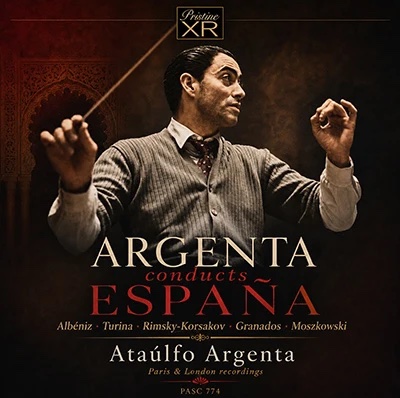
Ataúlfo Argenta: ESPANA = ALBENIZ: Iberia, excerpts; TURINA: Danzas fantasticas; RIMSKY-KORSAKOV: Capriccio Espagnol; GRANADOS:Andaluza: No. 5 from Danzas españolas; MOSZKOWSKI: Spanish Dances – Pristine Audio PASC 774 (complete listing and credits below; 79:11) [www.pristineclassical.com] ****:
Possibly the most notable of all of conductor Carl Schuricht’s proteges, Ataúlfo Argenta (1913-1958) left us a legacy of classical standards and zarzuelas that testify to his deep affection for the Spanish folk idiom. His untimely demise by misadventure — carbon monoxide poisoning in his automobile — cut short his flowering association with several ensembles, those included on this disc and the L’Orchestre de la Suisse Romande in Switzerland. Andrew Rose and Pristine here combine Decca studio recordings from the 1950s whose resonance has been enhanced by the XR remastering process.
Leading the Paris Conservatory Orchestra in 1953, Argenta first addresses selections from Isaac Albeniz’s Iberia suite (1905-1909), beginning with the impressionistic, languorous “Evocacion,” whose repetitive, enchanting melody in modes of A-flat eventually comes to the flute. The colorfully striking “Corpus Christi Festival in Seville” proceeds in modes of F#, subsuming whatever solemn, martial character of the occasion to a sultry, exotic mysticism reminiscent of Borodin. The pageant literally blazes forth, quadruple forte, after having sung in the vibrant cante jondo of Andalusia. We next sojourn to the gypsy quarter of Seville for “Triana,” rife with fandango rhythms of distant guitars, brass, and percussion. Once more the seductions of flute and strings transforms the modes of F# into compelling and alluring Spanish and Andalusian energies.
From the town of Cadiz we encounter the zarzuela impulses of “El Puerto,” set in flamboyant, blustering figures. The woodwinds project an ironic sense of diverse human traffic, alternately mincing and swaggering. As evening sets in, the mood becomes more sentimental and affectionately bucolic. We say extended farewell in Granada, from “El Albaicin,” a moody piece in haunted modes of B, softly ablaze with martial cadences tempered by the sound of brass and tambourines. Argenta emphasizes the sultry erotics of the procession, a quality no less apparent in the suite as a whole.
The French orchestra led by Argenta next performs the 1920 arrangement of Joaquin Turina’s 1919 piano suite Danzas fantasitcas, after a novel by Jose Mas. The first of the set, “Exaltacion,” generously expresses a jota aragonesa, whose eroticism pulsates and throbs with grand intensity. The large, central dance, “Ensueno,” presents a 5/8 zorziko melody in melancholy guitar figures, in the which the strings and winds extend the wistful atmosphere. The passionate finale, “Orgia,” assaults us with flamenco combinations of Andalusian farruca and cantes jondos. The music invokes the mesmerizing scent of the local flora, a shimmering, swirling dance in the best tradition of Manuel de Falla.
Few orchestral works exploit the color possibilities of the diverse choirs like Rimsky-Korsakov’s 1887 Capriccio espagnol, which the composer considered under-appreciated for its brilliant presentation of themes of Spanish character. In five distinct sections, the piece carries an impressive momentum, resonant with the rhythms and colors of the Asturian region of Spain. To date, my own preference in performances has been that of George Szell and his viscerally inflamed Cleveland Orchestra. The expressive violin cadenzas make me wish Rimsky-Korsakov had conceived a full concerto for the instrument to complement his wonderful writing for Scheherazade and his Fantasy, Op. 33 on Russian Themes.
Argenta leads the LSO 1956-57 in highly effective realizations of the scores that embrace Granados and Moszkowski besides the Caprice. After an exuberant sunrise “Alborada” in the Caprice, the second section of serene variations features some silken oboe and horn work complemented by luxurious strings in cante jondo. The “Alborada” returns, trumpets afoot, and the solo violin in alluring, gypsy form. The “Gypsy Song” proper enjoys a fanfare of splendid resonance, invoking the violin cadenza, which soon embraces the harp and tympani. The flute enters over a tympanic and cymbal accompaniment, along with harp and triangle, to make way for the glorious fandango finale. Each solo instrument seems intent on surpassing his fellows, and the battery section of the LSO sounds particularly alert. The clarinet enter with more Iberian luxury, while pizzicato strings sound out a martial tattoo that incurs a stratified medley of compounded tunes. Argenta saves his speedy paroxysm of energy for the last, animated thrust of a coda.
Spanish languor returns for the ever-appealing Granados “Andaluza,” his glorious andantino from the 1900 set of Spanish Dances, Op. 37. Set in E minor, the piano (or guitar) piece sashays in a loose waltz, flamenco rhythm, a ternary form nostalgic and compelling on every level.
Argenta concludes with five Spanish Dances (c. 1883) by piano composer Moritz Moszkowski. From the very first, in C major, a sense of flamboyant, aristocratic elegance emerges. No. 2 in G minor offers a more thoughtful pose, Velazquez in refined portraiture. Its central section has more of the swirling, courtly dance element. The A major No. 3 flourishes in high gestures in the Asturias tradition, almost the kind of color preparation for either the court ball or bulllfight. No. 4 in B-flat major appears more contrived, mannered in its syncopated gestures, though its middle section, bursting with castanets, insures its appeal. The finale, No. 5 in D major, enjoys a Spanish ostinato that helps the music bounce along in dramatic, polonaise gestures, including high fanfares that resonate with an allure reminiscent of Tchaikovsky.
—Gary Lemco
Ataúlfo Argenta: ESPAÑA
ALBENIZ: Iberia: 5 Excerpts;
TURINA: Danzas fantasticas, Op. 22;
Paris Conservatory Orchestra/
RIMSKY-KORSAKOV: Capriccio espagnol, Op. 34;
GRANADOS:Andaluza: No. 5 from Danzas españolas, Op. 17;
MOSZKOWSKI: Spanish Dances, Book I, Op. 12
London Symphony Orchestra
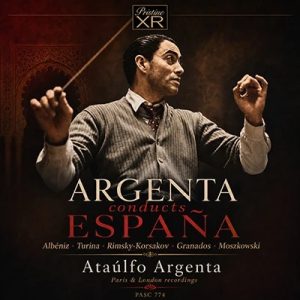
From Pristine Audio, Ataúlfo Argenta conducting “España”, a collection of Spanish Music. Classical Review by Gary Lemco.