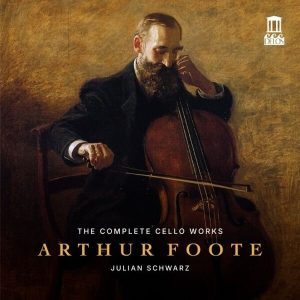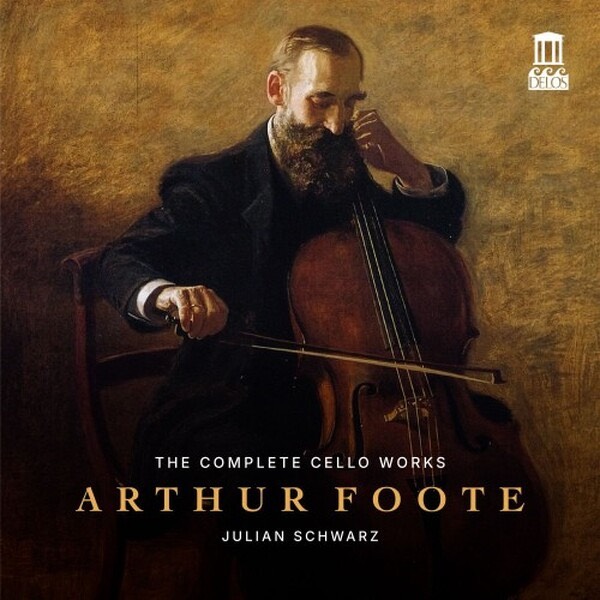
FOOTE: The Complete Cello Works = 3 Pieces, Op. 1; Aubade, Op. 77; Scherzo, Op. 22; Cello Sonata in E Minor, Op. 78; Cello Concerto in G Minor, Op. 33 – Julian Schwarz, cello/ Marika Bournaki, piano/ Buffalo Philharmonic Orchestra/ Gerard Schwarz – Delos DE3619 (8/28/26) (69:50) [Distrib. by Outheremusic] *****:
Arthur Foote (1853-1937) has remained, for me, a “singular success,” known for one piece, his Suite for Strings in E Major, Op. 63, recorded by Serge Koussevitzky and the Boston Symphony on 19 March 1940. A member of the “Boston Six,” Foote held the singular repute for having been trained strictly in the US, his instrument having been the organ. A pedagogue and educator, Foote advocated for both Brahms and Wagner, given his own penchant for Romantic expression. His catalogue boasts considerable opera in chamber music, and his works have gleaned a respect parallel to the reputation of Walt Whitman in poetry.
Cellist Julian Schwarz opens with 3 Pieces, Op. 1 (1881), whose No. 1 (Andante con moto) reflects a Schumann pathos, moving from a simple parlando filigree into a luxurious and virile middle section, then returning to the opening material. The instrument, a 1743 Gagliano, projects a lower range of commanding beauty. No. 2 (Andante) has a Brahmsian cantabile quality, close to the famous Lullaby from Brahms Op. 49. The middle section may remind some listeners of moments in Dvorak before assuming a more aggressive tenor. The piano fioritura, no less rich in sonority, has Bournaki’s Hamburg Steinway B to claim sweet credit. The third of the set proffers an agile tarantella, marked Allegro con fuoco, and fiery it is. The piano writing flows in a Schumann spirit, but let’s not diminish Foote’s innate melodic powers.
The 1912 Aubade celebrates the virtuosity of Alwin Schoeder, principal cellist of the Boston Symphony Orchestra. A gentle sicilienne rocks lullingly, intoning a secondary, breathful melody of ample ascendancy. With the appearance of low notes, the music proceeds with a bariolage cadenza before resuming to the da capo.
Foote’s Scherzo, Op. 22 (1890) presents a bravura moment of active motion which then enters into a folk song of Schubertian attractiveness. Playful and ardently melodic at once, the music flows in a seamless progress, returning to its whimsical opening with the same security that we find in the best pieces by Grieg or MacDowell.
The Cello Sonata in E Minor (1912-1918) has enjoyed relative popularity amongst cello players, due to its skillful combination of melody and chromatic harmony. The first movement, somberly expressive in the cello’s low register, soon sweeps upward to sing, Allegro appassionato. A strong Schumann influence can be felt, but the lyrical spontaneity declares Foote his own man. The secondary tune, more reflective, allows pianist Bournaki her moment in the sun, soon joined by the duo’s expressive, circuitous harmonic routes to develop the rare intimacy and ardent passion of the occasion. The luminous quality of the Gagliano instrument shines even in plucked as well as in arco passages. The coda proves richly fertile in sonority, assertive without exaggeration.
Foote remains noted for his fondness of antique forms within which to express his often-restrained lyricism. The second movement, Andantino con moto, presents an extended cantilena for the cello, to which the keyboard adds lush harmonic context. Meditative and quietly melancholy, the music moves in small gestures, akin to the sequences familiar from Brahms and Schumann. The piano, though, invokes liquid runs reminiscent of Debussy when it occasionally intrudes upon the cello’s solo musings.
The latter part of the movement re-establishes the grand melodic curve that marks this movement for special dispensation. The relatively brief final movement, Vivace assai, enjoy a robust momentum, often verging on the tarantella rhythm, but moving to a more stentorian and expressive exclamation. The suave sense of musical transition keeps us alert to the many striking effects asked of cellist Schwarz, who realizes Foote’s requirements with a hefty aplomb. The extended coda provides a dramatic sense of closure for both participants.
The Cello Concerto in G Minor, Op. 33 (1896), here given its world premiere commercial recording (23-24 March 2024), was dedicated to cello virtuoso Bruno Steindel (1866-1949), then principal of the ensemble that would become the Chicago Symphony under Theodore Thomas. Given the melodic richness and virtuosic tessitura of the solo part, this work should inhabit the same, lofty regions as Victor Herbert’s Second Concerto. Opening much in the mode of the Lalo Concerto, the Allegro ma non troppo first movement immediately offers a cadenza which, in its own way, reminds us of Elgar’s E Minor Concerto. The orchestra enters, only to be silenced by another cadenza, deeply and passionately intoned in multiple stops.
The cantilena extends accompanied by thin orchestral support so that the cello can urge the music forward in shifting, yearning gestures. A new section emerges, lyrically and rhapsodically engaged. The orchestra suddenly looms up in full force, layering the thematic gestures in the manner of Schumann and Liszt. Strong bariolage effects announce the cello’s presence once more, double stopping, and rising on the open strings to bask in melodic kernels for the sheer exuberance of the cello’s glamorous sound. The coda appears to develop its own music that, attacca, leads to the Andante con moto second movement.
This lovely movement possesses its own song momentum, even as the melody is interrupted by a misterioso passage that flowers into a passionate meditation. The scalar motion of the theme, with its transparent accompaniment, enjoys an operatic luminescence, almost a nocturne, as if an alto solo were moving freely in a bucolic, natural setting.
A brusque rondo gesture opens the last movement, Allegro comodo, a swaggering motion enhanced by virtuoso filigree from cellist Schwarz. The music insinuates a folk element that the cello takes up for melodic development. Jaunty gestures from the orchestra maintain the lightness of tone, though the urge to solo bravura proves too tempting to deny. The swirling, robust motion invests all participants with an energy the bariolage of the cello compresses into an explosive force. The rhapsodic nature of Foote’s melodic gift returns, leading to another cadenza, this a dramatic tour de force, rife with pungent, shifting effects and high tessitura, only to maintain a long pedal so the orchestra and Schwarz may savor a last, potent crescendo.
—Gary Lemco