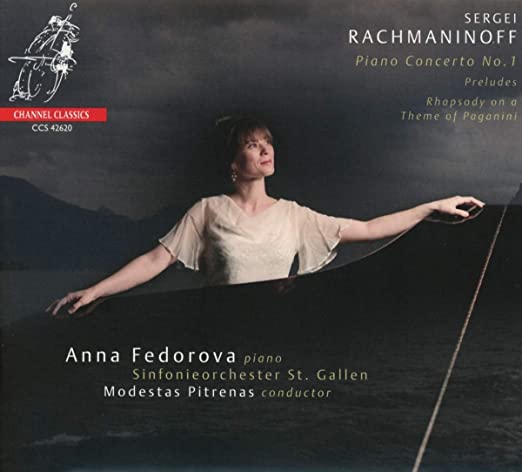
RACHMANINOFF: Piano Concerto No. 1 in F-sharp minor, Op. 1; Preludes: F-sharp minor, OP. 23, No. 1; G-sharp minor, Op. 32, No. 12; G Major, Op. 32, No. 5; B-flat Major, Op. 23, No. 2; Rhapsody on a Theme of Paganini, Op. 43 – Anna Federova, piano/ Sinfonieorchester St. Gallen/ Modestas Pitrenas – Channel Classics CCS 42620, 69:00 (3/6/20) [Distr. by Harmonia mundi/PIAS]****:
Rachmaninoff worked upon and completed his Piano Concerto No. 1 in the summer of 1891, while still a student of Arensky at the Conservatory. The work premiered on 17 March 1892, under the orchestral direction of Safonov, who seems to have accepted the score without his making his own editorial cuts. That task came later, during the 1917 Russian Revolution, when Rachmaninoff revised the central tutti of the first movement and the first half of the cadenza. Rachmaninoff openly confessed that his model for the score lay in the A minor Grieg Concerto.
The piece opens with a hearty orchestral fanfare – from bassoons, clarinets, and horns – rife with the sound of Russian bells, a Rachmaninoff gambit that finds its justification in both liturgy and Edgar Allan Poe. The sense of Russian passions derives from constant alternation of tonic and dominant chords, and Federova does not stint on the massive sonorities. The large, lyrical theme spills from the orchestra into the keyboard, whose components Rachmaninoff breaks into sequences, flighty figurations, and rhapsodic musings, some in B minor. The cadenza proper – centered in D-flat Major – resonates with Grieg’s example, though this Slavic composer has his own power of expression, especially when it comes to revving up the energies at the coda. The innate warmth of the St. Gallen string line has been well captured by Producer Jared Sacks.
Certainly, the opening of Grieg’s second movement informs Rachmaninoff’s own Andante movement, but he resists pure imitation to forge distinctive, harmonic wanderings. The music plays as a combination of nocturne and rhapsody, a series of meditations, a theme succeeded by two, freely conceived variants. Rachmaninoff’s use of unresolved dominant seventh chords adds to the ethereality of the movement. While the music urges us towards D Major, Rachmaninoff consistently denies us much pause in this tonality, relying on C-sharps to maintain the tension. The cloudy, dreamy, intimate harmonies finally cede to the call of D Major. The dominant C-sharp actively participates in the rousing last movement, Allegro vivace, a true virtuoso showpiece, more rhetorical than substantive, but whose big theme justifies the ride. Federova meets the often, grueling rhythmic challenges, which revel in galloping 9/8 and 12/8 fragments, broken up and then recurring whimsically. The sweeping arpeggios and grand gestures accentuate the theatricality of the music. The generous, Rachmaninoff lyric occurs in E-flat Major, and the piano and strings remind us of what future pleasures this composer would bring to us. Much of the keyboard figuration conveys the composer’s great admiration for Chopin. Rachmaninoff decides to propel his music to D Major, and then with a huge shift at the coda, Allegro vivace, to the parallel tonic F-sharp Major. Federova has a fully demonic explosion at the finale, pure bravura, for a most satisfying rendition of this early, vibrantly promising work.
As part of her “express train” traversal of Rachmaninoff’s development in this album, Federova provides us yet another, passionate reading of the 1934 Rhapsody on a Theme of Paganini, his final work for piano and orchestra. Taking its cue from the 24th Caprice in A minor, Op. 1 from Paganini, as had Liszt and Brahms for their respective etudes, the single movement subdivides into three sections in the manner of the standard concerto. That the piece might be construed as a ballet or fantasy based on the “legend” of Paganini has full credence in the Moira Shearer/James Mason episode in the 1953 film The Story of Three Loves. At Variation 7, the bassoon introduces a meditative tune accompanied by the Dies Irae of the Requiem Mass, a constant motif in the Rachmaninoff canon. The half steps and minor thirds of the original tune allow Rachmaninoff to create the splendid inversion at Variation 18 in D-flat Major that has become a musical icon with a life of its own. Federova imparts a glistening patina upon the entire progression, relishing the keyboard’s upper registers and the music’s natural, singing capacities. Her interplay at Variation 16 with oboe, violin and horn has a mesmeric quality, as the music moves into its most erogenous zone, culminating in D-flat. Variations 19-24 provide a dazzling, extended coda, rife with canny manipulations of rhythm and whiplash, digital prowess. That the Dies Irae itself reigns triumphant ultimately nods to Liszt and his own Totentanz, although the sense of personal victory has refused to yield to the forces of dissolution.
Federova chooses four Rachmaninoff preludes as a sort of intermezzo in her program: she calls the F-sharp minor, Op. 23, No. 1 “deeply tragic, dramatic and hopeless.” The Op. 32, No. 12 in G-sharp minor conjures for Federova the image of troika, set in a snowy landscape, the sled pulled by horses wearing little bells around their necks. The way ahead feels both whimsical and melancholy, performed in a most liquid fashion. Federova feels that the G Major, Op. 32, No. 5 exudes “fresh spring air, the scent of lilac which Rachmaninoff adored and the feeling of quiet ecstasy from uniting with nature and beauty.” Federova pays deep homage to this lustrous piece, much as does Moiseiwitsch in what I consider the definitive recording. Finally, the optimistically explosive Bb Major, Op. 23, No. 2, “the bright side of Russian soul – festive Easter Church bells, jubilation and exultation, generosity and warmth, and a big loving heart!” Here, Federova reveals something of the “Richter tradition” in large chords in splendid volume, massive, but without intrusive percussion and still singing.
–Gary Lemco