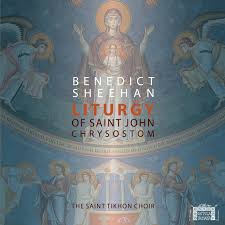
BENEDICT SHEEHAN: Liturgy of St. John Chrysostom – The St. Tikhon Choir/ Benedict Sheehan/ Timothy Parsons, countertenor/ Michael Hawes, baritone, Jason Thoms, bass – Cappella Records CD + Blu-ray Pure Audio CR421-CDBR, 75:13, 2:23:31 *****:
It’s not too often that we get a full recording of any kind featuring a newly composed setting of the Liturgy of St. John Chrysostom. The catalog is full of various editions by a host of Slavic and other composers (Tchaikovsky, Rachmaninoff, et al), and of the entire liturgy but with various elements taken from disparate sources. Occasionally there may be a Byzantine or other ancient-sourced audio documentary offered and many of these are truly excellent. But though the dearth of modern composed efforts in this regard does not reflect the actual number of pieces created, recordings are rare aside from the occasional audio clip or YouTube recording. So it is nice that Cappella Records, home to the fabulous Capella Romana ensemble has decided to offer this new work (2018) in such a comprehensive and full-blooded treatment that gives us the goods in standard CD, Blu-ray audio, and the whole shebang in excellent audio and video filmed at the St. Nicholas Cathedral of the Orthodox Church in America in Washington, DC.
The work itself is fresh and vibrant, a product of composer and Orthodox Christian Benedict Sheehan, currently the Director of Music at St. Tikhon’s Orthodox Seminary and Monastery, the latter the oldest established Orthodox monastery in the United States. Being Russian in liturgical tradition, Sheehan has stated that this is perhaps the guiding element in his composition of the work, yet anyone familiar with Russian Orthodox choral music can be forgiven if they are not overwhelmed by this particular influence. Though the Russian Orthodox Church, which had banned Tchaikovsky’s Liturgy many years ago yet had long since allowed what was originally frowned upon—harmonic settings of the liturgy—to become the standard of what we all now recognize as the great Russian Orthodox choral tradition, changes in modern day practice among even Byzantine composers allowing harmony settings have widened the notion of what constitutes Orthodox music greatly. Influences abound everywhere in this work, reflective of the increasingly eclectic Orthodox music scene.
This is not a bad thing—many people have been calling for the broadening of what Orthodox music is according to the many cultural influences found everywhere that Orthodoxy is practiced, almost every country in the world. This is after all, exactly what happened in Russia itself. But this is not indicative of a free-for-all, musically speaking, as the Orthodox Church insists on a certain degree of musical vibrancy that encourages the souls of worshippers to prayer and reflection on the glory of God and avoid any sort of cheap sentimentalizing, something that many of the famous Russian and Serbian (and others) church compositions overindulge. Orthodox worship is not to play solely to the emotions, but to provoke gratitude and compunction in the hearers.
The above statement is perhaps what I like best about Sheehan’s liturgy. When it is over, I cannot really recall any moment that I hum or remember in some indelible way. This would be the kiss of death in a piece like Rachmaninoff’s All-night Vigil, which has melodies that are as memorable as any orchestral or piano piece he ever wrote, but was also intended as a reflection of religious piety (and for the concert hall) instead of something for actual worship in a church. This is a testament to the power of this offering in that it doesn’t draw attention to itself, but to the functional worship of God in a liturgical setting. There are memorable moments in the piece, but they are encountered in the context of the immediate worship experience. The only time I sensed this to not be the case is the only non-liturgical piece here, Psalm 148, offered as “filler” in the divine liturgy during the communion of the clergy and preparation of holy communion for the faithful, a common practice in Orthodox churches, and not a part per se of the divine liturgy.
Sheehan emulates the incursions of the so-called “god squad” of Gorecki, Tavener, and Part, along with their many disciples in the current choral scene in offering a work that is scintillating in its effervescent close harmonies, unashamed dissonances (always used efficiently without emphasis), and general love of harmonic richness. There is a myriad of other influences that abound but dissecting them would prove pointless and disavow the subtlety of their effectiveness. He does use a pentatonic idee fixe as a guiding discipline in his composition but trying to discern it proves defeating and distracting from the overall effect. My one point of contention is perhaps the use of a countertenor as soloist. Though there can be no doubt that today they sing with force and virtuosity unknown just a few decades ago, I’ve not encountered them in Orthodox music, nor can I find examples of their use in the past in this genre. It feels just a bit trendy to me, though I freely admit this as a personal conundrum as one who objects to the rather strained and unnatural sound they produce. I cannot fault Mr. Parsons, as he seems to execute the role as well as any on record today in other literature.
This is a superb effort on many fronts, not least of which is the quality of the work itself. The production is engineered by the wonderful technicians at Soundmirror, which is self-recommending, and the St. Tikhon’s ensemble is spot on, captured in brilliant surround sound. Here’s hoping that more releases like this, from Sheehan and others, are in the offing for the near future.
—Steven Ritter