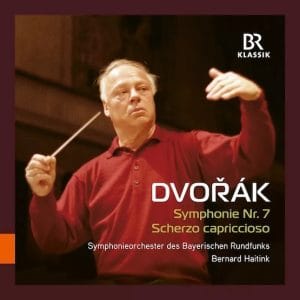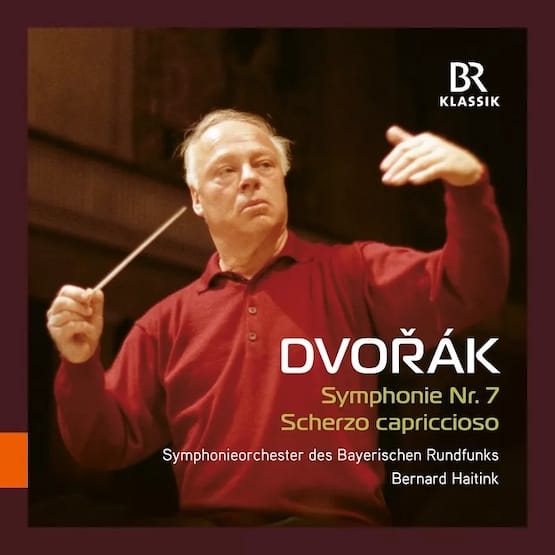
DVORAK: Symphony No. 7 in D Minor, Op. 70; Scherzo capriccioso, Op. 66 – Bavarian Radio-Symphony Orchestra/ Bernard Haitink – BR Klassik CD 900223 (49:41) [Distr. by Naxos] ****:
Dutch conductor Bernard Haitink (1929-2021) sustained a productive relationship with the Bavarian Radio Symphony Orchestra – much in the tradition of his predecessor Rafael Kubelik (1961-1979) – until October 2021, the time of Haitink’s death. BR-Klassik has issued a series of live, previously unreleased performances, of which this Dvorak Seventh Symphony (Munich, 3/27/81) emanates heroic power. The complementary Scherzo capriccioso derives from a studio session 3/24/81, also taped at the Herkulessaal der Residenz, Munich. The 1885 Seventh Symphony received critical acclaim for its potent, robustly dramatic expressiveness, warranting Tovey’s assessment that it – following the Schubert Ninth Symphony and the four symphonies of Schumann – stands firmly in the tradition established by Beethoven. The 1883 Scherzo capriccioso exploits Czech folk impulses in a free adaptation of rondo and sonata form, including a colorful harp cadenza. As an exuberant exercise in orchestral virtuosity, the work proves exuberant and effective, a virtuoso display piece that reverberates with national color.
Prior to this BR Klassik issue, my personal favorite readings of the Dvorak D Minor Symphony have been led by Carlo Maria Guilini and the New Philharmonia Orchestra (BBC Legends BBCL-4194); George Szell from Cleveland on CBS (SS 89412); and Sergiu Celibidache from 1987 Munich on youtube. Haitink, whom I often admired – and then dismissed – as a linear, literalist interpreter whose demand for clarity often diminished his expressive powers, suddenly sheds any sense of reticence and allows Dvorak’s combination of tragic sensibility and color spontaneity burst forth in ravishing spectacle. The bucolic elements of the score, such as the fertile lines from flute, strings, and blazing horns, only serve to intensify the driven, fateful motto of the opening Allegro maestoso. The driven pedal points alone achieve a mighty fervor, while Dvorak mounts luxurious melodies in song, often in modal counterpoint. At the coda, the heavens quite open in harmonious pandemonium, only to subside to Nature’s surcease.
Haitink continues Dvorak’s darkly pastoral mystique in the F major Poco adagio, in which his principal flute establishes bright foil to the melancholy anguish in the low strings. In this movement we feel the lingering presence of fellow composer Johannes Brahms, whose symphonies had profoundly affected Dvorak, especially in his scoring of French horn and string choirs in syncopation and counterpoint. The melodic content ranges from optimistic hymnal to throbbing, minor mode lamentation, but always incredibly fertile in texture. The climactic moment feels resigned to a gripping fate only slightly assuaged by the plaintive oboe solo and flute. The Scherzo: Vivace seems the soul of Slavic ambiguity, an athletic dance in D minor that posits falling fifths in expressive contour. Haitink elicits striking accents from his string and brass sections, in martial and swirling filigree. Nature once more asserts its potential healing power in the Trio (in G major), but the menacing forces of fate seem intent on their dispensation of angst, concluding with a potent statement from the violas and an uncompromising, dark coda.
The monumental last movement, Finale: Allegro, opens with a resolute sigh an octave long, soon moving to a statement of mourning. A countertheme of songful, chorale exuberance makes an attempt at spiritual consolation, but the procession to catastrophe overpowers the bucolic elements. Structurally, Dvorak employs his “academic” sense of classical development and fugal writing, but the expressive sincerity flows so smoothly as to disguise the elegance of his craft. When the evolution becomes a Draconian march, the spirit of Beethoven has arisen, but here in Dvorak’s inimitable originality. Though the coda resolves into F major, we feel that the composer, after Poe, laughs but smiles no more.
The Scherzo capriccioso extends Dvorak’s capacity to blend whimsy and tragic awareness, again performed in seamless, dance symmetries by Haitink and his responsive ensemble. Though scored in the expressive, often romantic, key of D-flat major, this music takes its own, dark turns, and the waltz theme harbors some distinct, agitated melancholy.
Except that this disc lasts only two-thirds of an hour, it would be perfect. But do not let its surface brevity prevent your audition.
—Gary Lemco