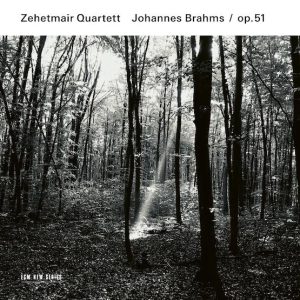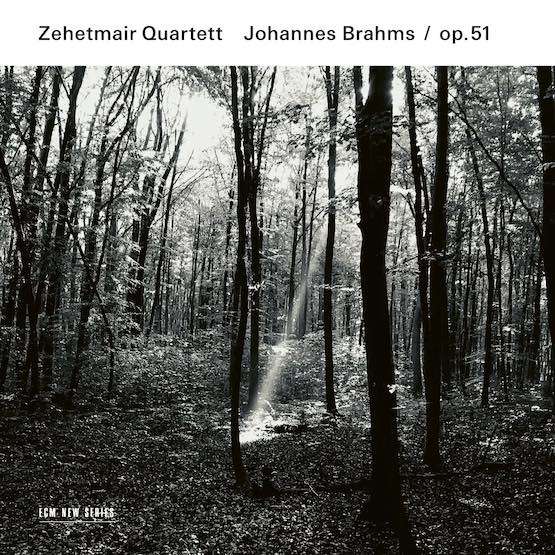
BRAHMS: String Quartet in C Minor, Op. 51/1; String Quartet in A Minor, Op. 51/2 – Zehetmair Quartett – ECM New Series 487 8228 (10/18/25) (64:15) [distr. by Universal Music Group] ****:
Brahms had delayed any publication of his string quartet oeuvre until 1873, his having claimed to consign some twenty such works to the flames. It had been 30 years since Robert Schumann’s three contributions to the quartet medium had appeared, and Brahms may well have feared negative criticism if he entered the genre so dominated by Beethoven and Schubert. The Zehetmair Quartett – Thomas Zehetmair and Jakob Jakowicz, violins; Ruth Killius, viola; and Christian Elliott, cello – recorded these Brahms quartets in November 2021 at the Konzerthaus Blaibach, under the production supervision of Reinier Maillard. The resultant combination of tonal accuracy and interpretive passion proves startlingly refreshed.
Both Op. 51 quartets were completed in Tutzing, Bavaria, whose bucolic setting did not prevent Brahms from expressing tragic sentiments in the C Minor Quartet, whose several points of allusion embrace Beethoven’s quartet in the same key, Op. 18/4 and his piano sonata in that key, Op. 13, Pathétique. The Zehetmair ensemble seizes the agitation of the first movement Allegro 3/2 immediately, the viola and cello in shifting registers while the dotted rhythm and its syncopes establish a modal tension between C minor, G major, and F minor. Huge pedal points drive us onward while the interior instruments continue to pulsate in heated dialogue. A secondary theme emerges in modes of E-flat, creating a meandering, often dizzy, pattern of motion that somehow reconnects to the initial, driven impulse. Frantic, cascading figures weave in and out of the matrix, brief explosions of unbridled passion held in check by the first violin’s attempts at compromise. The cello part appears to inject its own fury as it moves in octave shifts with the first violin. The sudden diminuendo to a soft C major almost basks in resignation.
The second movement Romanza – Poco Adagio in A-flat major, ¾, ushers in an extended moment of (relatively homophonic) peace, despite a disturbed note from the second violin. Short dolce phrases incrementally urge the melodic line forward, the rhythm now stated in triplet figures. Some tender moments transpire in a distant B major, syncopations and dotted rhythm in sweet evidence. The chromatic lines and enharmonic “puns” abound, making what appears impulsive and whimsical much more symmetrical in its architectural sense of closure. The first violin part has proved elegantly decorative throughout. Both restless and ghostly, the third movement, Allegretto molto moderato e commodo refers to movement one, but its trio reverberates with a folk-like, rural nostalgia, almost a berceuse. The da capo returns to a somber C minor, haunted by shades who perhaps laugh but smile no more.
The final (relatively condensed) movement, Allegro, suggests a parody of the first movement, except the texture favors polyphony, spiced by a sense of grave urgency. The rising figures of the earlier movements now tack on a falling seventh to increase the dramatic tension. At moments, the texture, highly stratified, resembles similar lines from passionate Bach fantasies. A manic coda refuses to concede to the major mode for resolution, and rather strikes out, in a manner suited to Beethoven, with defiance. A Trio evolves, ¾, and after some development, an Intermezzo in C minor reprises the Allegretto opening. The first violin tends to soar above the interior lines, eventually dropping out to allow the viola and cello interspersed canon motives that contribute to a rich texture involving double stops and various “symphonic” effects that enrich the modulations into F minor. Of real significance dramatically, Elliott’s cello holds a low C pedal point (for 13 bars) while the upper instruments provide a passionate expressivity, stringendo.
If the Brahms A Minor Quartet may claim dual paternity, then composer Franz Schubert and violinist Joseph Joachim serve as spiritual antecedents. Schubert, who composed his own Quartet in A Minor, D. 804 (1824), intones a testament to an exquisite loneliness. Joachim inspired Brahms to employ a musical anagram F-A-E, “frei aber einsam,” free but lonely, as a compulsive motto through many of his works and evident from the initial statement of the opening Allegro non troppo. Brahms simultaneously employs – with his innate German tradition – many of the csardas, gypsy strains he imbibed as a collaborator in 1848 with violinist Ede Remenyi (1828-1898).
The first movement from the Zehetmair basks in elegiac gestures, somber moments of soaring reflection interrupted by aerial, even wistful, celebrations of romance. The harmonization of the upper stringed instruments alternates the modes of A, sudden incursions of gusto juxtaposed against studied reflection. Almost in the style of Chopin, Brahms manipulates the (often syncopated) rhythmic structure to effect a sense of freedom within the confines of impending loss. Zehetmair himself glows in his active, principal role in this quartet, conceived with Joseph Joachim’s instrument in mind. After the outbursts of impulsive passion, the series of sighing gestures that move to the coda seem to anticipate the strategy employed in the later Third Symphony.
The second movement, Andante moderato, the one movement set in the major mode, proceeds with sensual intimacy, yet rife with contrapuntal, canonic episodes, often hued by distinctly Hungarian scales. The texture assumes a ‘modernist’ color some five minutes into the performance, quite anticipatory of the Second Viennese School of Berg and Schoenberg. A drawn-out pedal point signifies the end of this consoling music. The third movement, Quasi minuetto – Allegretto vivace, takes its delicate, diaphanously hazy texture from Mendelssohn, master of the faerie idiom. The little episodes comprised of double canons, the music fuses quicksilver and learned elements into a dazzling unity.
The last movement, Finale: Allegro non assai, anticipates the fervor the Violin Concerto’s last movement in its Hungarian gypsy impulse. The Zehetmair ensemble’s pungent, slashing attacks and strident accents, buttressed by the clarity of their contrapuntal lines, makes for spirited listening. Time to credit Tonmeister Rainier Maillard and Recording Supervisor Guido Gorna for their excellent sound image. The coda, at first a slow canon, breaks out into a sturdy Hungarian dance, a fitting tribute to those influencers who helped mold the Brahms style.
—Gary Lemco