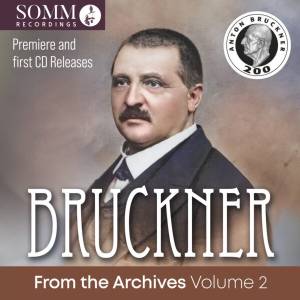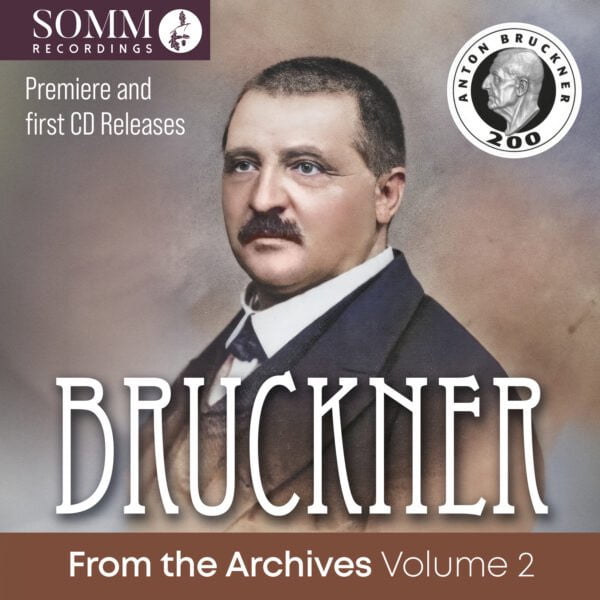
BRUCKNER: From the Archives, Vol. 2 = Mass No. 2; Symphony in D Minor; Symphony No. 2 (complete credits below) – SOMM ARIADNE 5027-2 (2 CDs: 73:39; 55:58) (5/17/24) [Distr. by Naxos] ****:
SOMM here issues the second installment of the “Bruckner from the Archives” collection, having as its source some 11,000 recordings, the six double-CD volumes meant to celebrate the 200th anniversary of the composer’s birth in 1824. The set boasts “Premiere and first CD Releases” of sonically potent interpretations, courtesy of Executive Producers Lani Spahr and Siva Oke. This Volume 2 explores the work of burgeoning composer Antor Bruckner, developing his style after having honed his craft with Austrian instructor Simon Sechter (1788-1867).
Initially, Bruckner composed his 1866 Mass No. 2 in E Minor on a commission from the Archbishop of Linz, meant for the dedication of the Votive Chapel of the Immaculate Conception. Because of delays, the actual performance, under Bruckner’s direction, took place in September 1869; subsequent revisions by the ever-insecure composer postponed a final (of four) version in 1886. Following the Cecilian movement’s reforms of liturgical music, Bruckner scores no soloists in his Mass, given their dislike of “theater.” Rather, the chaste Renaissance example of Palestrina guided their taste, proceeding in a cappella style, the emphasis on devotional polyphonic lines. Bruckner does utilize winds, brass, organ, and chorus; here, the veteran Karl Forster (1904-1963) leads his patented Choir of St. Hedwig’s Cathedral, Berlin, an ensemble he directed from 1932 until his death. Taped in various sessions, 24 June – 1 July 1956, the recording originally appeared on the Electrola label.
The purity of style emanates immediately, from the opening Kyrie, a four-part, antiphonal setting for women and men’s chorus, built upon contrasting dynamic masses, soft and loud, delicate and intensely ornamental. The texture changes slightly in the Gloria, which the choir intones, in the manner of the liturgical mass. The sudden appearance of a fugue marks this music’s “learned” influence from Sechter. The organ provides color to the energetically intoned, central Credo, highly sectionalized and palpitating with wind and brass punctuations. Mainly homophonic in texture, the Credo does exhibit a particular richness at et incarnatus est. For the relatively brief Sanctus, Bruckner borrowed – his only such moment of unoriginality – motifs from Palestrina’s Missa Brevis in F, exploiting its richly contrapuntal sonorities. Bruckner demonstrates a mastery of eight-part, vocal writing, the rhythmic energy and lyrical nature of his melodic lines marked by a free use of chromatic harmony, much oh which he had begun to glean with increased familiarity with Richard Wagner’s music, especially from scenes from Die Meistersinger. The immediate popularity of this Mass in E Minor helped Bruckner secure a position in Vienna, as Professor of Harmony, Counterpoint, and Organ, the city that defined his calling (Lebensberuf) as a symphony composer.
Though unpublished in his lifetime, the D Minor Symphony of 1869, the so-called “Nullte,” had been prepared for a trial run by the Vienna Philharmonic as led by Otto Dessoff, but the verdict from the players found the music “themeless.” After two years of lying dormant, the symphony failed to meet Bruckner’s own standards of formal suitability, and it received the verdict “ungiltig, ganz nichtig, annulirt,” invalid, totally void, annulled. The work came to light in 1924, published by Josef Venantius von Woess and performed by Franz Moissl. The present, live performance, from a Netherlands Radio aircheck, features Bruckner acolyte Eduard van Beinum (1900-1959) and dates from 13 March 1955, alert to his typically energetic style of interpretation, direct, driven, and sonically balanced.
The opening series of ostinato, rhythmic kernels, in a martial Allegro, sets the tone for what will become Bruckner’s signature thematic-group divisions. A lyrical second theme offers sanctuary from the sense of impending conflict, the woodwind figures easily suggestive of an idyllic interlude that moves to an extended, string trill. The agitation soon renews itself, trumpets ablaze over the ostinato rhythm, now vehement and aggressive. The broad development exploits the motivic and dynamic contrasts, infused with the Beinum affection for feral energies. A Wagnerian pomp infiltrates the late pages of the recapitulation, offset by hints of a chorale motif. The coda builds from the initial, repeated rhythmic pulsation, now made brashly grandiose, Bruckner’s own Valhalla.
The slow movement bears the rare indication Andante sostenuto, rather than Bruckner’s later, patented adagio. Ceremonial, lyrically dreamy, the music dwells in exalted string and woodwind phraseology. It becomes apparent that Bruckner intends a song-without- words quality to inhabit the twelve minutes of its realization, with sonorous resonance from horns and low strings. The darker episodes do not detract from the spiritual repose the music establishes, much in the Schubert tradition of dramatic juxtaposition. Much of the writing in the latter pages emanates directly from organ diapason sonority, built in layered presentation by opposing orchestral choirs.
The Scherzo: Presto – Trio: Langsamer und ruhiger, briskly anticipates the wild energy of the later Bruckner style. Robustly skittish, the music advances a militant, unapologetic aggression, rife with colors from the torrents of spring. The potent impetus relents for the rustic pleasantries of the Trio section, but only momentarily. Beinum has the whirlwind at his disposal, and he invests the moment with thrilling force, a true highlight in a performance of historic note. The Finale: Moderato (Andante) begins meditatively, but a brass tocsin intrudes and initiates a martial progression that includes some virtuoso passages for several of the orchestral choirs. Counterpoints, triplets, and syncopations – vestiges from Wagner’s Die Meistersinger – mark the diverse emotions that constitute this movement, not the least of which, chorale-fashion, quote Bruckner’s own sacred works up to that point. What indications of youth that inhabit this music lie in the somewhat awkward transitions between ideas, sometimes coming to a dead stop, even after a fugal development. A sudden burst of pageantry – brass and timpani let loose – drives the music towards its ineluctable, thundering climax that resolves all in the major mode. Ther audience response is deeply gratifying.
Following successful visits to Paris and London both as organ soloist and conductor, between 1869 and 1871, Bruckner returned to Vienna to work on the score of his Symphony No. 2 in C Minor, a composition with which he never felt completely happy, creating several versions based on criticisms from colleagues and various would-be interpreters. Bruckner led the first performance at the closing ceremonies of the World’s Fair on 26 October 1873, the concert’s having been under-written by Johann II, Prince of Liechtenstein. The symphony soon assumed the title “Pauses Symphony,” due to its huge dimensions that insisted on musical “exclamation points” and “question marks.” Georg-Ludwig Jochum (1909-1970) was the first to perform a documented version of the complete (1872) score, edited by Haas; this surviving performance dates from 1944 with the Linz Bruckner Orchestra. Jochum was the younger brother of esteemed Bruckner interpreter Eugen Jochum (1902-1987), and this first-release performance by Georg-Ludwig Jochum derives from a live WDR Symphony aircheck made April 1962.
Bruckner often mentioned the “chaste” style of lyricism he created in this work, whose cello line gained the admiration of virtuoso and pedagogue David Popper. Jochum takes various licenses with the Robert Haas edition of the 1930s, taking cuts in the first movement coda and in the coda of the Finale, ignoring the repeat of both halves of the Scherzo and Trio that Haas had indicated. What Jochum does achieve proves a driven, rather streamlined interpretation, often explosive in the outer movements. The matter of a consistent pulsation in the opening Ziemlich schnell creates a unifying effect, despite the movement’s periodic structure and unfolding. The string and brass work contribute to a “whistling” effect that intensifies the moments of pageantry and pomp. The second theme group, in the relative E-flat major, sings luxuriously, uplifted by Wagnerian imperiousness in the brass. Even the stern critic of the time, Edward Hanslick, conceded the music enjoys “many significant, beautiful details,” these despite what he termed “insatiable rhetoric.’ The coda invests a torrential gallop that quite sweeps us away.
The succeeding Adagio (in A-flat major), too, establishes a decisive pace that carries the melodic line above pizzicato patterns that rise to majestic heights in the course of the music’s evolution. In five-part song form, the music, Feierlich, etwas bewegt, allows the bassoons a rare moment of unique expressiveness, followed by the French horn. Always verging on a martial but plaintive chorale motif, the music finally confesses a theme taken from Bruckner’s F Minor Mass, just prior to the coda, the latter made distinct by a duet for solo flute and violin capped by a horn entry. Jochum maintains an aerial clarity of instrumental voices, the string, woodwind and horn interplay resonantly enmeshed.
The C Minor Scherzo, marked Mäßig schnell – Trio: Gleiches tempo, moves in boldly vehement ¾ time, rife with rustic impulses. Bruckner’s mature musical personality has here emerged with a dominant sense of confidence, revealing an intensity born of a full identification with the folk spirit. The tremolo and pedal points hover and instill a charisma that will long define the composer’s mystique. The Trio in C major enjoys a luster easily akin to moments in both Schubert and Beethoven. The initial impulse comes from the violas, but the brass and timpani invest a power Bruckner will once more exploit in his last Symphony No. 9 in D Minor.
The Finale: Mehr schnell will recall elements from the opening of the symphony, while also quoting the composer’s Kyrie of the F Minor Mass. Consequently, the music projects a noble grandeur and idyllic spirituality. Bruckner indulges any number of fierce ff interjections and martial, wild episodes that do not always fit seamlessly. The music breaks off suddenly to establish a blissful interlude close to Wagner’s Parsifal. The playful pantheism that emerges half-way into the movement contrasts much with the passing serenity, a constant juxtaposition of opposites. The fervent renewal of primitive, driving motion some five minutes before the coda has become breathless, only to desist so that a flowery bower of bliss may console us. Trumpet work and deep bass harmonies succumb to yet another spasm of intense strata of colored, kinetic energy. The Kyrie motif intones one last time before the eddies of massive contrapuntal forces make their gallop to a sumptuous conclusion.
—Gary Lemco
BRUCKNER: From the Archives, Vol. 2 =
Mass No. 2 in E Minor, WAB 27
Choir of St. Hedwig’s Cathedral, Berlin/ Berlin Philharmonic Orchestra/ Karl Forster, cond./
Symphony in D Minor, WAB 100 (Ed. Woss) “Die Nulte”;
Concertgebouw Orchestra of Amsterdam/ Eduard van Beinum, cond./
Symphony No. 2 in C Minor, WAB 102 –
Cologne Radio Symphony Orchestra/ Georg-Ludwig Jochum, cond.
More information through SOMM Recordings