Testament SBT 1424, 67:16 [Distrib. by Harmonia mundi] *****:
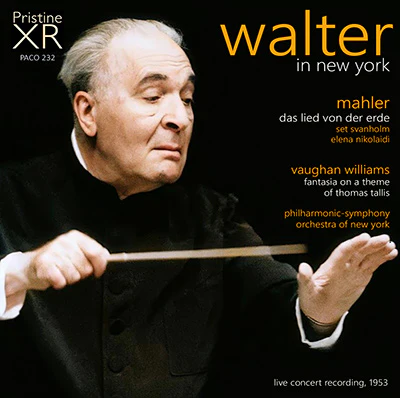
For those who know only the commercial recordings of Bruckner by Bruno Walter (1876-1962), especially the inscriptions made in Los Angeles after his heart attack in 1957, this entire disc (the Carnegie Hall concert of 23 December 1954) provides some uncanny, fresh music-making, the perfect foil to those thick, slow, overly sentimental realizations which Otto Klemperer once denigrated. Given that no note of Walter in the music of Gluck has survived–a pity, since he adored Orfeo ed Euridice–that we now have his performance of the Iphigienia in Aulis Overture is a major addition to the Walter discography, as well as a fine complement to those distinguished performances of the piece by contemporaries Abendroth, Klemperer, and Furtwaengler. The music itself bears many points of comparison with Beethoven, lyrically dramatic and often burning with exalted frenzy.
In fine sound–even audience coughs against the woodwind entries prove well defined–the exemplary molding of the Bruckner E Major sallies forth in resplendent colors, the speeds brisk and the contours aggressive. The progression to the end of the Allegro moderato first period achieves a remarkable pageantry, then a form marcato-allegretto ensues, supplemented by a demonized lyricism and inflamed brass from the Philharmonic. The third period opens with a noble Adagio maestoso, broad and visceral in the cellos and horns, the melodic extension without sag. Though moving quickly, the music retains the aura of comfortable, noble repose in all parts. Wagnerian fire at the center of the first movement to restate the main theme, now transformed along chromatic lines for development, the Philharmonic strings in luminous fettle, the sound parallel to what Mitropoulos gives us in Mahler and Prokofiev. Note Walter’s excellent transition back to the E Major recapitulation, strings both arco and pizzicato, and horns walking a march variation from Tannhauser. Walter takes the coda as a germ motif deep in the basses over a rolling tympani pedal, then the strings flutter and resolute French horns take us to Valhalla.
Walter paces the Adagio to correspond to almost the exact length of his opening movement. Walter infuses the music with a plaintive desire for spirituality in the midst of urgent doubt. The secondary theme emerges with simple, tender grace; repeated, we hear the high flute as Nature’s consolation. Beautiful string tone from the Philharmonic viola section. The ostinato strings’ riffs take on an incandescence quite remarkable, while the bass hymnal theme assumes alternately reverential and dissenting character until the horns ecstatically reaffirm all faith, Laus Deo. Brucknerian counterpoint moves us forward, gracefully enough, given the occasional, dark sentiments that indicate storm clouds in Heaven. By the closing pages, we have indeed witnessed the “many mansions” in Thy Father’s house. No dawdling for the Scherzo, among the quickest in Bruckner history; and given the concert conditions, this rendition becomes Walter’s version of the Ride of the Valkyries. Herculean energies follow, a descent in the maelstrom. The counter theme offers an immediate anodyne to the fiery torments, a consummation devoutly to be wished. He “trumpets of prophecy” return with accelerated vehemence for the da capo, the horseback ride not so far from the Berlioz Ride to the Abyss. The syncopated trumpets generate plenty of sparks, Prometheus unbound, and the final plummets leave us breathless.
Light fingers invite the opening of the Finale, a flutter of Nature and Destiny. The hymn theme–with its occasional flute commentary–walks a hearty pace up the mountain, whether Sinai or that of Purgatory is a toss-up. When the next period opens, trumpets and low winds muttering in twisted agogics that culminate in a sweet trill and tympanic pedal, the Manichean elements are now all in place, the battle–or even marriage–of Heaven and Hell. A bit of ensemble raggedness does not diminish the lyrical period–with its bucolic hints at Dvorak–only for the fierce march to reassert its crusaders’ power. Via harmonic labyrinths we enter the recapitulation, strings and horns ablaze with apocalyptic vision. The last pages achieve something like Glory in music, a real “testament” to the divine inspiration Walter could generate in music and musicians when in his spiritual element. Highly recommended.
–Gary Lemco