CARSON COOMAN “A Trip to the Sky” = A Trip to the Sky for solo piano; Schumann Serenade for string trio; Quartet for Piano and Strings; Estampie for two violins; Tombeau-Aria for string quartet; Cavatina for viola and piano: Four Aphoristic Inventions for string quartet; Planctus for viola; Viola Quintet (Unquiet Parables) for two violins, two violas and cello – Sarah Darling, viola/ Jeffrey Grossman, piano/ The Slovak Chamber Players – MSR Classics MS 1387, 68:01 [Distr. by Albany] ****:
The title track in this very attractive collection of music by Mr. Cooman, A Trip to the Sky, captures the listener’s attention immediately. Written for “any interesting or combination of instruments” (which makes me want to see the score), the solo piano version is beautiful; rambling a bit but filled with some drama and some impressionistic filigree. In this case, the composer is the pianist and a very fine one at that. Cooman is an American composer, base in New England, who has studied with Bernard Rands and Judith Weir, among others. His music is tonal but eclectic and very accessible.
Each of these works has a slightly introspective character and a bit of brooding in places that contrasts with the beauty to be had from very high quality string writing. Cooman clearly works very well in chamber forms and creates some very attractive counterpoint out of small materials. Best of all, each of these works does not require any deep listening and familiarity with polyphony to enjoy. I actually thought the best piece on this disc is Cooman’s “Quartet for Piano and Strings”. Subtitled “A Sea Liturgy”, this single movement work consists of six separate but connected sections that evoke a particular religious “feel”, but not a particular religion (for example, “offering”, “baptism”, “invocation”) The net effect is very good; opening in a declamatory way with open piano chords, that reappear in between some very chant-like solo string writing – a very beautiful work that does have a sense of meditation and reflection to it. Cooman’s “Planctus” for viola has a similar religious feel to it and is a dark, plaintive work that I found both relaxing as well as melancholic.
The “Viola Quintet” is another fascinating work that has the unusual scoring of two violins, two violas and cello. In this three movement work, it is, indeed, the viola that plays a very prominent role. Much of this work, as well as much of Cooman’s other string works does have a sound and intentional references to earlier American as well as medieval music. Witness both sound and title of his “Estampie” for two violins, which is atonal around a modal context and has some lilting moments of the requisite repeated rhythmic patterns.
The “Schumann Serenade” is a bit unique of its own accord, containing fragments of melody from the works of Robert Schumann in a fascinating blend of tempos and styles. The Schumann melody (from the “Scenes from Childhood”) puts in a clear, brief appearance while the strings separately break it down into the final measures. This, too, is a demanding but captivating work for string players and listeners to experience. Cooman’s “Tombeau-Aria” for string quartet and his “Cavatina” for viola and piano leave a very positive impression as well and contain more of what might be Cooman’s “signature” sound, tinged with introspection.
Carson Cooman seems like a very talented composer with some clear connections to the music of earlier times and to church music. He writes exceptionally well for strings and I am anxious to hear more of his music and to learn more about him. MSR has a good track record for producing and releasing music by lesser-known modern composers and artists as well as classics performed by lesser-known ensembles. The performing forces on this disc are top quality (In fact, the Slovak Chamber Ensemble and other ensembles are orchestras from Slovakia have done very well recording music from America) Sound engineering is also great; the disc sounds clear and distinct.
I liked this disc a lot and I suggest that anyone who enjoys modern string music or good quality music by lesser-known American composers would also like this release a great deal. I would also be interested in hearing more of Carson Cooman, especially his choral works or his larger pieces. A perusal of his website shows that Cooman has written a great deal and in almost every possible form. If this disc is any indication, it should all be quite good and well worth hearing!
— Daniel Coombs
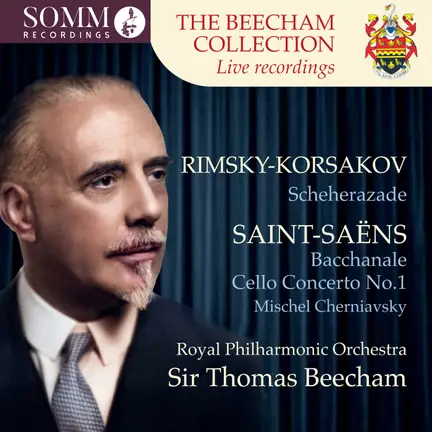
Sir Thomas Beecham conducts Rimsky Korsakov, Saint-Saëns – SOMM
Three mid-century concerts