CHOPIN: Piano Sonata No. 2 in B-flat Minor, Op. 35 “Funeral March”; 3 Mazurkas; 3 Preludes, Op. 28; 2 Etudes, Op. 10; 2 Etudes, Op. 25; Nocturne in C Minor, Op. 48, No. 1; Polonaise in F-sharp Minor, Op. 44 – Maurizio Pollini, piano
Archipel ARPCD 0610, 67:06 [Distr. by Qualiton] ****:
The occasion of these inscriptions – March, 1960 Warsaw – alerts us that 1960 was the year Pollini won the International Frederick Chopin Competition in Warsaw, memorialized in the famed recording of the Concerto No. 1 under Paul Kletzki and available on EMI‘s Great Recordings of the Century. The young Pollini’s style demonstrates brilliant proficiency, but we cannot ascribe “warmth of tone” as among his attributes. He takes the “doppio movimento” directive of the Sonata’s opening quite literally, sweeping to the transition with resonant chords and articulate harmonization in staccato and detached chords, but the affect, like that of Sviatoslav Richter, emanates from an icy lunar module. Despite the “live” recording, the piano tone remains thin. Drive and percussive punch define much of the momentum, a blatant sense of the music’s emotional frenzy interrupted by periods of wistful regret. Pollini plays the Scherzo as a monochrome piece, with little relaxation in the taut line for the trio section. Pollini’s sang-froid proves “ideal” for the funeral march, the trills of which ripple along one’s spine. The interlude on D-flat Major does relent in severity, its dewy nocturne some tenderness. If the last movement depicts “the wind howling around the gravestones” in Artur Rubinstein’s estimation, then Pollini would have made an efficient gravedigger.
The clarity of detail in Pollini’s realization of the C-sharp Minor Mazurka, Op. 50, No. 3 renders it limpid and spit-and-polish brilliant at once, much in the ornamental manner of Lipatti. The C Major, Op. 33, No. 3 canters through figures that waltz, dance, and evoke a stately nocturne, all at the same time. The F-sharp Minor, Op. 59. No. 3 tenders a decidedly Polish nationalism, authoritatively resolute. Its agogics pose no difficultly for Pollini, who moves briskly through its metric and harmonic, “three-hand layers” with dauntless aplomb. We move into the angst of the A Minor Prelude, Op. 28, No. 2 as a world that Pollini will explore further in Webern and Schoenberg. The F-sharp Minor (“Molto agitato”) rolls chromatic scales at us, mezzo-voce, those same waves of sound fraught with menace. The dark depths become quite manic in the D Minor Prelude, which we recall Hurd Hatfield favored as Dorian Gray because it suggested “he was losing his youth.” The relentless ostinato bass line quite vanquishes us in Pollini’s gripping rendition.
Pollini would glean much critical favor for his DGG inscription of the complete Chopin etudes: here, he opens with the tumultuous B Minor, Op. 25, No. 10, whose B Major second section elicits a grudging legato from Pollini. The A Minor, Op. 25, No. 11 “Winter Wind” Etude calls for digital polyphony in both hands, the sixteenths managing to sing in a variety of colors through the left hand’s flexibility and stamina. Pollini converts the whole into a march with any number of color fluctuations. Pollini segues into the C Major from Op. 10, the introduction to the entire set, Pollini’s gobbling up the right hand stretches in liquid gulps. The A-flat Major, Op. 10, No. 10 emphasizes unity in variety with polyphonic modulations on patterns set in four and six. Pollini takes the piece quite fast, creating a shuddering, glistening line whose pedal points imbue it with an unearthly tension.
The C Minor Nocturne by Pollini emerges more as a study in harmonic tensions, hardly satisfying anything like a “romantic” sensibility. Both ballade and chorale, the piece explodes under Pollini with grandly cool menace, often assuming a breadth reminiscent of Cesar Franck. The crescendos and nervous octaves in this interpretation descend through emotional labyrinths that connect Chopin to Liszt and Busoni. Finally, the big 1841 Polonaise, Op. 44, the “Tragic,” calls for huge chords from Pollini in the style of a fantasia that eventually become mazurka lines in a potent mixture. Pollini’s merciless percussion makes a brittle counterpoint against the legato periods, but the infiltration of martial affects wins out. A powerful Chopin recital if the neo-Classic approach of hard lines suits your musical taste.
–Gary Lemco
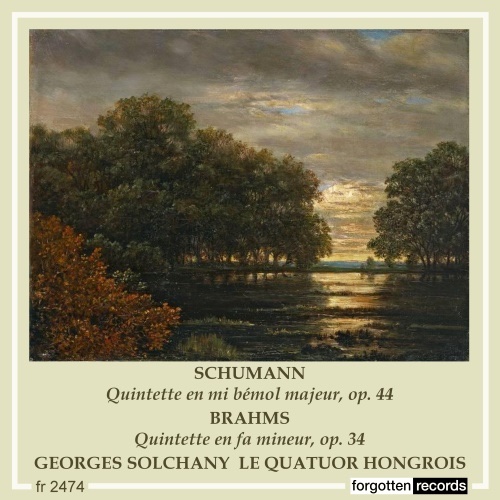
Georges Solchany and Hungarian String Quartet – Piano Quintets of Schumann; Brahms – Forgotten Records
Two mid-century recordings by Solchany and the Hungarian Quartet