A “win-win” for big band jazz lovers- Classic V-Disc 10 CD box set…
Classic V-Disc Big Band Jazz Sessions – Mosaic Records #MD10-284 – 10 CD box set – 1943-1948 – ****
(Big Bands include: Woody Herman, Les Brown, Charlie Barnet, Stan Kenton, Boyd Raeburn, Gene Krupa, Buddy Rich, Harry James, Claude Thornhill, Count Basie, Lionel Hampton, Glen Gray, Jimmy and Tommy Dorsey, Glenn Miller, Jimmy Lunceford, Don Redman, Hal McIntyre)
The 1940s were arguably a “golden” period for jazz big bands. Bands could travel, and audiences were eager to dance. An issue arose however, when the musicians’ union placed a ban on commercial recordings, because the union felt that the major recording labels were taking jobs from local performing artists, and not paying royalties to the musicians royalty funds. This ban took place from 1942-1944.
When the United States entered World War II, and GIs were sent to Europe, a fortuitous opportunity arose, and now 80+ years later, big band jazz lovers can rejoice. What happened then, was that the armed services felt that morale of the troops would benefit from having the chance to listen to their favorite music. The recording ban was halted for the GIs (only), as long as the records were not available commercially. Musicians were not to be paid, and recording labels could not profit. Since shellac, which had been used for 78 rpm records, was in short supply, a “vinyl-lite” product was used.
The records were called V-Discs, short for Victory Discs, and they became a roaring success, as small record players were sent to Europe for the soldiers. What made these V-Discs even more special is that because there were no restrictions, big bands could avoid cross label artist conflicts, and also since they were 12″ discs, tracks could be lengthened providing longer solos, and opportunities for improvisation. The discs and masters were supposed to be destroyed after the war, but many were kept, and the Library of Congress has a complete set.
There were over 800 separate releases (including classical music), and 8 million were sent to servicemen world wide. Each side could handle six and a half minutes in length, large enough to handle a full extended song.
Now we get to the good part… Mosaic Records, the boutique jazz label for jazz aficionados, has just issued a 10 CD set, (Classic V-Disc Big Band Jazz Sessions), comprising 218 tracks, with six alternates, all completely remastered by Nancy Conforti and Shane Caroll, using 24-bit technology. All but one CD exceed 70 minutes.
Acoustics are superb, full and rich, and the intros by the band leaders are included, heartwarming to hear, as they relay love to our soldiers, with the hope that they enjoy their brief respite from battle.
Review of the band leaders above, reveal that they include nearly all the major big bands of that era, with the exception of Duke Ellington.
Here are some of the highlights, beginning with the first CD:
There are four Woody Herman sessions. “Red Top” is blistering with notable solos from Bill Harris on trombone, Flip Phillips on tenor sax, and Herman leading the way on clarinet. This was a dream version of his “herd” as the band included the Candoli brothers, Neal Hefti, and Chubby Jackson and Dave Tough in the rhythm section. Jackson and Tough lead the group, without Woody, on “Meshugah,” Yiddish for “crazy,” and Chubby makes a great “cheerleader” for the group.
Les Brown’s group featured a velvety Ted Nash on tenor, on Ellington’s
“Prelude to a Kiss,” and an early visit with Doris Day, on vocals, on “Take Me in Your Arms.”
Charley Barnet’s 1944 group had Barney Kessel on guitar, and Dodo Marmarosa on piano. The group does a feisty version of “Pompton Turnpike,” and Peanuts Holland is super hip on vocals on Nat King Cole’s “Straighten Up and Fly Right,” adding a nice trumpet solo.
Stan Kenton only had one V-Disc session, that included June Christy on vocals, on “That’s the Stuff You Gotta Watch,” and trumpeter Ray Wetzel singing on another Nat King Cole number, “I’m a Shy Guy.”
Drummer, Gene Krupa, used 10 string players, and five different vocalists on his sessions. There is a robust tenor solo by the great Charlie Ventura on “The Very Thought of You,” and his bands’ horn power is on full display on “Ooh, Hot Dog (Boogie Blues)” that has Anita O’Day on vocals, and altoist, Johnny Bothwell, showing a Johnny Hodges influence.
Buddy Rich had three V-Disc sessions. Standouts are tenor legend, Allan Eager, on “Daily Double,” and Jimmy Giuffre and Hal McKusick on “Four Rich Brothers.”
The popular trumpeter, Harry James’ 1945 band had 30 members and 16 strings giving a full production for the troops. I dug Willie Smith on alto and clarinet, on “Rose Room.”
A highlight of this set (of course) is four sessions from Count Basie. We get to hear a legendary front line of Buck Clayton, Buddy Tate, Don Byas, and Harry “Sweets” Edison. To top it off, Basie had a brief wartime reunion with Lester Young. (Young was later replaced with Lucky Thompson in 1945).
The gang takes on “Kansas City Stride,” “Circus in Rhythm,” each with a “Pres” solo, while Jimmy Rushing does a righteous version of “Gee, Baby Ain’t I Good to You?”
Lionel Hampton had 1944/45 dates, and there is the requisite version in two parts (nearly nine minutes) of “Flying Home,” with solos spread around, while “Screamin’ Boogie” builds with the band exhorting each other.
Glen Gray’s band (Casa Loma Orchestra) was an early big band sensation, and their arrangements were copied by many other groups. Cornetist, Bobby Hackett, shines on “No Name Jive.”
A highlight for soldiers were sets by Jimmy and Tommy Dorsey. It was a major coup to have the two brothers (who had feuded for years) re-unite for a two track session. They both share time on “More Than You Know.”
Jimmy’s own date shows an early bop influence, with Dizzy Gillespie’s arrangement on “Grand Central Getaway,” while Jimmy’s talents on alto sax and clarinet shine on “Long John Silver.”
Tommy Dorsey had nearly 80 V-Discs which included radio, and film soundtracks. He features a soulful Charlie Shavers on trumpet and vocals of “At the Fat Man’s.”
Captain Glenn Miller had three sessions included in this set. His best known V-Disc was “St. Louis Blues March,” considered a masterpiece at the time. His ballads of “Stardust,” and “Stormy Weather,” had lush backing from strings, while his version of “Moon Dreams” was reinterpreted later by Miles, Mulligan, and Konitz.
Two of the later CDs include Armed Services Bands, with trombonist, Kai Winding, in a Coast Guard Band, soloing on “Annie Laurie.”
There are also dates from Jimmy Lunceford and Don Redman. Don swings hard with his alto sax on “Redman Blues.”
For both fascinating listening and historical significance, there is so much to recommend here. In addition to this fine big band music, there is a 44 page LP sized booklet with full discography, and erudite liner notes from historian, David J. Weiner. There will be only hand numbered 5000 sets issued.
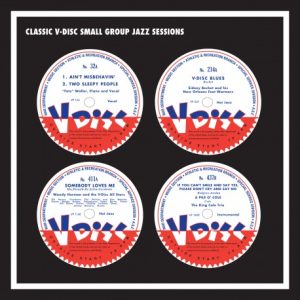
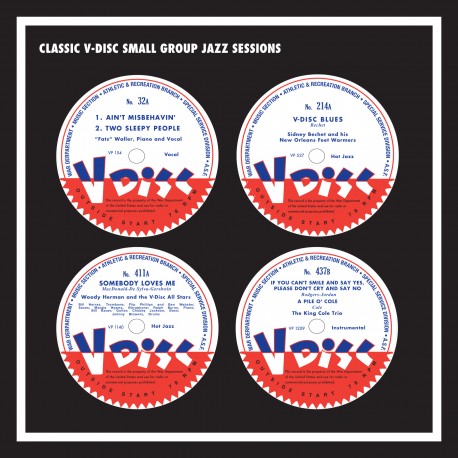
Kudos to Mosaic Records and producer, Scott Wenzel, for taking on such a massive project. For fans of small jazz groupings from this era, Mosaic also issued an 11 CD set of V-Discs (Classic V-Disc Small Group Jazz Sessions). Both come well recommended. They are available from the label at www.mosaicrecords.com
CD 1: 77:16
CD 2: 76:03
CD 3: 77:03
CD 4: 62:40
CD 5: 78:33
CD 6: 76:36
CD 7: 76:09
CD 8: 75:34
CD 9: 78:31
CD 10: 77:55
–Review by Jeff Krow